1 - Introduction ~5 mins
Welcome
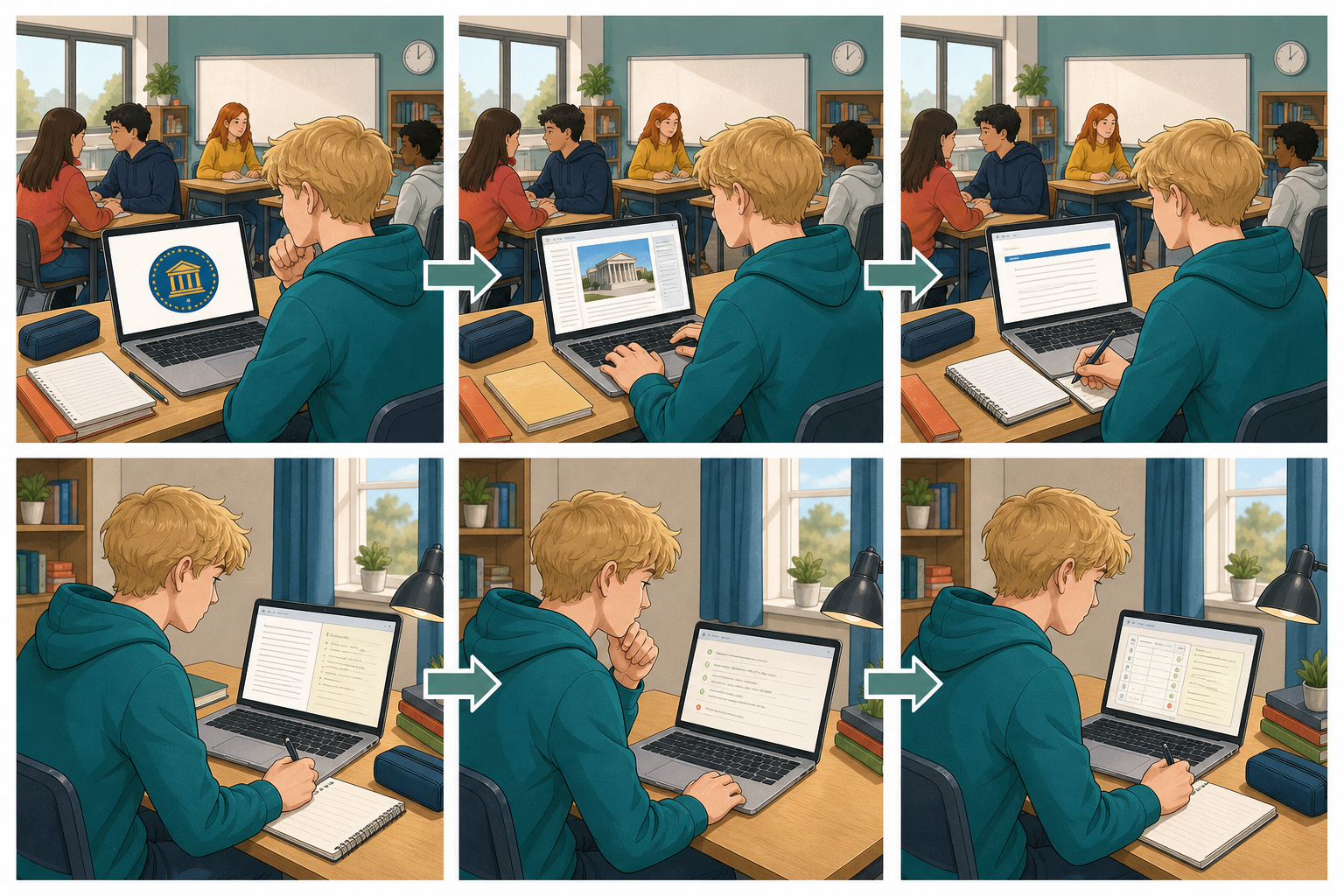 You already have {{code:02_search_log}} with real queries for your Something Real project. Today you decide which of those results you can actually trust. A polished page, a confident AI answer, or a familiar logo is not enough. You will learn a five-part test, practise it on short claim-and-source pairs, then write one-line verdicts on three of your own Search Log sources.
If you do not have three sources yet, tell your teacher. You will add them at the start of Portfolio Build. Nobody is blamed for a missing file from an earlier lesson.
By the end of this lesson, you will be able to:
- Run the CRAAP checks and write honest one-line verdicts on your own Search Log sources
- Compare your first gut reaction to a source with what you can actually verify
Warm-up
Without looking anything up: which would you trust more for health advice, a named dietitian's plain blog with links to HSE pages, or a glossy site that looks like an official health authority but is selling a detox tea? Hold your answer. Today's work is about catching the gap between that gut call and what you can actually verify.
2 - Key Concepts ~7 mins
Listen as your teacher walks the five rows. CRAAP is a five-part check you run on any claim: a web page, a social post, or an AI-written answer. Source type is not source quality. A careful specialist writing under their own name can beat a polished "official" page. The real question is always: what can I verify about this claim?
| Concept | Why it matters | Example |
|---|---|---|
| Currency — how recent the information is, and whether freshness matters for this topic Plain question: how old is this, and does that matter? | Out-of-date rules, prices, or medical advice can sink a Work Experience report or a pitch that cites them | A 2019 page on Intreo appointment booking may describe a process that has already changed |
| Relevance — whether the source actually answers your question for your Irish context Plain question: does this answer my question here in Ireland? | A brilliant US guide can still be useless for PAYE, GAA club rules, or a local Centra stocktake | US minimum-wage advice does not help a student checking Irish Work Experience rights |
| Authority — who wrote it, what qualifies them, and whether you can name them Plain question: can I name who wrote this and why they know? | Anonymous claims are hard to challenge; a named practitioner can be checked | A physio writing under their real name and linking HSE guidance beats "Health Tips Daily" with no author |
| Accuracy — whether facts are backed by sources you can open and check Plain question: can I open something that backs this claim? | This is the defence against confident AI answers and recycled press releases | Open the cited Citizens Information or Workplace Relations Commission link and confirm the claim is really there |
| Purpose — why the page exists: to inform, persuade, sell, or entertain Plain question: is this here to inform, persuade, sell, or entertain? | Sales pages and engagement bait dress up as neutral advice | A "research summary" that ends in a Buy Now button for a detox tea is not a neutral source |
AI verification rule
Treat every AI answer as a draft claim, not a finished fact. Open at least one cited source. If it does not back the claim, the verdict is don't use until you find something that does.
This feels slower than skimming. That is the point. One opened link now beats defending a weak source in your Something Real write-up later.
Worked example (all five letters)
Claim: Work experience students have the same right to a safe workplace as other workers.
Source: Citizens Information page on workplace rights for work experience, updated this year, with a link to the Workplace Relations Commission (WRC).
- Currency: updated this year, so the advice is fresh enough for rights that change.
- Relevance: written for Irish work experience, not a US internship guide.
- Authority: Citizens Information is a named public information service you can check.
- Accuracy: the WRC link opens and backs the safety claim.
- Purpose: the page is there to inform, not to sell a course or product.
One-line verdict (copy this pattern later):
{{code:CRAAP verdict: Trust — Currency and Accuracy hold (updated this year; WRC link backs the claim). Checked against: WRC link — backed the claim.}}
One-line verdict template
After CRAAP, pick one verdict and write it in plain English:
- Trust — checks hold; I would cite this.
- Partial trust — useful for X, but not for Y (name the limit).
- Don't use — fails on [name the CRAAP letter]; I need another source.
3 - Flip Your Instinct: Sort the Sources ~13 mins
Six short claim-and-source pairs. First, as a class, talk through only three spotlight cards without dragging: the named physio blog, the glossy detox tea site, and the AI answer about GAA club returns. Where does your gut put each one, and why? Then place every card into a bucket. Challenge mode will bounce a wrong drop, so you find out whether the answer the class argued for survives CRAAP.
Trust, partial trust, or don't use?
4 - Common Issues ~6 mins
If you are stuck between buckets, you are doing it right. Use the table below.
Teacher models one Search Log verdict
Before you open your own log, watch your teacher run one live CRAAP pass on a realistic student-style source (or one volunteered from the class). Listen for each letter said aloud, then copy the shape of the one-line verdict on the board.
Sample source in a Search Log: TikTok from a plumber under their real name showing how they quote a bathroom job.
- Currency: recent demo video.
- Relevance: useful if your Something Real project needs a trades quote process.
- Authority: named tradesperson; good for process, not for law.
- Accuracy: no link to Revenue or WRC; tips are practical, not checked rules.
- Purpose: to show their work and attract customers.
What you type under that source in {{code:02_search_log}}:
{{code:CRAAP verdict: Partial trust — useful for process tips (Authority OK: named plumber) but don't use for tax or legal rules (Accuracy/Purpose). Checked against: Revenue.ie self-employed pages — video did not back any tax claim.}}
Common Issues
| Issue | Solution |
|---|---|
| I trusted it because it looked official | Look past the logo and layout. Name the author, the date, and one claim you can open elsewhere. If you cannot, the look does not count. |
| The AI answer sounded sure and listed sources | Open at least one cited link. If the page does not actually support the sentence, mark the AI answer "don't use" until you find a source that does. |
| I cannot decide between partial trust and don't use | Ask: is any part still useful if I name the limit? Process tips from a named tradesperson can be partial trust. A sales claim with no evidence is don't use. |
| My Search Log sources are all social posts or short videos | CRAAP still applies. Authority and purpose often fail first on social. Note what the post is good for (a demo, a vibe check) and what it is not good for (rules, prices, medical or legal facts). |
5 - Portfolio Build ~20 mins
When your teacher says go, everyone opens the same file path and works for about 20 minutes. Raise your hand if you need a CRAAP letter named for you. Your teacher will come round.
Portfolio Build: class task
Example line to imitate:
{{code:CRAAP verdict: Trust — Currency and Accuracy hold (updated this year; WRC link backs the claim). Checked against: WRC link — backed the claim.}}
{{code:CRAAP verdict: Partial trust — useful for process tips (Authority OK: named plumber) but don't use for tax rules (Accuracy/Purpose). Checked against: Revenue.ie — video did not back any tax claim.}}
- {{code:02_search_log}} shows CRAAP verdict notes under your sources (minimum viable in class: two full verdicts; finish the third before the next session or as homework if time runs short)
- Each verdict names trust, partial trust, or don't use, plus the main reason in plain English
- Every verdict includes {{code:Checked against: ... — backed / did not back the claim}}
- A reader can tell which sources you will keep using for your Something Real project and which you will drop
6 - Reflection ~4 mins
Think about
- Which of your sources looked strongest before you ran CRAAP, and did the verdict stay the same after you checked?
- If an AI answer helped your Something Real research, what one habit will you keep so you never paste a claim you have not opened a source for?
Discuss with your class if your teacher opens the floor. You do not need to type or save a reflection. If time is short, answer one question out loud as an exit ticket.
7 - Lesson Summary ~5 mins
What you covered
- I can run Currency, Relevance, Authority, Accuracy and Purpose on web, social and AI sources
- I can judge a claim by what I can verify, not by how official it looks
- I can compare my first gut reaction with what CRAAP shows
- I can write one-line CRAAP verdicts and update {{code:02_search_log}}
Extension challenge
Pick one "don't use" or "partial trust" source from your log. Find a stronger replacement that passes CRAAP for the same claim, add it to {{code:02_search_log}}, and write one sentence on what made the new source better (date, named author, Irish context, or a link you could actually open).
Unlock the full learning experience
You're previewing this lesson. Get full access to this lesson and hundreds more — each one ready to teach, with interactive activities, printable resources and pupil progress tracking built in.
This lesson is copyright of Coding Ireland 2017 - 2025. Unauthorised use, copying or distribution is not allowed.