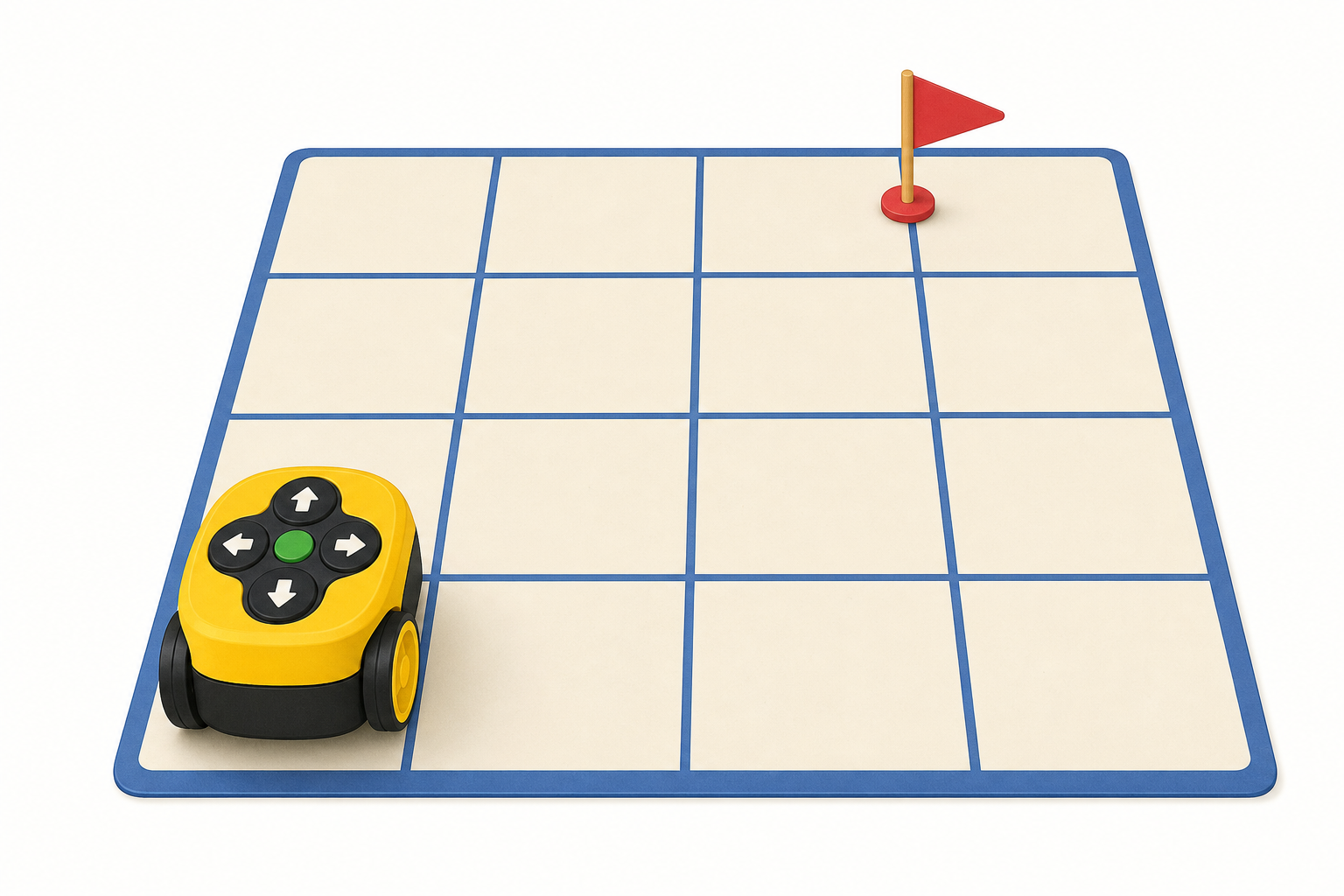
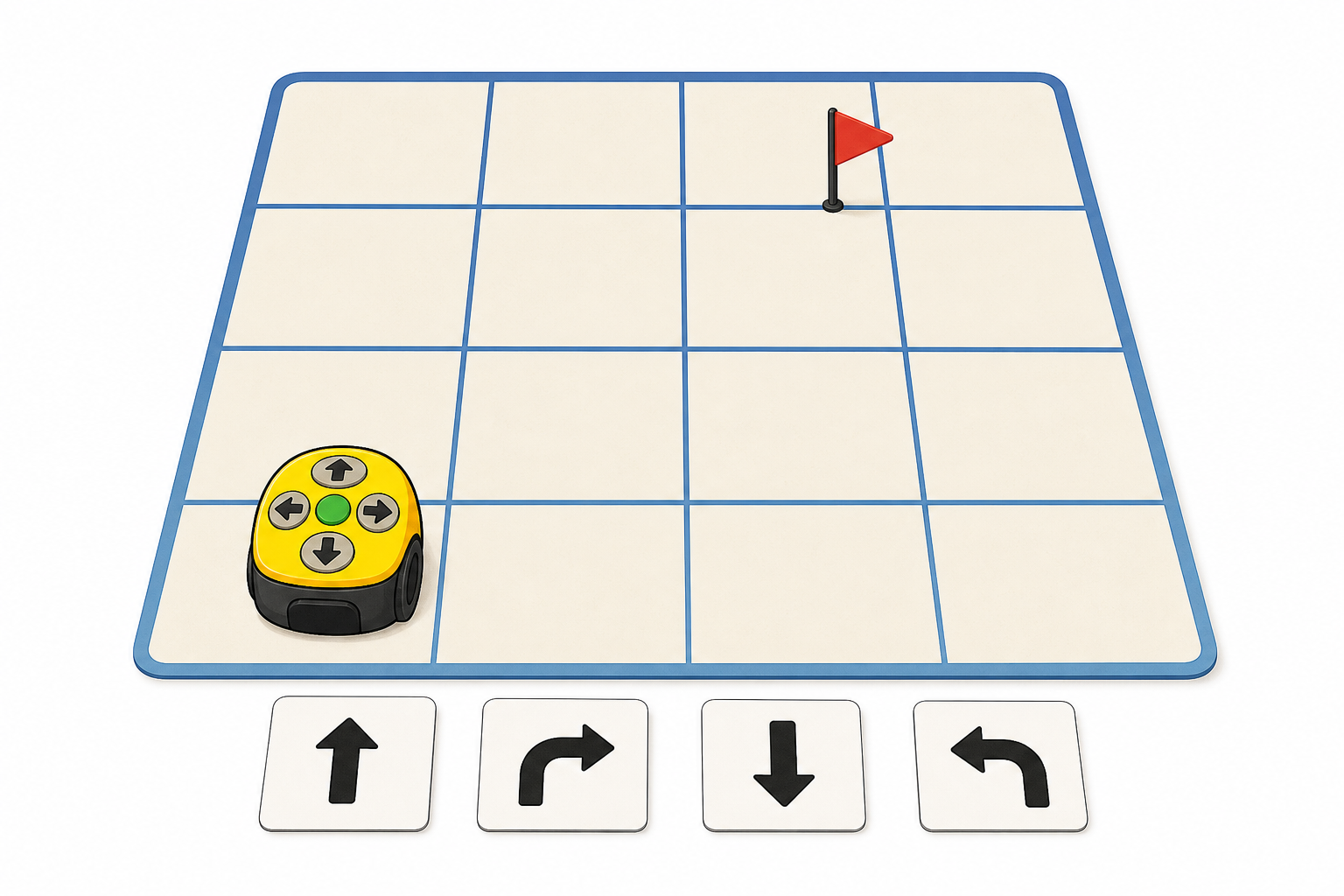
Our little robot is stuck on its start square, and the flag is waiting. It cannot guess the way. How do we give it instructions so it can get there?
Place one floor robot on a taped mat with a clear flag or target card a few squares away. Keep the hook light: one question and a quick round of ideas. Do not enter a full route yet. Mats are already pre-set, so three minutes is enough for the curiosity beat.
Key questions: What is the first move? Does the robot know the way on its own, or only the steps we give it?
STEM eyes: Real robots and toys that move on their own follow step-by-step instructions just like this.
Today's words: algorithm — our list of moves in the right order, like forward, forward, turn right, forward. Bug — a wrong step that sends the robot the wrong way.
A turn stays on the same square — only forward steps onto the next one. Watch one short route. Will the robot stop on the flag?
Board version stays short: only algorithm and bug, each paired with the concrete move list. Say program lightly as everyday talk for the buttons we press, not as a third word to learn.
| Concept | Why it matters | Example |
|---|---|---|
| Algorithm — a clear list of steps in the right order that tells someone or something how to do a job | The robot only does what we tell it, so the order of our steps decides where it ends up | Forward, forward, turn right, forward — that list is the algorithm that sends the robot to the flag |
| Bug — a wrong step in the list that makes the robot go the wrong way or stop short | Finding the bug and fixing it is how we get the robot to the target | The robot turns left when it should turn right — that wrong turn is the bug |
Teacher language only (not on the board): When children press the buttons, revoice that as entering the program — the algorithm becomes the moves on the robot. Do not add "program" as a third board word.
Run this full cycle once before groups try their own routes.
Turn rule (say this out loud while pointing): A turn stays on the same square. Only forward moves the robot one square the way it is facing. Demonstrate with a finger on the grid before you press go.
Pacing lever (protect these inside five minutes): Non-negotiable — say the two board words with the move-list example, state the turn rule with one finger demo, and complete one predict–run–observe pass (deliberately buggy is fine if you want a quick fix). Optional if time slips — a second clean run after the fix, or a long "I think" wrap. If the model misses and needs a fix, cut the second clean demo and move straight into the board interactive in the next step.
Misconception to head off: Children may think the robot "knows" the way or can guess. Revoice: it only follows the buttons we press, in that order.
If you have no physical robot, use a child as the robot following arrow cards on the same taped grid, and drive the interactive on the IWB for the plan.
Help plan a short route on the board. Call out the next move: forward, turn left or turn right. Your teacher will drag the steps and press run. Before go, put your hands up if you think the robot will land on the flag.
Drive the interactive on the IWB. Pupils call out which command comes next; you drag and run. Before you press run, take a quick class prediction: hands up if you think it will land on the goal.
Name what is on screen: a 4 by 4 grid, robot sprite at bottom-left facing right, flag two squares right and one up, and the three command cards — forward, turn left, turn right.
Known-good path for the first model (matches startState): forward, forward, turn left, forward. That lands on the flag. You may deliberately swap one turn first so the class can spot the bug, then fix that one step and run again.
Turn rule reminder: A turn stays on the same square — only forward moves the robot one square the way it is facing. Point this out on the grid if a pupil's route assumes a turn also advances.
If the first run misses, ask: Where is the bug? Which step should we change? Fix one step only, then run again so the class sees debugging as a normal part of the work.
Keep this whole-class and short. Groups will try their own routes next.
Transition (last minute): Mats, robots and flags should already be set from before the lesson. Send groups to their mats with a clear stop signal. Each group takes one set of arrow cards. Do not use the programming minutes for taping grids.
In your group:
Groups of about three to four. One child enters moves, one watches the path, one keeps the arrow cards in order beside the mat. Rotate roles if time allows.
Visible sequence (must do): Before anyone presses go on a run, the group lays arrow cards in the order they will enter. After a fix, they change the matching card first, then put the same fix on the robot buttons. The final working line of cards stays beside the mat for the journal step — groups must not pack the cards away until after recording.
Turn rule while you circulate: A turn stays on the same square; only forward moves one square. Spot groups who expect a turn to also step forward.
Success looks like: the group says the sequence before pressing go; they predict the stop square; if the robot misses, they name the wrong move and change it rather than starting a brand-new random list; the final list is still visible on cards.
Scaffold: Offer a short menu of three-move or four-move routes for groups who need a tighter start. Stand with them for the first clear and enter.
Stretch: A second target on a longer path, or a route that needs two turns, still with one clear goal.
Kit-short plan (1–2 robots only): Run a robot station plus child-robot mats. Two groups share each physical robot: while Group A enters and runs, Group B plans on arrow cards at a child-robot mat (one child is the robot). Swap after one successful reach or after about five minutes so every child presses buttons at least once. Roles still rotate: enterer, path-watcher, card-keeper. If you have only one robot, keep the IWB interactive open as a third station for planning, then rotate groups through the single floor robot for the enter–go–fix beat.
No-kit fallback: One child is the robot. The group lays arrow cards in order on the floor. The "robot" takes one step or turn per card. The same predict–run–fix pattern applies, and the card line is already the sequence artefact.
Key questions while you circulate: What is your first move? Where do you think it will stop? Which step went wrong?
On your Investigation Journal page:
Distribution: Hand out Investigation Journal pages as groups leave the mats (or have them ready at desks). Pupils copy from the arrow-card line left beside the mat — they are not reconstructing from memory.
Release the three marks in order: first the arrow line, then yes/no for the target, then circle the fixed step. Point to each prompt on the board after groups finish the one before so early writers do not stall on the first line only.
Drawing arrows in a line is enough. Do not invent extra boxes or column names for the journal. Say what to record; the page layout is generated later.
Support writers with the move-word cards already on the table to copy if they prefer words. Early finishers draw a second shorter route they would try next time, still on the same page if space allows, or tell a partner quietly.
You're previewing this lesson. Get full access to this lesson and hundreds more — each one ready to teach, with interactive activities, printable resources and pupil progress tracking built in.