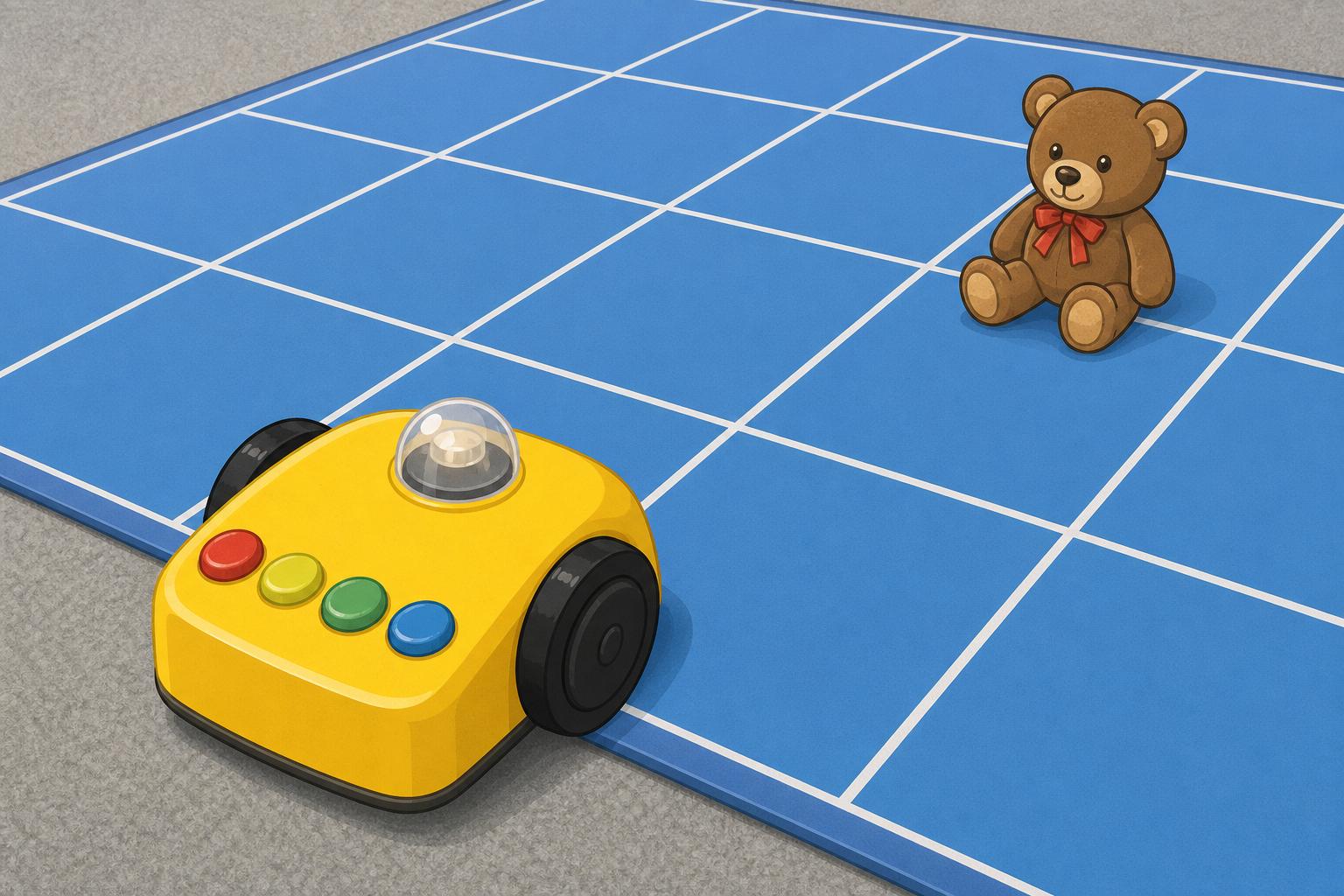
Look at our little floor robot. How do we tell it to get to the teddy? What should we say first?
Place the floor robot (or a big arrow card and a child ready to be the robot) on the taped mat so the class can see it. Point to the teddy picture on one square. Keep this beat light: one question and a few called-out first moves. Do not run a full sequence yet.
Key question: What should we say first? Accept any sensible first move. Guesses are never wrong.
Link for you to say once: Real robots follow step-by-step instructions, just like ours.
Look at the robot on our mat. We will tell it each move one after another. What could our first move be?
Board stays almost empty. One spoken line only, tied to the robot already on the mat. Do not teach the label as a vocabulary lesson yet. Name steps in order after the robot has moved in the next step, when the idea is concrete.
| Concept | Why it matters | Example |
|---|---|---|
| Steps in order — we tell the robot each move one after another, and it does them in that exact order | The robot only knows what we give it. If our steps are muddled, it will not reach the teddy | Forward, forward, stop: the robot rolls two squares and sits on the teddy picture |
Misconception to head off (after the demo): children may think the robot "knows" where the teddy is. It does not. It only follows the steps we give it.
After the robot has moved, say simply: We give the robot steps. It does them one by one, in order. That is steps in order.
Watch carefully. We will give the robot some steps, then guess where it will stop before it moves.
Clear first: press Clear (or the robot's memory-reset) so the robot starts empty. Say: Empty robot. No old steps left inside. Do this before every new sequence and after every miss.
I wonder: can I send the robot to the teddy with just a few steps?
I think: if I press forward, then forward again, it will stop on the teddy.
I try: press the sequence slowly so the class sees each button. Pause. Take a class guess with the on-screen options before you press Go.
I noticed: the robot did exactly those steps, in order, and stopped on the teddy (or past it if you chose a longer path on purpose for talk).
I think now: the robot only does what we press. Our steps have to match the path. Name the idea here: steps in order.
Turn fact (say when a turn appears, or once as a stretch cue): When we press turn, the robot stays on its square and only faces a new way. Then forward moves it. Point at the robot's face or nose before Go.
Facing cue: before the next step, ask Nose toward the window, or nose toward the teddy? so children check which way the robot is looking.
If the robot misses, smile and say our steps were not quite right — we can clear and fix them next. Do not frame it as failure. Always Clear before the retry.
Differentiation: for children who need it, use only forward moves on a straight path. For a stretch, add one turn left or turn right after a whole-class body turn facing the same way as the robot.
On the board, I will put the steps in a line from your ideas. We will start with forward. Guess where it will stop, then watch when I press Run.
Open the algorithm-sequencer interactive in explore mode on the IWB. The class sees a small grid, a robot sprite, and a goal. You move the cards; children call out ideas. They do not drag on the board.
Default path: keep the first successful route forward only on the straight line to the teddy (for example two forwards). Leave turn left and turn right for a stretch once the class has one clean forward win.
When you do use a turn: stop and do a quick whole-class body check. Everyone stands facing the same way as the robot sprite, then turn left or right together so left/right is shown with bodies, not only named. Remind them: turn stays on the square; only the nose changes.
Goal on screen: reach the teddy without leaving the grid. Keep the path short so four- and five-year-olds can hold the plan.
Ask: Which step first? Where will it stop? Invite hands up before you press Run. Fold the whole class in: Do you agree with that step? What would you choose next?
This plan is a model for the real mat. After one or two successful short routes, send groups to the floor robots (or child-robot stations).
If the interactive is unavailable: lay big arrow cards on the floor in a line and "walk" the route with your finger or a toy before groups play.
In your group we use our robot chant: say the steps, clear, press, guess, Go! One job at a time. Then watch where it stops.
Short station bursts, not one long sit. Rotate groups if you have only one or two robots. Groups waiting can lay arrow cards on the floor to plan their next try.
Celebrate reaching the picture. If it misses, ask which step should we change? then chant again from Clear so the new try really tests the new sequence.
Remind once if turns appear: turn stays on the square; only the nose changes. Then forward moves it. Cue facing: Nose toward the window or nose toward the teddy?
No Bee-Bot: one child is the robot. Friends hold up big arrow cards in order. "Clear" means the child robot stands still facing the start way before the first card. The child robot takes one step per card (or turns on the spot for a turn card) and freezes at the end so the group can check.
Safety: clear walkways; robots on the floor only; no running to "help" the robot.
Differentiation: straight forward-only paths for support; one turn for stretch after a body check. Keep every sequence short.
You're previewing this lesson. Get full access to this lesson and hundreds more — each one ready to teach, with interactive activities, printable resources and pupil progress tracking built in.