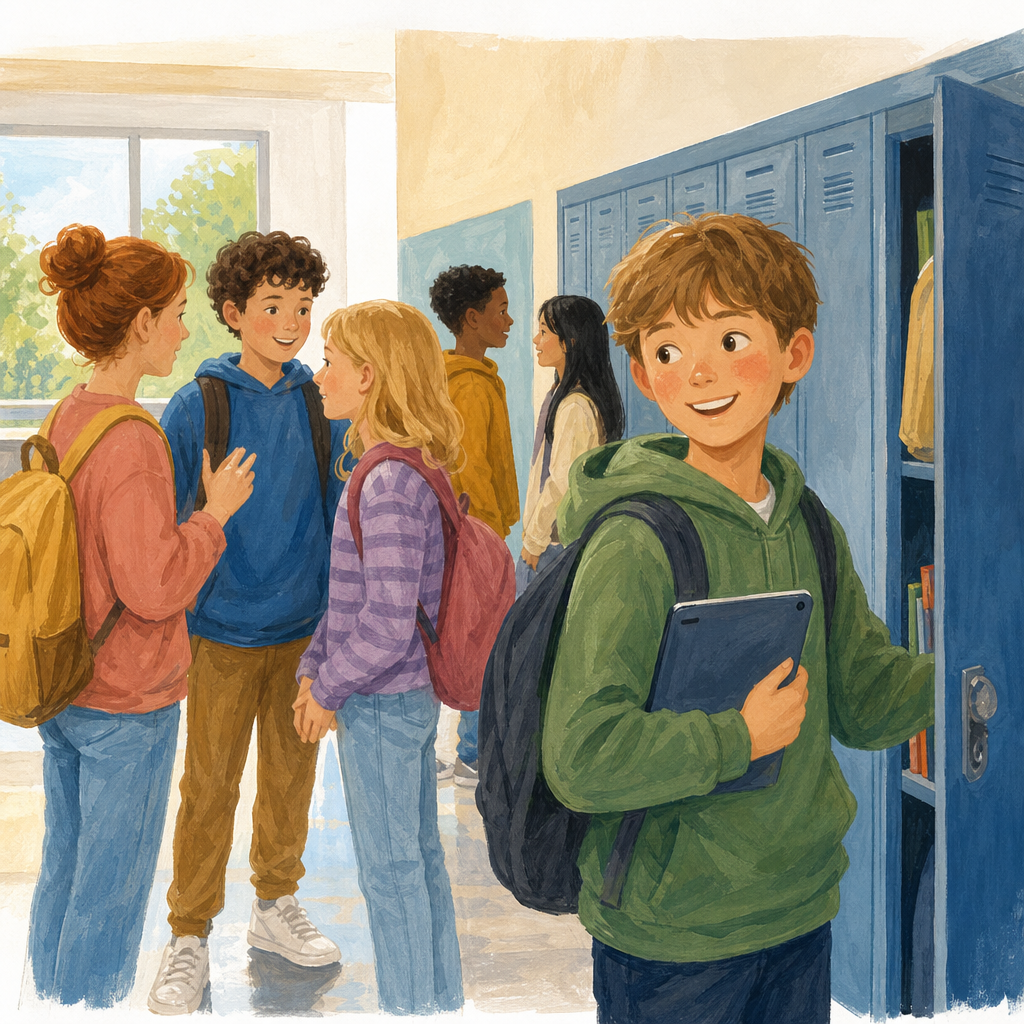
Look at what your teacher is wearing today. In English, describe it in one full sentence. Include at least two colours.
In France, most pupils choose their own outfit for school. Today you will learn the French words for those clothes, and later you will join a colour so it matches the clothing word.
Invite two or three short English descriptions of what you are wearing. Keep it light and quick. Do not translate yet. The point is to set up full sentences with colour, which is what they will produce later in French.
One warm line if energy is low: French school corridors often look more like a street-style parade than an Irish uniform line. That is the hook for later.
Remind the class they already know colour words from earlier in the course. Agreement comes after they own the clothing nouns.
Here are today's eight clothing words. Tap each one, listen, then say it back together.
Watch the article carefully: some take le, some take la, and shoes take les. Say the full pair every time: le pull, la jupe, les chaussures.
Today is hear, say and see the nouns first. Full sentences with colours come next.
Tap each word on the board. Class repeats twice, once all together and once by table. Point at the article every time so the pair is what they hear.
Stay on le / la / les only in this step. Do not introduce Je porte, un/une or colour agreement yet. That comes after the matching game so the load stays manageable.
Common trap: pupils drop the article. Insist on le pantalon, not bare pantalon. When a table lands a clean full pair, give a quick yes so the class hears what success sounds like.
Pronunciation focus: le pull is roughly luh PEWL (French /pyl/), not English "pool".
Flip two cards at a time and find each French clothing word with its English meaning. Say the French quietly, article included, as you turn each card.
Default: run this as a whole-class game on the IWB with volunteers taking turns. No pupil devices needed. (Optional only: if devices are already available, tables may play a second round.)
If a pair is missed twice, pause and say the French together before moving on. Listen for the article on every answer. If a pupil says only jupe, prompt gently: full form is la jupe (lah ZHOOP).
Keep the pace brisk and celebrate clean articles. This is still recognition only; sentence building is next.
New frame: after you know a noun with le or la, sentences often use un or une meaning "a".
With colours like bleu, vert and noir that you already know, feminine nouns add e: une jupe bleue. Stick to colours you already know today.
Board model: Je porte un pull gris et un pantalon noir pour le collège. (I am wearing a grey jumper and black trousers for school.)
First, say the frame together when your teacher points at a clothing picture and a colour. Then open your copy and write one short sentence: keep Je porte and fill only the clothing and colour slots. Prefer singular items today.
Before pens move (about 3 minutes): whole-class oral gap-fill. Point at a clothing picture plus a colour; class chorally says Je porte un/une … several times. Keep the word-table on screen.
le/la → un/une (say this out loud once): le/la = the (naming the word); un/une = a (in a sentence about wearing something). Phonetics: un ≈ uhn (nasal), une ≈ oon. Side by side: le pull → un pull; la jupe → une jupe. Keep les chaussures for oral labelling only today, or model one plural if needed: Je porte des chaussures noires (zhuh PORT day shoh-SUR nwahr): des + plural colour ending. Do not require plural writing in the copy.
Colour agreement strip (known colours only; no new colour words today; singular focus):
Plural agreement (e.g. les chaussures bleues) is out of scope for writing today.
Writing (about 3 minutes): everyone's pen should move. Strong model stays on the board. Pupils may copy the frame Je porte ___ and fill clothing + colour slots rather than inventing from scratch. Walk the room and check articles, accents, and feminine colour forms. When the extra e appears on bleue or verte, celebrate it: that is real French agreement. Do not collect these.
Léa is heading to collège in Lyon. Like most French state-school pupils, she wears her own clothes (no uniform).
Listen first: your teacher will describe one item she is wearing in French. Point or vote which item it is, then click the correct French label on the figure.
This is listening and decision first, then labelling, not another silent card flip. Keep the figure on the IWB. Say a short French phrase; class points or votes; a volunteer places the label.
Ready colour phrases with phonetics (use after a label is placed, or as the listen prompt):
les chaussures: either skip the colour, or model one plural form so the "add e" rule does not silently fail: les chaussures noires (lay shoh-SUR nwahr). Do not ask pupils to invent plural agreement unaided.
If someone nails la robe rouge, get a quick class repeat and a clear yes. If energy dips, keep the pace brisk and celebrate clean pronunciation.
Short culture aside while the figure is up: this is everyday French school dress, the same idea you will discuss next.
You're previewing this lesson. Get full access to this lesson and hundreds more — each one ready to teach, with interactive activities, printable resources and pupil progress tracking built in.