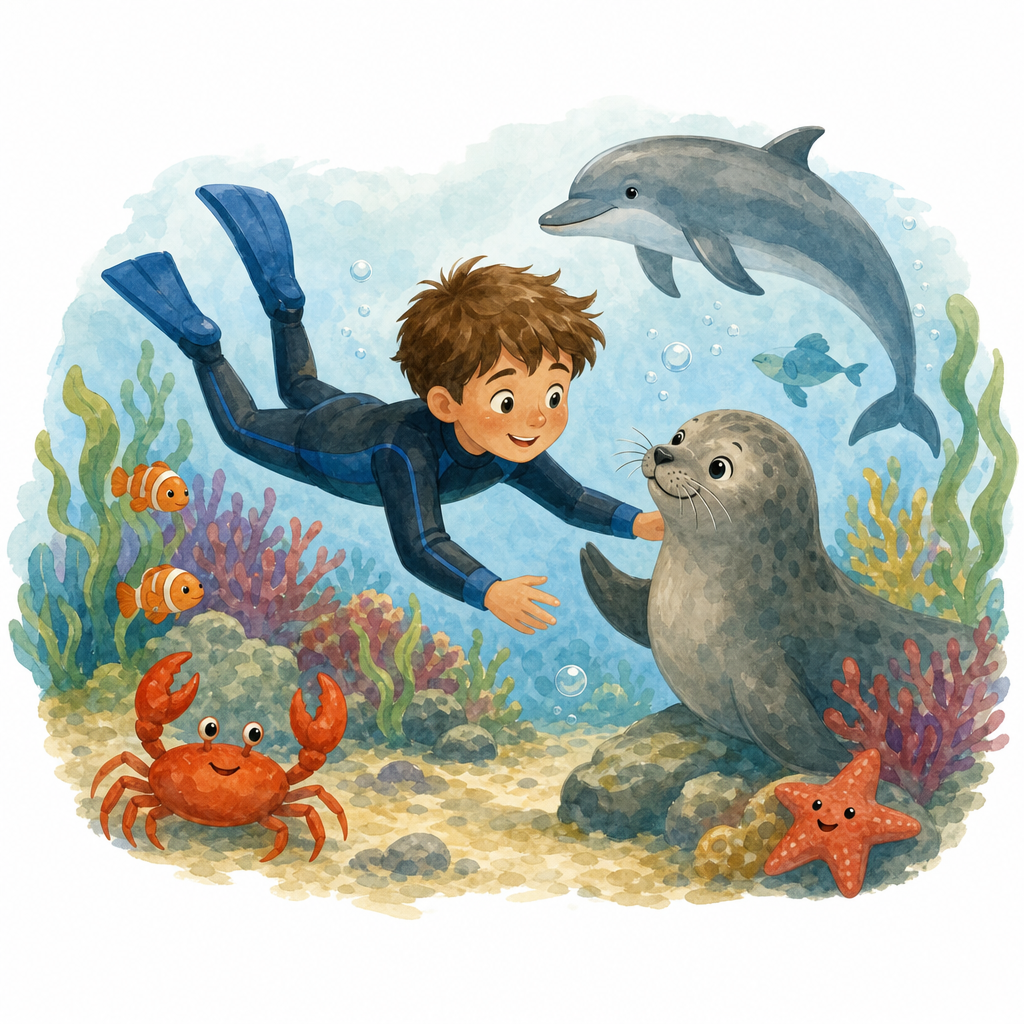
 Ireland is an island, so the sea is right on our doorstep. In twenty seconds, shout every sea creature you know in English… then we dive in and meet eight of them auf Deutsch!
By the end of this lesson, you will be able to:
- Name eight sea creatures in German
- Match each German word to its English meaning
- Say a sea-creature word aloud when the wheel lands on it
We are visiting an aquarium on the North Sea coast. Tap each creature, listen, then say it back together — article included. Watch the article each time: most take der, and two take die (die Qualle and die Krabbe).
Volunteers click each aquarium tank label, then its English meaning, on the board. When a pair is found, we all say the full German word quietly together, article included.
Open your copy and write four sea creatures with their articles, ordered from smallest to biggest. Take care with capital letters and the article in front of each word.
- der Seehund — Seal
- der Hai — Shark
- der Wal — Whale
- der Delfin — Dolphin
- die Krabbe — Crab
- der Seestern — Starfish
- die Qualle — Jellyfish
- der Oktopus — Octopus
The aquarium wheel spins — name whatever swims up, with its article. A volunteer spins the wheel. When it lands on a sea creature, that volunteer says the full German word (article + name). If you need a reminder, we play the audio once and you try again. Then we choose a new volunteer.
Unlock the full learning experience
You're previewing this lesson. Get full access to this lesson and hundreds more — each one ready to teach, with interactive activities, printable resources and pupil progress tracking built in.
This lesson is copyright of Coding Ireland 2017 - 2025. Unauthorised use, copying or distribution is not allowed.