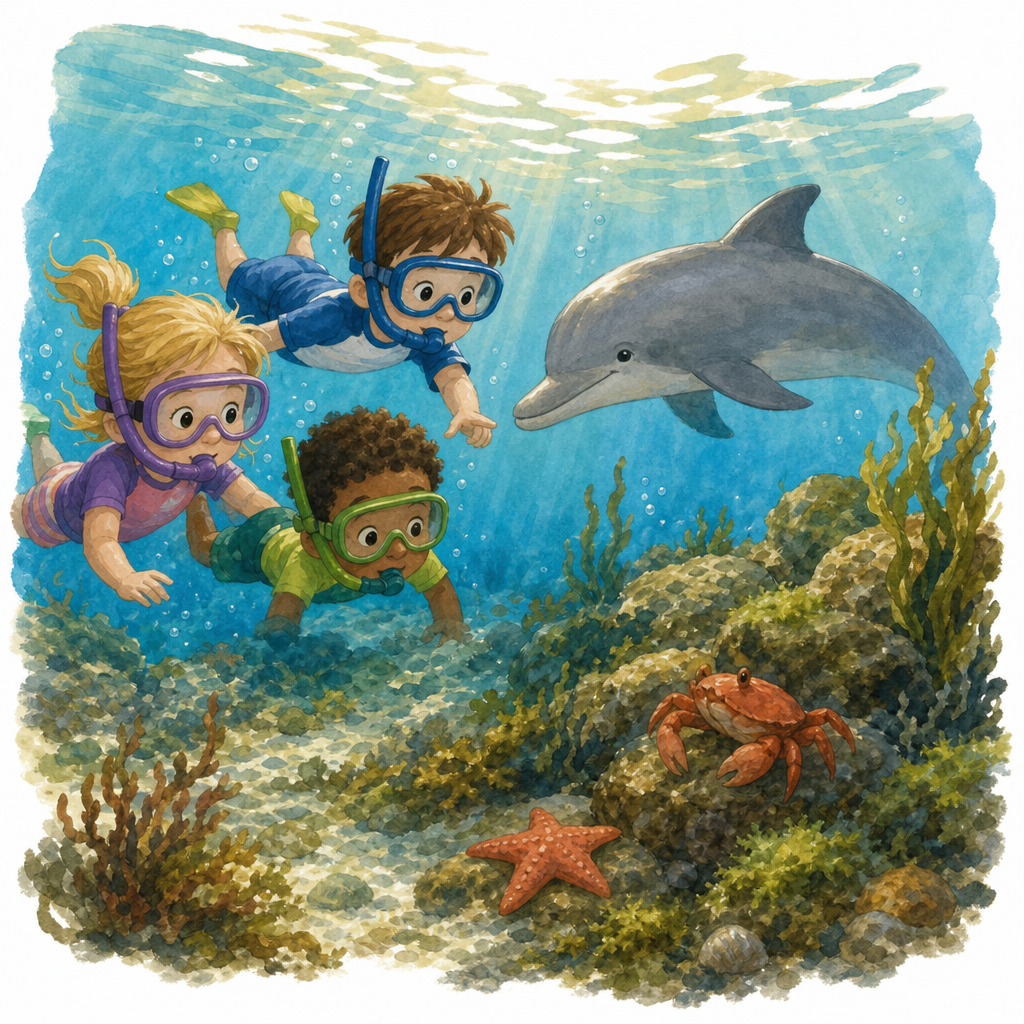
 Ireland is an island. How many sea creatures can you name in English in twenty seconds?
Keep a quiet count on your fingers. One of them looks almost the same in French: le crabe (the crab). We will dive in for seven more.
By the end of this lesson, you will be able to:
- Name eight sea creatures in French
- Match each French word to its English meaning
- Say the words aloud with confidence
We have arrived at Océanopolis, the big aquarium in Brest on the French Atlantic coast. Take a big breath for the first dive.
We will meet four creatures first. Listen as each is tapped on the board, then say it back together. Watch which ones take le and which take la.
After a quick recap of those four, four more appear, including the one that starts with l'. Then the guide will point at pictures or say the English and the whole class answers in French.
Time to label the tanks at Océanopolis. Volunteers click the pairs on the board. When a volunteer picks a French word, everyone else whispers it with its article. After each successful match, the whole class says the French pair together.
Open your copy and write four sea creatures with their articles, ordered from smallest to biggest. The word list stays on the board, copy carefully, including accents and the apostrophe in l'étoile de mer.
- le homard — Lobster
- le dauphin — Dolphin
- le requin — Shark
- la baleine — Whale
- le crabe — Crab
- la méduse — Jellyfish
- l'étoile de mer — Starfish
- la pieuvre — Octopus
The underwater camera at Océanopolis caught something. Before we spin, whisper all eight creatures with their articles one last time.
When the wheel stops on you, announce the creature with its article like a marine biologist on a French documentary. In round one you may glance at the prompt strip: the eight words with their articles, kept where you can see them. Stuck? Phone a table: your table whispers it to you, then you say it aloud.
Unlock the full learning experience
You're previewing this lesson. Get full access to this lesson and hundreds more — each one ready to teach, with interactive activities, printable resources and pupil progress tracking built in.
This lesson is copyright of Coding Ireland 2017 - 2025. Unauthorised use, copying or distribution is not allowed.