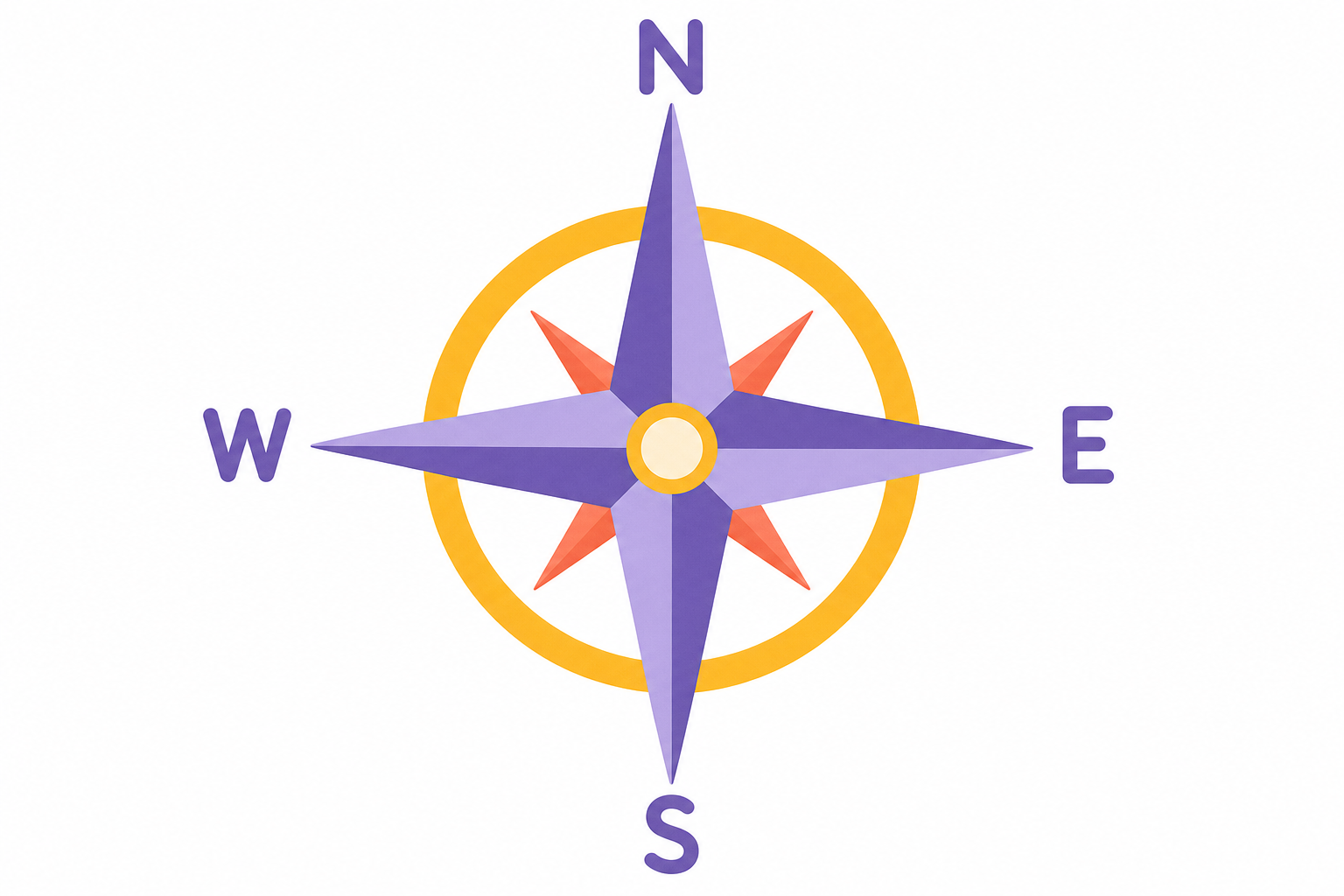
Here is a map of a schoolyard, and up in the corner is a compass rose. North points up the page.
On the map, the gate is on the bottom-left square. The hall is 2 squares to the right of the gate, then 2 squares up from there.
If north is up, which way is east? And if you stood at the gate, how would you walk to reach the hall?
Display the yard map with the compass rose as pupils come in. Take two or three hands-up answers on which way is east? before confirming east is to the right. Give five seconds of quiet think-time on the gate-to-hall route, then take one pupil's route.
Read the gate and hall positions off the board so every pupil has the same starting picture. The route works out as east 2, then north 2. Trace it on the map with a finger so the class sees the heading stay the same the whole way along each leg.
A heading is a compass direction — north, south, east or west — and it points the same way from anywhere on the map. A turn is not like that: it depends on which way you were already facing. Watch two children get the same instruction and walk off in opposite directions, then watch the heading route on the grid stay the same for everyone.
Aoife and Cian start on the same square, both told turn right. Aoife faces north, right hand points east, walks east. Cian faces south, right hand points west, walks west. Same words, opposite directions — draw out why: a turn depends on the direction you were already facing.
Then run the grid route: east 3, then north 2, starting from the marked square. Point to the compass rose — east is east and north is north from anywhere, so this route traces the same path for everyone.
Keep it light: a heading never depends on where you stand, a turn always does.
In your maths copy, draw a compass rose and label the four arms N, S, E and W, with north pointing up the page.
Check your rose against the board: north up, south down, east to the right, west to the left.
Walk the room glancing for N pointing up and all four arms labelled. This is whole-class copybook practice, not marking. Prompt any pupil who is stuck to copy the four arms from the board rose. Keeping this beat to drawing only leaves the harder direction-writing for after routes are worked in Try It Together.
Now we follow routes together on the grid map. North is up and east is to the right, so we slide the marker one square at a time. We are using headings today: north, south, east and west.
We will work through these routes one at a time:
Start on the marked square and go east 3, then north 2. To get home, we do the opposite direction in the opposite order. North becomes south, and east becomes west. The last move we made is the first one we undo. So we come home south 2, then west 3.
This round is for talking it through together, so pupils take turns at the board and the class agrees or corrects out loud. No marking yet.
Reveal and work one route at a time rather than showing them all at once. On the grid, north is up, east is to the right, south is down and west is to the left. Before each move, ask the class to predict which way the marker slides.
For the going-back part, walk it one step at a time on the board: send the marker out east 3 then north 2, then bring it home south 2 then west 3, saying last out, first back as you undo each move. This is the reversing method pupils will use in the Class Challenge, so make sure they see it land on the start square.
Pupils tracing on the grid_map printable at their seats can pencil each finish square, which helps if the board is far away.
To reverse a route, write the opposite direction for each step and put the steps in the opposite order. Last out, first back.
We work through routes together on the grid map. Read each direction, move the marker one square at a time, then check where it finishes.
First the easy ones:
Now the reverse. Worked example on the board first: you went east 4, then north 1. We write the reverse set of directions together.
Check on the grid: start from the far square, follow south 1 then west 4, and plot the square you land back on. It should be the start square.
Your turn on the last challenge: reverse east 3, then north 2 the same way, write the directions, then plot the square you land back on.
Practice questions: pupils take turns at the board, class confirms, keep it brisk. Predict the finish square before the marker moves. Pupils can plot finishes on the grid_map printable at their seats.
Worked reverse (do this on the board before the final challenge, real numbers end to end):
Then set the final interactive challenge: reverse that same route and plot the return square (start at (2, 1)).
Slip to catch: pupil flips the headings but keeps the same order (west 3, then south 2). Ask them to trace it and see it misses the start. Fix: opposite directions AND opposite order. Have them write the reverse directions on the board or in copy before they plot.
You're previewing this lesson. Get full access to this lesson and hundreds more — each one ready to teach, with interactive activities, printable resources and pupil progress tracking built in.