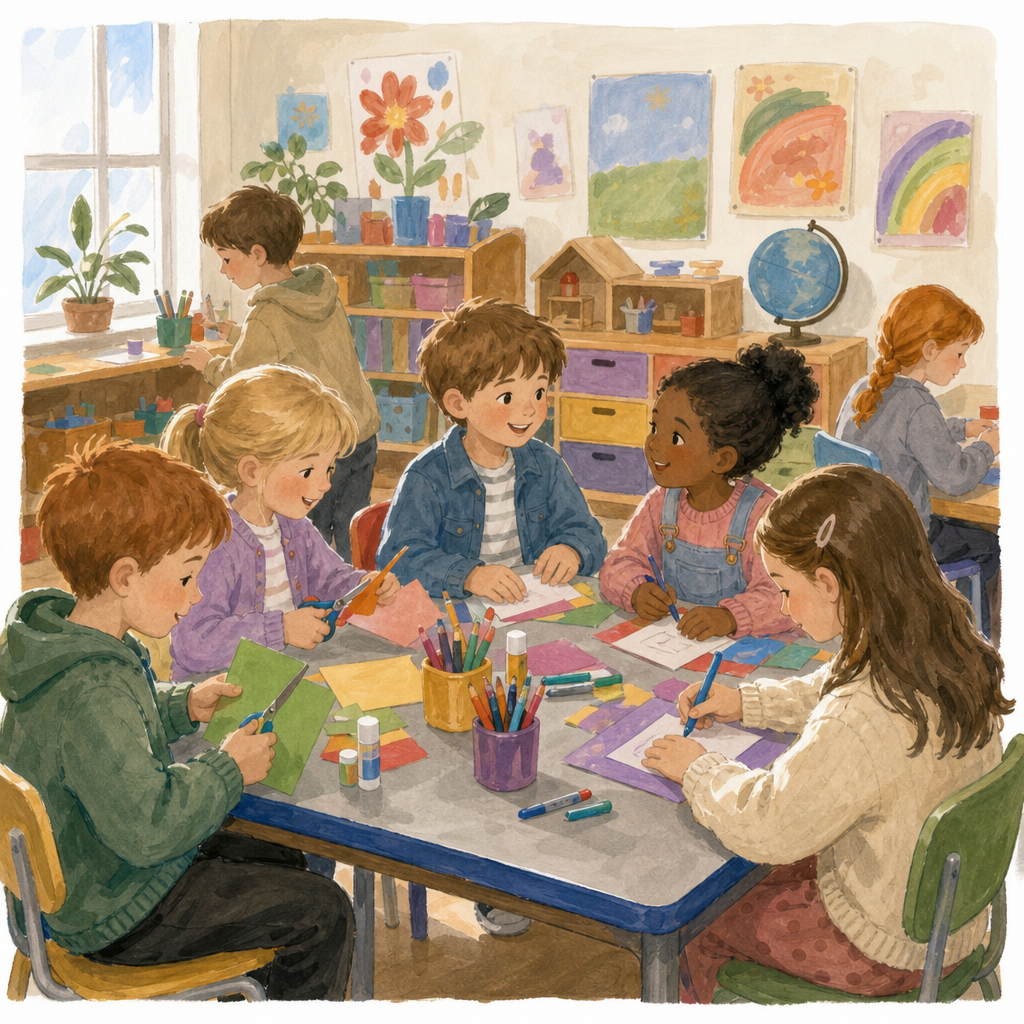
Look around. Name three things in this room and their colours, in English.
Today those colour words go into Spanish sentences. Something clever happens: some Spanish colour words change their ending to match the thing they describe. We will practise with a sunny street scene full of Spanish colour, from a red bus to a white football shirt.
Take three or four quick answers only. The point is to warm up colour plus object, not to collect a long list. Do not introduce the Spanish words yet; the flashcards do that next.
If a pupil already knows a Spanish colour from last year, smile and park it: Hold that thought; we will check the ending in a moment.
Optional hook (one sentence): picture a busy street in Seville, a red city bus, white football shirts, flags and fruit stalls. That scene supplies our model phrases later.
Watch the board. English comes first. Listen to the Spanish, then repeat it twice with the class. Do not guess before you hear it.
After a few colours we will freeze on the endings and chorus short phrases together.
Whole class on the IWB flashcards (auto-configured). Flip each card or play the audio, then class repeats twice. Pupils never say the Spanish before they have heard it.
Pronunciation coaching (keep it playful):
Load management: Chorus all eight for recognition. Spotlight careful oral production on the core set rojo, azul, verde, blanco, negro. Treat rosa, naranja and amarillo as quicker cognate add-ons (still heard and repeated once or twice).
After two or three core cards, pause for agreement. Display this board line and choral-repeat each pair twice:
Rule in teacher voice (not a long lecture): colours ending in -o (rojo, amarillo, blanco, negro) change to -a for a feminine noun. Colours ending in a consonant or -e (azul, verde) stay the same. Rosa and naranja usually stay the same too (they behave like the nouns they came from).
After the first correct feminine ending from the class: Yes. You made the ending match; that is the whole trick today.
Leave this short box visible before you leave the step:
Endings we need today: rojo/roja, blanco/blanca, negro/negra, amarillo/amarilla · stay the same: azul, verde, rosa, naranja
Closed carrier bank (reuse all lesson): el autobús, la camiseta, el balón, la bandera, el libro, la puerta. Do not invent extra nouns.
Watch the board together. When you spot a match, call it out as a class. Then everyone says the Spanish colour inside one short phrase from our bank, not as a bare word.
Phrase bank (choose one each time):
Remember: rojo/blanco/negro/amarillo change to -a after la.
Whole-class IWB matching-pairs (auto-configured). Volunteers may tap, but every pupil speaks on the choral phrase after each match. Row 3 job: lips moving on every chorus.
Only use the closed carrier set (with pronunciation):
When a pair is found, point to one carrier on the bank and run: class says full phrase twice. Rotate carriers so you hit both el + -o and la + -a, plus at least one invariable (azul or verde).
Model answers you can always fall back to: el autobús rojo, la camiseta roja, el balón blanco, la bandera blanca, el libro azul, la puerta verde, el balón negro, la camiseta negra.
If a pair is missed twice, stop, say the Spanish colour together, slot it into a bank phrase, then continue.
Success check in this step: comprehension (match) + pronunciation (choral colour) + production/agreement (full phrase with ending).
Open your copy. Choose three phrases from the bank on the board. Copy each one carefully, then change only the colour (and the ending if you need -a).
Example: if the board shows el autobús rojo, you might write el autobús azul or el autobús negro.
Word bank (stay inside this list):
This is the first pen-to-page Spanish of the lesson. The rule has just been sorted and spoken in Colour spy; keep that board visible (change / stay-the-same lists plus the eight model phrases).
Pause other board clutter. Leave the full word bank and the endings box visible for the whole three to four minutes. Everyone writes; this is the only stretch where every pupil's pen is moving.
Before pens move (30–40 seconds): choral-read the eight bank phrases once. Point at two feminine -a endings and one invariable colour so the pattern is fresh.
Task is copy-and-adapt, not free composition. Pupils pick three lines from the bank and may swap in another practised colour with the correct ending. They must not invent new Spanish nouns.
Walk the room. Check endings on the -o colours after la. Whisper support: la wants -a on rojo/blanco/negro/amarillo.
Support: allow a pupil to copy three bank phrases unchanged if agreement is still shaky. Extension: same carrier twice with two different colours (still from today's eight).
Do not collect the copies.
Watch the board. Help the class place each colour label on the right picture.
When a label lands correctly, do not stop at the bare colour. Everyone says a full Spanish phrase from our bank: el or la + thing + colour, with the right ending.
Carriers only:
After la, colours that end in -o need -a.
Whole-class IWB label-the-image (auto-configured from the colours theme). A volunteer may drag, but every pupil speaks on the choral phrase after each correct label. Row 3 job: lips moving every time.
Do not improvise nouns from the picture. The interactive shows colour swatches and images only; you always supply the carrier. After each correct colour label, point to one carrier on the bank and run the full phrase twice. Never ask pupils to name whatever object they think the image shows.
Closed carrier set (with pronunciation):
Fallback model answers (rotate so you hit -o/-a and invariables):
Keep the endings box visible: rojo/roja, blanco/blanca, negro/negra, amarillo/amarilla · stay the same: azul, verde, rosa, naranja.
If a label is wrong twice, stop, chorus the colour from the audio model, slot it into a bank phrase, then continue.
Success check: comprehension (correct label) + pronunciation (choral colour) + production/agreement (full phrase with ending).
Spanish-scene flavour (optional, 15 seconds): la camiseta blanca like a Spanish club shirt, el autobús rojo on a sunny Seville street, naranja as the fruit that shares its name with the colour.
You're previewing this lesson. Get full access to this lesson and hundreds more — each one ready to teach, with interactive activities, printable resources and pupil progress tracking built in.