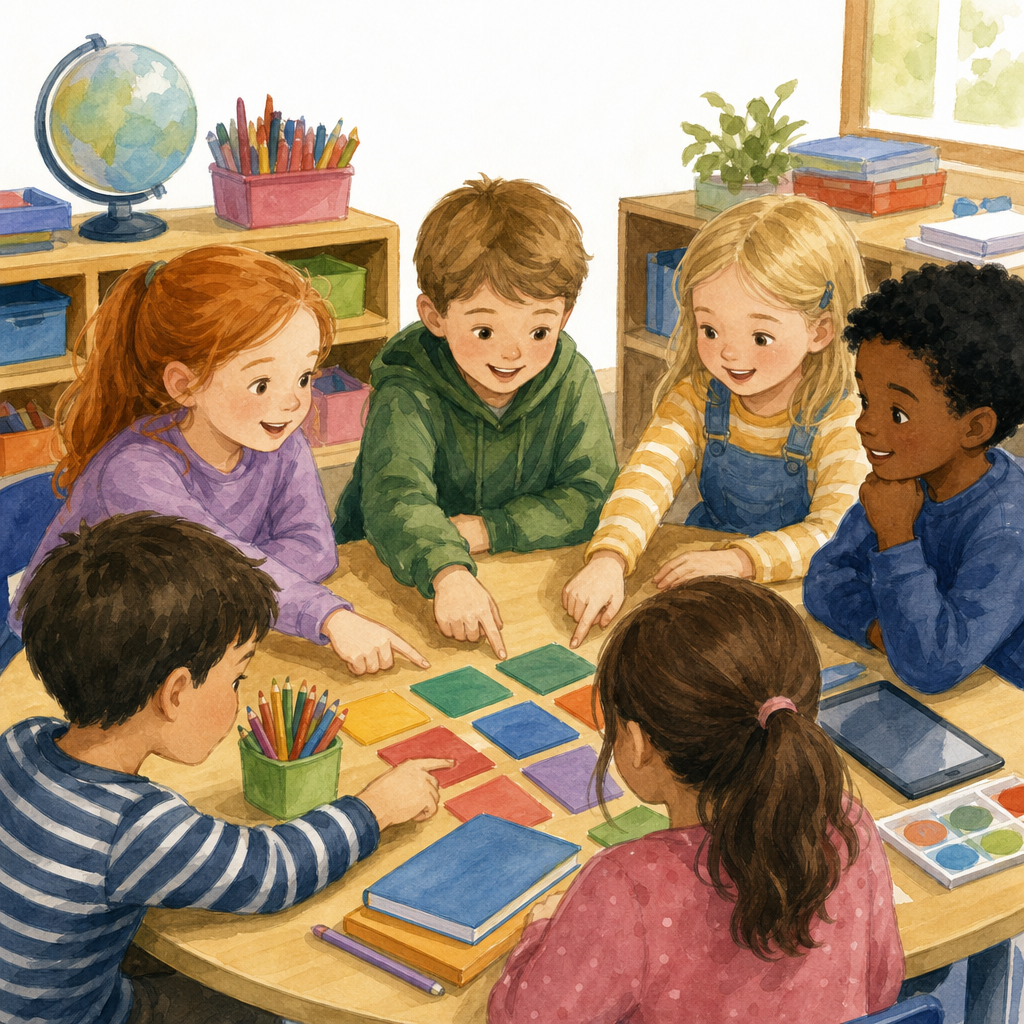
Look around the room. Name three things you can see and say their colours in English.
Today we put those same colour words into short German descriptions. We will also watch what happens to the ending when the colour sits in front of a noun, the way you might see colours named on a German pencil case or a Schultüte (the big cone of stationery German children get when they start school).
Take three or four quick English examples from the room (a blue jumper, a green door, a red book) and stop there. Do not teach the German yet; the flashcards in the next step carry the words.
If pupils offer a colour they already half-remember, smile and park it: "We will check that in a moment." The point of the hook is noticing that English colour words never change shape, and that German signs and school kit use the same colour idea with a slightly different pattern.
First pass: listen to the German colour on each card, then say it together with the class.
Second pass: English shows first; try the German before the card flips, then listen to check.
After a few colours, watch this pattern on the board: after ist the colour stays plain (Der Ball ist rot — the ball is red), but in front of a noun it often gains an ending: der rote Ball (the red ball), das grüne Buch (the green book) — same extra -e before the noun after der or das.
Run the flashcards on the board with the whole class. Do not demand German from English on first sight of a new word.
Pass 1 (hear–say): play the audio or say the German yourself; class repeats chorally. Keep a pronunciation strip visible on the board if helpful. Guides: rot (roht), blau (blau, rhymes with cow), grün (gruen, round the lips for ü), gelb (gelp), schwarz (shvarts), weiß (vice), orange (o-RAHN-zhuh), braun (brown).
After three or four colours, pause the deck. Board only the two model phrases with TTS/audio and a highlighted -e:
Class repeats each full phrase once together. Say simply: "the ending wakes up before the noun." No full grammar labels needed. Point out that the same -e appears after der and after das so pupils do not think it is only a "der thing".
Pass 2: English first; pupils try German before the flip; audio confirms. Finish all eight bare colours for recognition.
Orange: often stays as orange even before a noun — do not force -e on it the way you do with rot → rote. Prefer predicative models for orange if you need one: Der Stift ist orange.
Flip two cards at a time and find each German colour with its English meaning. When a card turns, say the German quietly with the class and listen for the audio.
Whole-class turns on the IWB work well here: one pupil flips, the class helps if needed, then another pupil takes a turn. If a pair is missed twice, stop and say the German together before moving on.
Where a card shows a bare colour, nudge stronger pupils to add a tiny phrase they heard in the flashcard step, for example der rote Ball (dair ROH-tuh bal). Keep this light; matching the meaning is the main goal of this game. Prefer the four focus colours (rot, blau, grün, gelb) for any full-phrase nudge. Full phrase production comes next in Colour detective.
Open your copy. The board still shows the models and word banks from Colour detective. Write two short descriptions by copying the pattern and changing the colour and the thing.
Stay on the board while you write:
Colour bank: rot/rote · blau/blaue · grün/grüne · gelb/gelbe
Noun bank: der Ball · das Buch · der Stift · die Tür · das Heft
Copy the pattern: article + colour-with--e + noun. If you get stuck on a noun, write the English in brackets. Take the umlaut on grün from the bank on the board — you do not need to invent the spelling from memory.
This step comes only after Colour detective. Leave both models and both banks visible for the whole slot — pupils cannot see your teacher notes.
Everyone writes two short descriptions adapted from the models (not three unaided sentences). Walk the room and check the colour sits before the noun with an ending where they follow the model. Accept English nouns in brackets. Do not collect these.
If a confident pupil wants a third line orally while packing away, hear it as a quick exit pass; do not extend the writing demand for the whole class.
Support load for a non-fluent teacher: everything pupils need is on the IWB. You only need to point and circulate.
Board round: one volunteer drags each colour label into place. The whole class says the German together and listens for the audio. Between labels, point at something near you the same colour and whisper the German. Tables may agree the next answer before the volunteer comes up.
Room round: your teacher points at real classroom things (or holds up kit like a pencil case or folder). As a class, say a short German phrase with the colour before the noun, copying the models on the board.
Models to copy:
Bonus: if you spot black, red and gold together, you have the colours of the German flag.
This step has two beats: the label-the-image board game, then a short whole-class oral round with real objects. Leave the two models and both banks large on the IWB for the full eight minutes — they stay up into the copy step that follows.
Board banks to keep up (pupils need these for the room round and the next copy step):
Board round: one volunteer drags; class says the German chorally; audio confirms. Between placements, everyone points and whispers a matching colour in the room. Optionally tables agree the next label first so more voices are used.
Room round: hold up or point at real objects. Tables may whisper-agree, then the class says the phrase chorally, or one volunteer leads and everyone echoes. Keep the productive load on rot, blau, grün, gelb with -e before the noun. Revisit schwarz, weiß, braun, orange as bare colours only, or as predicative (Der Stift ist orange).
Articles stay glued to the noun chunks (der Ball, das Buch, die Tür) so pupils hear all three without a gender lecture. If a table freezes, you say the full phrase and they repeat.
Quick oral exit (30 seconds): point at two objects; class calls the colour or a full phrase. Only then move on to writing — pens stay down until this round has run.
You're previewing this lesson. Get full access to this lesson and hundreds more — each one ready to teach, with interactive activities, printable resources and pupil progress tracking built in.