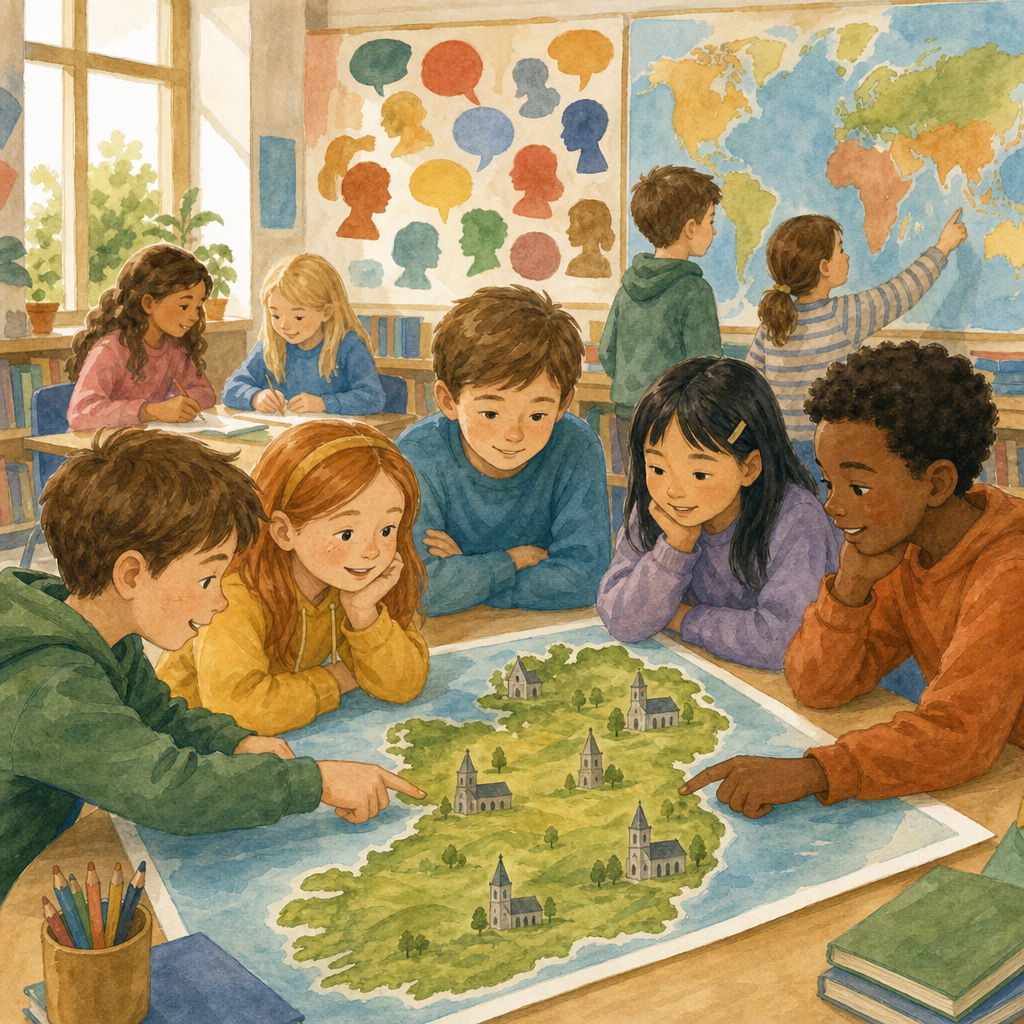
 Kilkenny. Kildare. Kilmainham. One little piece keeps turning up at the front of the name. It looks a bit like the English word for ending a life, but it has nothing to do with that.
Today we open those names and find what is really hiding inside.
By the end of this lesson, you will be able to:
- Spot the Irish word for church inside place names
- Say what the second half of a Kil- name adds
- Talk about why so many Irish towns carry a church in their name
Time to open the names. Watch the board as each town opens and the front piece peels away. Listen carefully for the Irish church words that keep appearing, then say them with the class. Be ready to choose the next town when you are asked. Notice what the second half of each name adds to the story.
Long ago in Ireland, monks often ran a school beside their church, so learning and prayer happened in the same place. On the board are five school words in five languages: English, Irish, French, German and Spanish. Help to join the words that mean the same thing. Before each word is joined, give a thumbs up if you think its five versions look alike, or a thumbs down if they look different. Then we read the short note about where the word came from.
Open your copy. Copy three Kil- names from the board. Under each, write in your own words what the second half adds (a person, a place, or something remembered). Spelling of the board model is enough: no extra words to learn off by heart.
- Kilkenny, Cill Chainnigh: church of Saint Cainnech (a person)
- Killarney, Cill Airne: church of the sloes (a berry that grew there)
- Kildare, Cill Dara: church of the oak (a tree)
Under your list, tick the church roots you heard today:
- cill (church)
- teampall (a church building)
💬 Discussion time
Kilkenny, Kildare and Kilmacthomas begin with a word for a church, not a killing. A map full of Kil- names is really a map of where communities built places of prayer and learning long ago.
Start here: Who might a place like Kilkenny have been named after, and what could that person have meant to the people who lived there?
Then try: What does it tell you about a country that so many of its towns are named after a church?
Stretch: Would a visitor who only saw English spellings notice the churches hiding inside the names?
Unlock the full learning experience
You're previewing this lesson. Get full access to this lesson and hundreds more — each one ready to teach, with interactive activities, printable resources and pupil progress tracking built in.
This lesson is copyright of Coding Ireland 2017 - 2026. Unauthorised use, copying or distribution is not allowed.