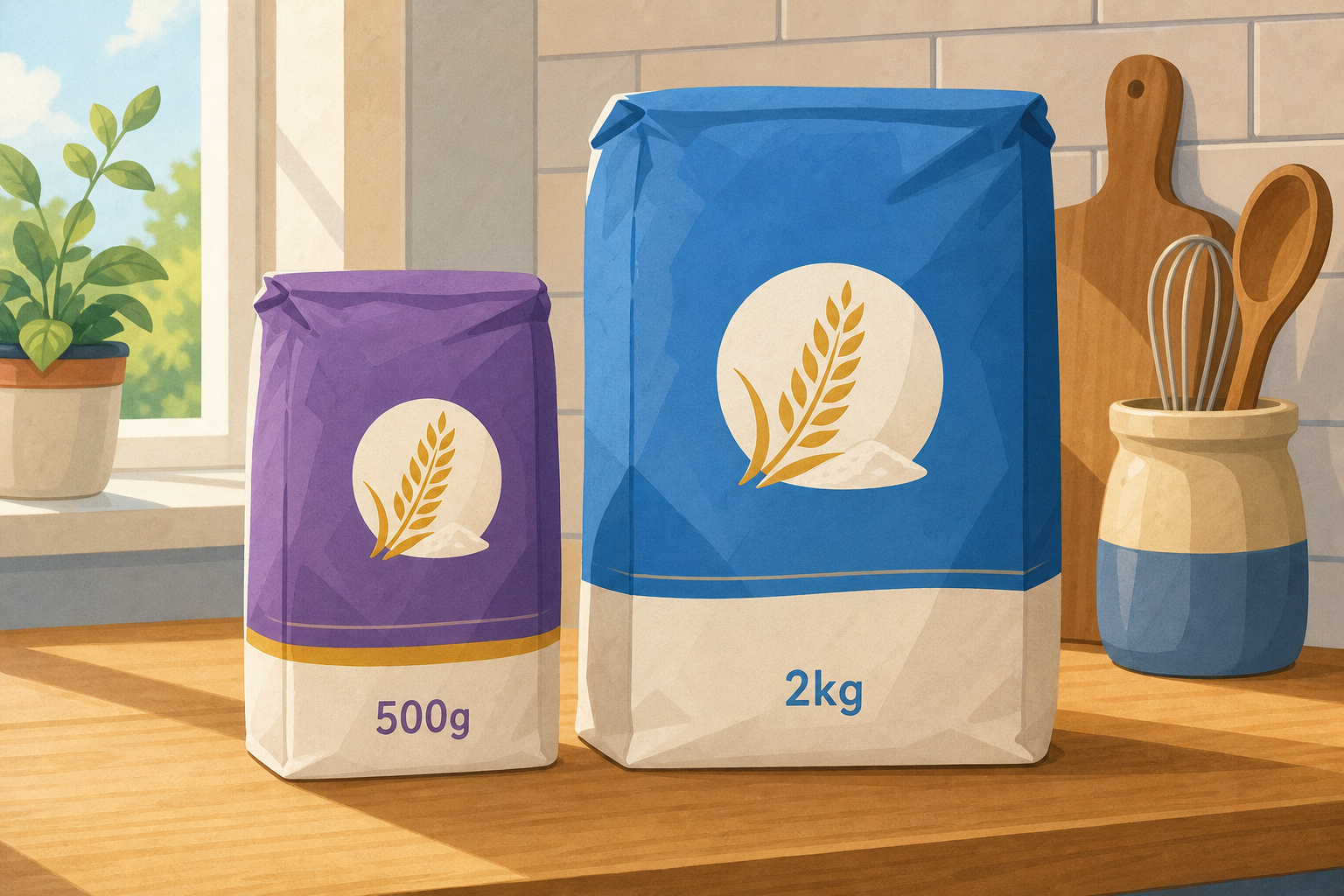
Here is a 500 g bag of flour beside a 2 kg bag. How many of the small bags would you need to make one big bag?
Take three hands-up answers, not open call-outs. Listen for whether pupils reach for 1,000 g = 1 kg. Do not confirm yet — the ladder in the next step makes it visible.
The word 'kilo' means a thousand, so 1 kg is 1,000 g. That is why changing grams into kilograms is always a ÷ 1,000 jump, and changing kilograms into grams is always a × 1,000 jump.
Watch four conversions on the ladder. Each digit crosses three place-value columns. Crossing one column is × 10, so crossing three columns in a row is × 10 × 10 × 10, which is × 1,000. The decimal point stays anchored in one place while the digits slide past it. Look for how many columns the digits move each time.
For the last one, say what you'd do to change grams into kilograms.
Work these four snapshots live on the ladder, one at a time; pause on each before the reveal and pull an answer from the class.
Now we work through four conversions together. First 2,000 g into kilograms. Then 0.5 kg into grams. Then 1,500 ml into litres. Last, 0.6 litres into millilitres. Before we check each one, say which way the digits will shift and how many columns they cross.
Talk this one through together — pupils take turns at the board and the class agrees or corrects out loud. Before each Check, ask the two prediction questions: which way do the digits shift when we go from grams to kilograms? and how many place-value columns do they move each time?
The four challenge rungs run as a set, taking the class from mass to volume in order. If the ladder does not carry the unit or category across on its own for a rung, set the From value and units for that rung before pressing Check — the labels on each challenge name the conversion you need.
Watch for pupils moving the decimal point instead of the digits — revoice the digits move, the point stays still. Hold out for the direction (× or ÷ 1,000) before each reveal.
In your maths copy, make a two-column table. Head one column with the small unit (g or ml) and the other with the large unit (kg or litres). Write the four conversions from Try It Together as four rows, one under the other: 2,000 g and its kilograms, 0.5 kg and its grams, 1,500 ml and its litres, 0.6 l and its millilitres.
Walk the room glancing at column headings and whether the decimal point lands correctly — no marking, this is whole-class copybook practice. Four rows is the target; keep it to those four.
Now we work through four conversions in order, each one a step harder. First 4,200 g into kilograms. Then 0.6 litres into millilitres. Then 3,750 ml into litres. The last one has two parts: a recipe needs 250 g of sugar four times, so first work out the total in grams, then convert that total into kilograms.
This is the practice round — pupils take turns at the board, check each answer, and the class confirms before moving on. Keep the board work brisk rather than over-explaining.
For the last one, work out the total in grams first (250 × 4 = 1,000 g) on the board so the class sees where 1,000 comes from, then convert. The challenge rung loads 1,000 g → kg so the ladder confirms 1 kg. Ask which is the tricky part — the multiplying, or the converting.
You're previewing this lesson. Get full access to this lesson and hundreds more — each one ready to teach, with interactive activities, printable resources and pupil progress tracking built in.