Mathematics
Intermediate
50 mins
Teacher/Student led
+65 XP
What you need:
IWB/Projector/Large Screen

Converting Decimals to Fractions

Learn how to convert decimals into fractions by reading the place value of the last digit to find the denominator, then simplify the result by finding the biggest number that divides into both parts.
Teacher Class Feed

Load previous activity

    1 - Getting Started ~4 mins

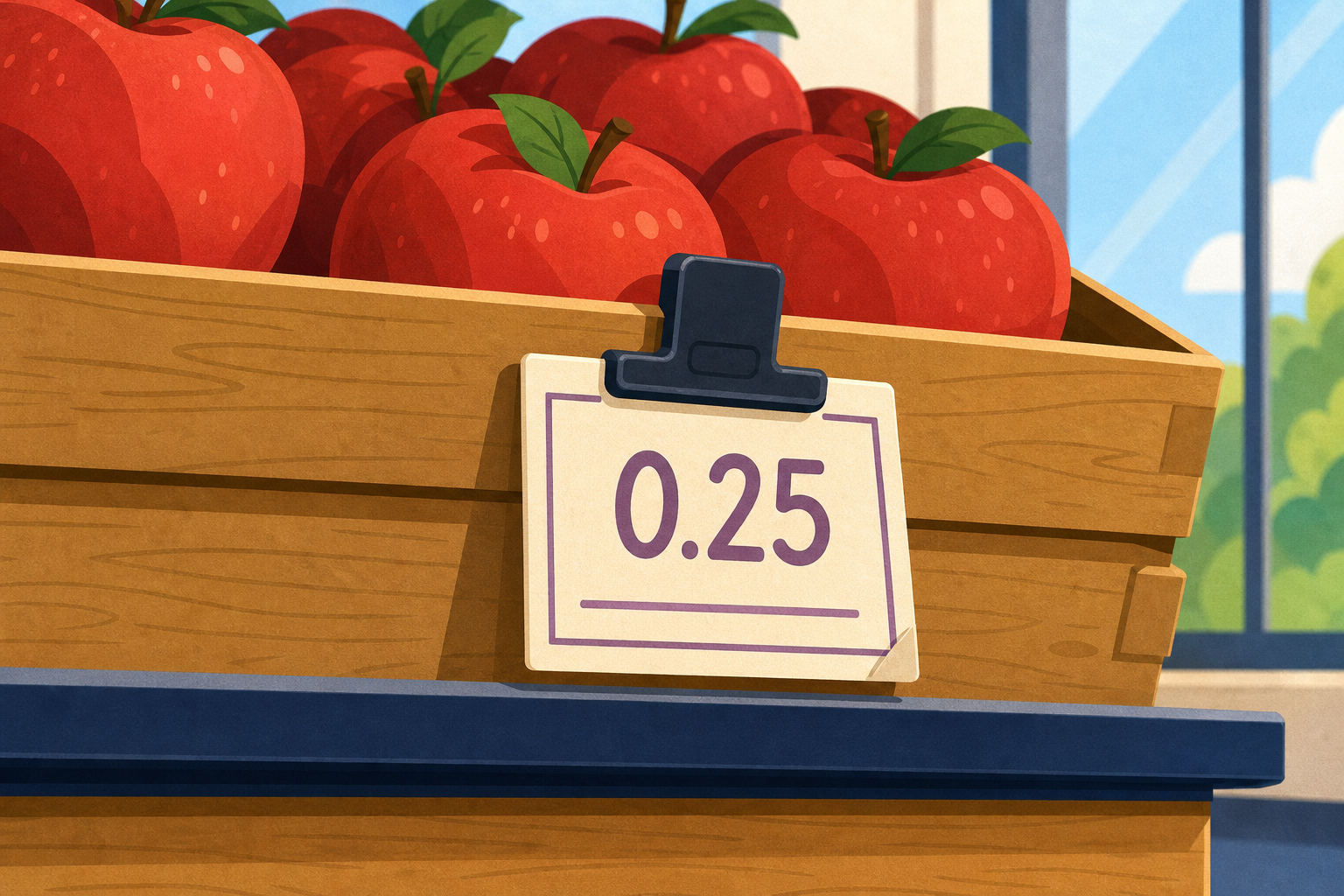
    Illustration for Getting StartedLook at this price tag: a bag of apples is €0.25 on offer. We say "twenty-five cent", but a quarter of a euro is also written as 0.25. So which fraction is hiding inside 0.25? Have a think before anyone answers.

    2 - Watch and Notice ~11 mins

    0.25

    Here is our first decimal, built on the place-value mat. Read it with me: two tenths and five hundredths. The last digit sits in the hundredths column, so the bottom of our fraction is one hundred. All the decimal digits become the top: twenty-five. That gives us 25/100. Now we simplify, and I want you to watch how I find the number to divide by. I ask: what number goes into both 25 and 100? I test five first — five goes into 25 (five times) and into 100 (twenty times), so five works. But can I do better? Twenty-five also goes into both: 25 ÷ 25 = 1 and 100 ÷ 25 = 4. Twenty-five is the biggest that fits, so I divide top and bottom by 25 in one step and 25/100 becomes 1/4. A quarter of a euro, exactly like the price tag said.

    0.6

    Our second decimal is shorter. The last digit is in the tenths column, so the bottom is only ten. Six tenths is 6/10. Now I hunt for the biggest number that goes into both 6 and 10. Five goes into 10 but not into 6, so five is out. Two goes into both: 6 ÷ 2 = 3 and 10 ÷ 2 = 5. Nothing bigger fits, so I divide both by 2. Predict with your neighbours: before I show you, what do you think the answer will be?

    0.125

    Now a longer one. The last digit reaches all the way to the thousandths column, so the bottom must be one thousand. One hundred and twenty-five over a thousand — 125/1000. This is the tricky one, so we hunt for the highest common factor slowly. Two does not go into 125 (it is odd), so I try five: five goes into both, giving 25/200. I keep going — five again gives 5/40, and five again gives 1/8. So dividing by five three times is the same as dividing by 125 in one go, because 5 × 5 × 5 = 125. Either way, 125/1000 simplifies right down to 1/8. That is the trick: if you cannot spot the biggest factor at once, keep dividing by a factor you can see until nothing else fits.

    3 - Try It Together ~8 mins

    Now we work through these three decimals together on the mat: 0.4, then 0.35, then 0.06. For each one, before anyone builds it, everyone predicts two things: how many decimal places it has (so what the bottom of the fraction will be) and what number we should divide by to simplify. Then a pupil builds it on the board and we check our predictions together. Watch the columns carefully on 0.06 — that zero in the tenths column catches people out.

    Watch out

    Watch the columns carefully on 0.06 — that zero in the tenths column catches people out.

    Build the decimal, then read off the fraction

    4 - Write the Fraction in Your Copy ~2 mins

    COPYBOOK MOMENT

    In your maths copy, write each of these decimals as a fraction over 10, 100 or 1000, then show the number you divide by and the simplified form beside it. Circle the simplest form on each line.

    • 0.8
    • 0.45
    • 0.08
    • 0.5

    5 - Class Challenge ~7 mins

    Key point

    Now we build and convert four fresh ones, in order: 0.8, then 0.45, then 0.375, then 0.08. Each one adds a wrinkle — a shorter decimal, then a two-place one, then a full thousandths one, then the sneaky zero-in-the-tenths trap. Predict the bottom number before each build, then build it, read the fraction, and simplify.

    Convert to a fraction and simplify

    Pupil practice
    Module 3 · Fractions, Decimals and Percentages Number
    Lesson 34 · Converting Decimals to Fractions
    Download Activity Book page (PDF)
    123learn · Online learning platform

    Unlock the full learning experience

    You're previewing this lesson. Get full access to this lesson and hundreds more — each one ready to teach, with interactive activities, printable resources and pupil progress tracking built in.

    Hundreds of curriculum-aligned lessons
    Interactive activities in every lesson
    Printable resources & progress tracking
    Copyright Notice
    This lesson is copyright of Coding Ireland 2017 - 2025. Unauthorised use, copying or distribution is not allowed.
    🍪 Our website uses cookies to make your browsing experience better. By using our website you agree to our use of cookies. Learn more
