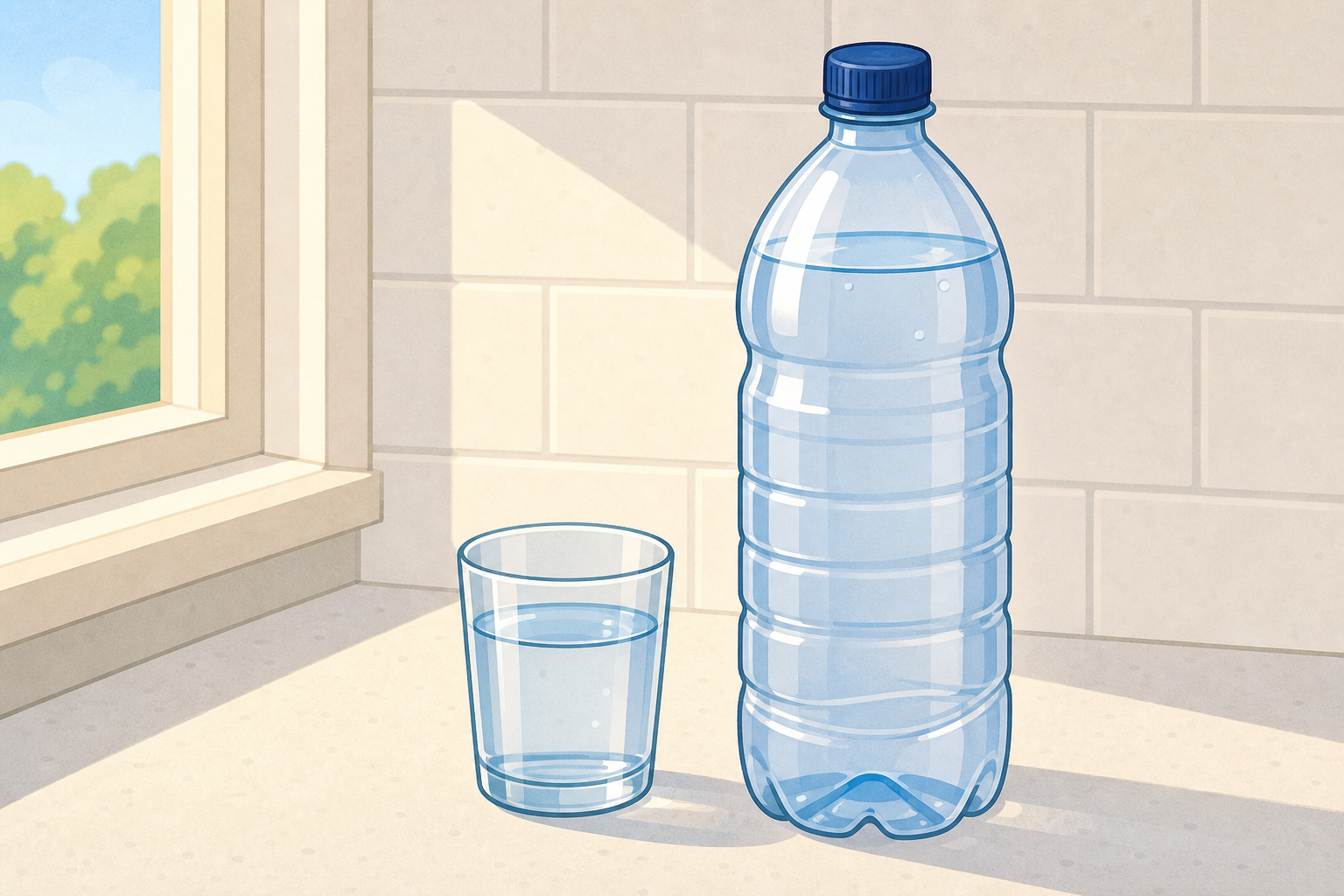
Here is a 1.5 l bottle of fizzy water and a 250 ml glass. How many glasses could you pour from the bottle?
To answer that, we first need both amounts written in the same unit. Which one is easier to change: the litres into millilitres, or the millilitres into litres?
Take two or three hands-up answers, not open call-outs. Don't settle the glasses question yet — the point is to surface that we can't compare 1.5 and 250 until they share a unit. Hold the litres-vs-ml choice open; it comes back at the wrap.
Watch the conversion ladder. Litres sit at the top and millilitres three steps below. The label between them shows how much bigger the number gets. Look at where the digits land as the unit changes.
We already met this exact three-column step when we changed kilograms into grams: 1,000 g make 1 kg, so kg → g is × 1,000 and g → kg is ÷ 1,000. See if you can spot what is the same here.
About 8 minutes. Work each step of the ladder live on the board — do not read a script.
The kg-to-g rule is on the board now, but hold back the explicit link — you want a pupil to name it at the wrap, not you.
Let's work these together on the ladder:
Say which way the digits will slide before each one appears, then we check.
Talk this one through together — pupils take turns at the board and the class agrees or corrects out loud. With four conversions across the 10 minutes, that is roughly 2 to 2.5 minutes each including the turn-and-check.
Work each conversion on the ladder together on the board. For each one, get the direction (left or bigger, right or smaller) from the class first. The last one, 75 ml → 0.075 l, is the trickiest — two leading zeros appear. Slow down and let the class read the answer off the ladder before confirming. Circulate the naming: × 1,000 or ÷ 1,000 aloud each time.
In your maths copy, work each conversion as l ↔ ml. For every one, draw an arrow from the starting unit to the finishing unit and label the arrow with the step you did.
Label each arrow either × 1,000 or ÷ 1,000 to show how you got from one to the other.
Walk the room glancing at the arrow labels — this is whole-class copybook practice, not marking. Watch for pupils writing × 1,000 when the number should get smaller; the arrow label is the check that catches it.
Your turn to fill each rung and Check. We cross between litres and millilitres:
Fill in each rung, then press Check.
This is the practice round — pupils take turns at the board, check each answer, and the class confirms before moving on. Keep the board work brisk rather than over-explaining.
The practice set rises: the first three are clean, 3,050 ml → 3.05 l has the awkward internal zero, and 45 ml → 0.045 l is the two-leading-zeros stretch. Before the tricky pair, ask the class to predict how many zeros will sit in front of the digits — then Check.
You're previewing this lesson. Get full access to this lesson and hundreds more — each one ready to teach, with interactive activities, printable resources and pupil progress tracking built in.