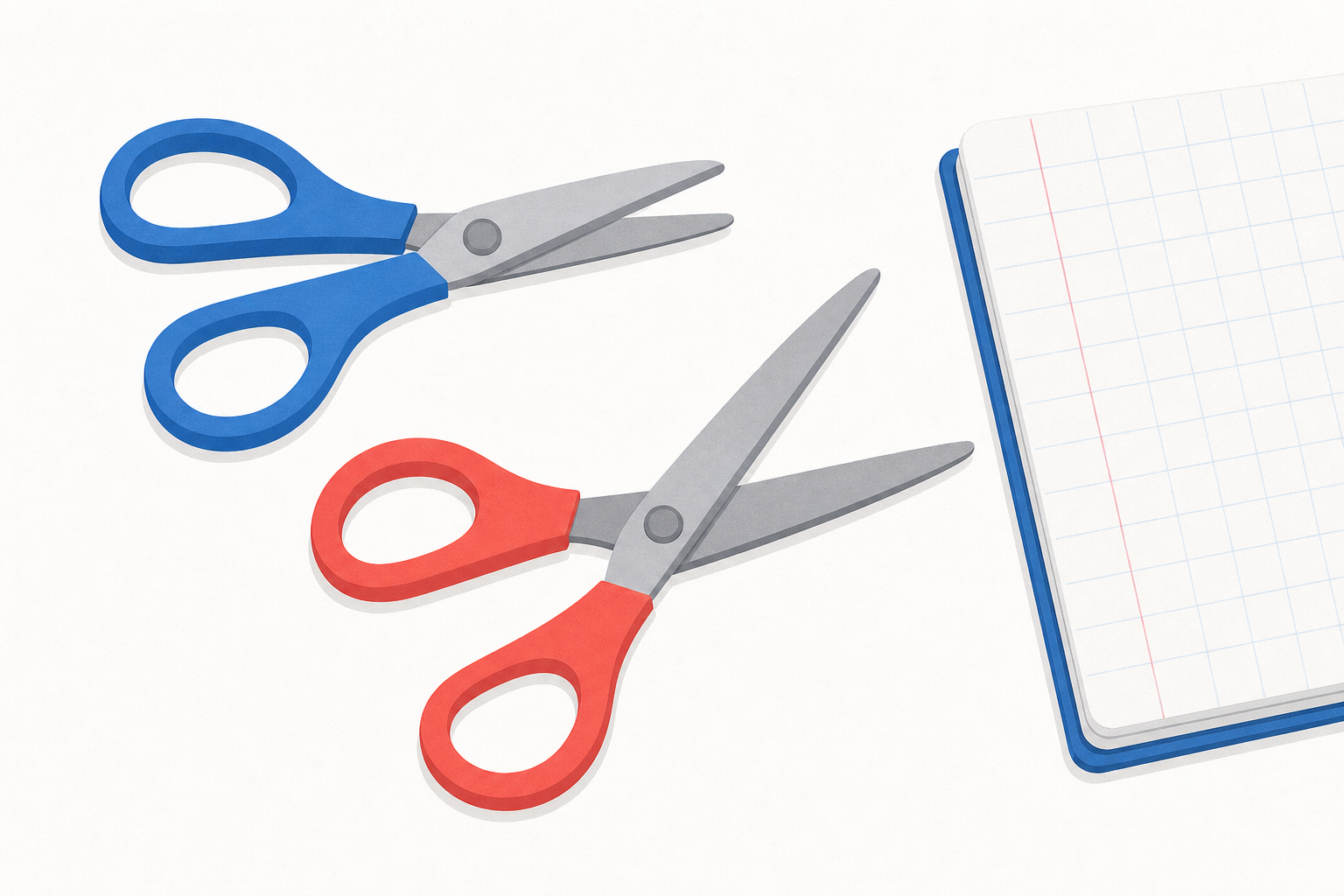
Look at a pair of scissors opened just a little, and then opened out wide. One opening is a small angle, the other is a big one. Which opening is smaller than a square corner, like the corner of your copybook? Which one is bigger?
Open real scissors slowly at the front, or use the shape-card fan. Take two or three hands-up answers, not open call-outs. Hold out for the word 'corner' — connect the square corner of the copybook to the idea of a right angle without naming acute/obtuse yet.
A square corner is a right angle. If the angle opens less than the corner, it is an acute angle. If it opens more than the corner, it is an obtuse angle.
Watch as each angle is held against a folded-paper square corner. Look at four angles in turn and decide, before the check, whether each is smaller or bigger than the square corner.
Use a folded-paper right-angle checker held against each angle in turn: a clearly narrow angle (acute), a clearly wide angle (obtuse), an angle just under a right angle (still acute), and one just over (obtuse). The close-to-square pair is the make-or-break — hold the checker still and ask the class to predict before you reveal. Say smaller than the corner and bigger than the corner as you go; keep degrees out of it.
Today we sort angles into three groups: acute (smaller than a square corner), right angle (an exact square corner), and obtuse (bigger than a square corner).
Pupils take turns at the board while the class watches and agrees aloud. We take the angles one round at a time. First we sort a clearly narrow angle and a clearly wide one. Then we look at an exact square corner. Last we check one that is only just bigger than a right angle. For each card, decide whether the angle is smaller than, the same as, or bigger than a square corner.
Talk this one through together — pupils take turns at the board and the class agrees or corrects out loud.
This is explore mode: any drop is accepted so the class can reason aloud. Prompt each pupil to picture holding the square corner against the angle before dropping it. The just-bigger-than-a-right-angle card is the one to slow down on — revoice: it opens a little wider than the corner, so it is obtuse. Rotate four pupils across the rounds.
In your maths copy, draw one acute angle and one obtuse angle. Use the corner of your copybook to check each one against a right angle. Label the smaller one acute and the bigger one obtuse.
Walk the room and glance for pupils actually holding the copybook corner against their drawn angle — this is whole-class copybook practice, not marking. Watch for an obtuse angle drawn too close to a right angle; nudge them to open it clearly wider.
Sort each angle card by whether it is smaller than, the same as, or bigger than a square corner. A tilted angle opens the same amount no matter which way it points.
Now we sort trickier sets. We work through four rounds:
This is the practice round — pupils take turns at the board, check each answer, and the class confirms before moving on. Keep the board work brisk rather than over-explaining.
Challenge mode bounces wrong drops and confirms with Check. On the tilted-angle round, remind the class the turn of the angle does not change how wide it opens — compare the opening, not the direction it points. The exact-right-angle round is where pupils second-guess: an exact square corner is neither acute nor obtuse.
You're previewing this lesson. Get full access to this lesson and hundreds more — each one ready to teach, with interactive activities, printable resources and pupil progress tracking built in.