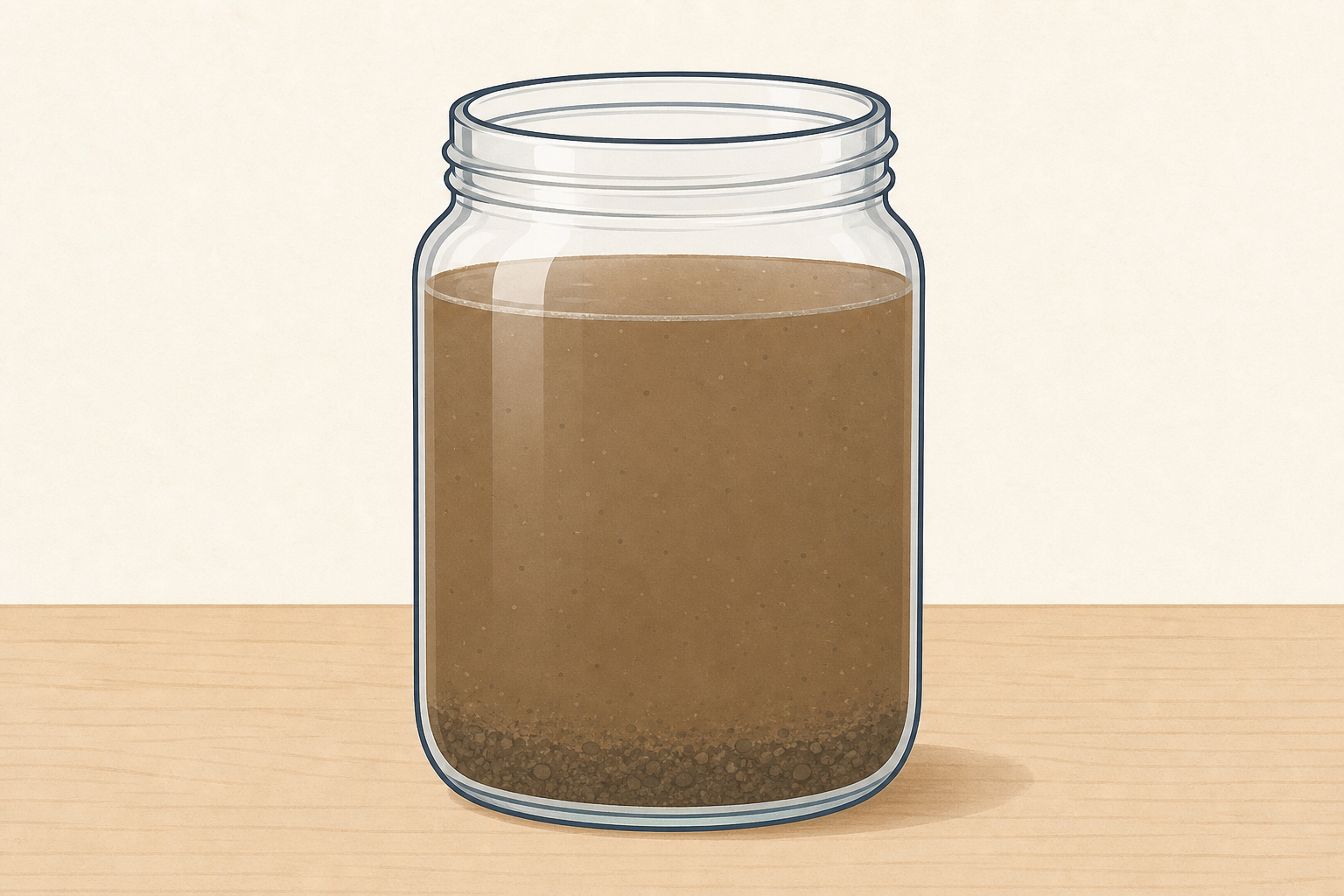
Look at this jar of muddy water. Would you want this coming out of a tap at home? Today your group will design a filter to clean muddy water, then fair-test whose design works best.
What do you already know about getting dirt out of water from earlier in this project?
Hold up one clear jar of well-stirred muddy water. Keep the hook light: curiosity and the challenge only. Do not hand out bottles or layers yet.
Link to the project: remind the class that earlier in this project they separated sand, salt and water and improved a method. Today they apply separation to a real problem: cleaning dirty water.
Key questions: What is still in this water that we do not want? What materials might trap the mud? Why must we never drink what comes out of our classroom filters?
Nature of STEM: engineers and water scientists design filters so communities get cleaner water. Ireland's water treatment works do a much more careful version of what the class will try today.
A filter traps unwanted bits as water passes through so the liquid that comes out is cleaner. Your filter design is which materials you choose and the order you stack them. Real water treatment is how water is cleaned so homes and schools can use it safely.
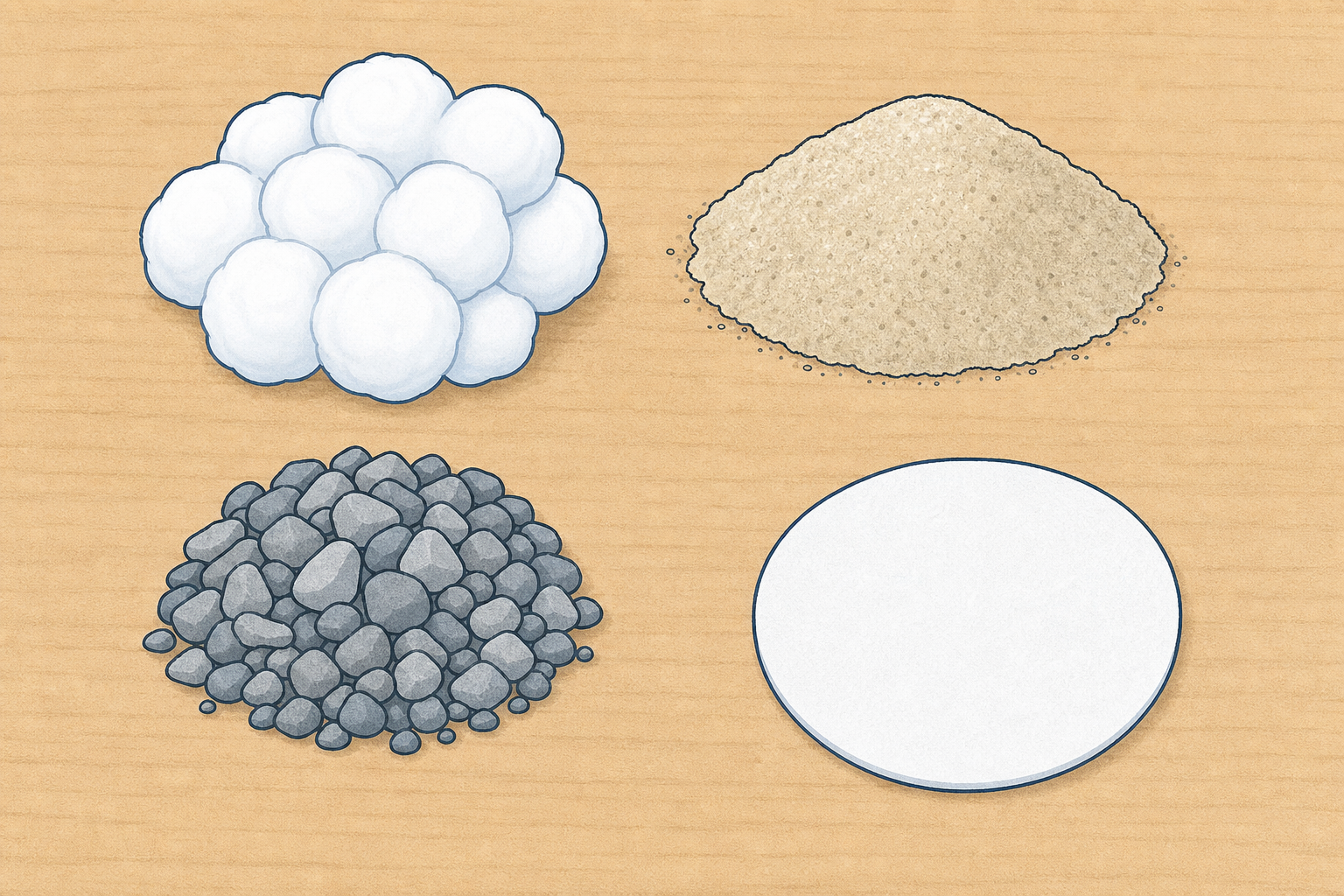
Your kit includes cotton wool, washed sand, washed gravel or small stones, and optional filter paper. Turn and talk for thirty seconds: which layer do you think should sit at the bottom of your bottle, and why? Then hands up to share one idea.
Keep the board short. Use the table below as your reference while you talk. Give one short spoken definition for each term, then run the turn-and-talk and a few hands-up answers before moving on.
| Concept | Why it matters | Example |
|---|---|---|
| Filter — a set-up that traps unwanted bits as a liquid passes through so the liquid that comes out is cleaner | Filters turn a messy mixture into something clearer without needing heat or chemicals in this lesson | Muddy water poured through sand and cotton wool comes out less cloudy underneath |
| Filter design — the materials you choose and the order of the layers | Design is the one thing groups change today, so a fair comparison is possible | Cotton wool then sand then gravel versus gravel then sand then cotton wool |
| Water treatment — cleaning water so people can use it safely at home and school | Links our bottle challenge to a real Irish and global need: reliable clean water | Treatment works filter and clean river or lake water before it reaches taps |
Misconception to head off: clearer classroom water is not safe to drink. Our filters only remove some visible mud. Real treatment uses more steps and careful testing. Say clearly: We never taste or drink the water from our filters.
Worked model (say aloud, do not project as a script): I wonder which simple design will clear muddy water better. I predict cotton wool under sand will trap more mud than sand alone. I test by pouring the same amount of muddy water through each. I observe the sand-only water stays browner. I think the cotton wool helped catch fine bits the sand let through.
Before we build, we plan a fair test. Five cards appear on the board: the filter design, how clear the water is, amount of muddy water, the bottle size, and how long we wait.
Help sort them. Which one do we change? Which one do we measure? Which three must stay the same?
Agree our shared clearness scale and keep it on the board: 1 very muddy, 2 mostly muddy, 3 half clear, 4 mostly clear, 5 almost clear.
Open the fair-test-planner interactive on the IWB in explore mode. The five variable cards on screen must match this list exactly: the filter design; how clear the water is; amount of muddy water; the bottle size; how long we wait.
Must do: sort the five cards into Change, Measure and Keep the same, and lock the shared 1–5 clearness scale on the board for the rest of the lesson.
If time is tight on predictions: use one quick whole-class stem instead of a full round of group predictions, for example "Hands up if you think a multi-layer filter will score higher than one layer," then one or two volunteers say why. Groups can name their own design prediction as they start building in the next step. Do not drop the fair-test lock-in or the clearness scale to make room for predictions.
Drag the filter design to Change, how clear the water is to Measure, and amount of muddy water, the bottle size and how long we wait to Keep the same. Invite hands up before each drag. Ask: What would make this unfair? (different amounts of muddy water, different wait times, or judging clearness in different ways).
Leave the 1–5 scale on the board (or write it beside the interactive) for the rest of the lesson so every group judges the same way during the test.
As a class you lock the fair-test rules. Each group still chooses its own layer order and which kit materials to use. That design choice is theirs.
Look-fors: pupils can name the one thing changed, the one thing measured, and at least two things kept the same without reading the board.
Your challenge: build a bottle filter that makes muddy water clearer. Use the kit on your table. Choose which layers to include and in which order. Label your design so another group could rebuild it.
Work as a group. Keep the outside of the bottle dry and stand it steadily over your clean collection cup.
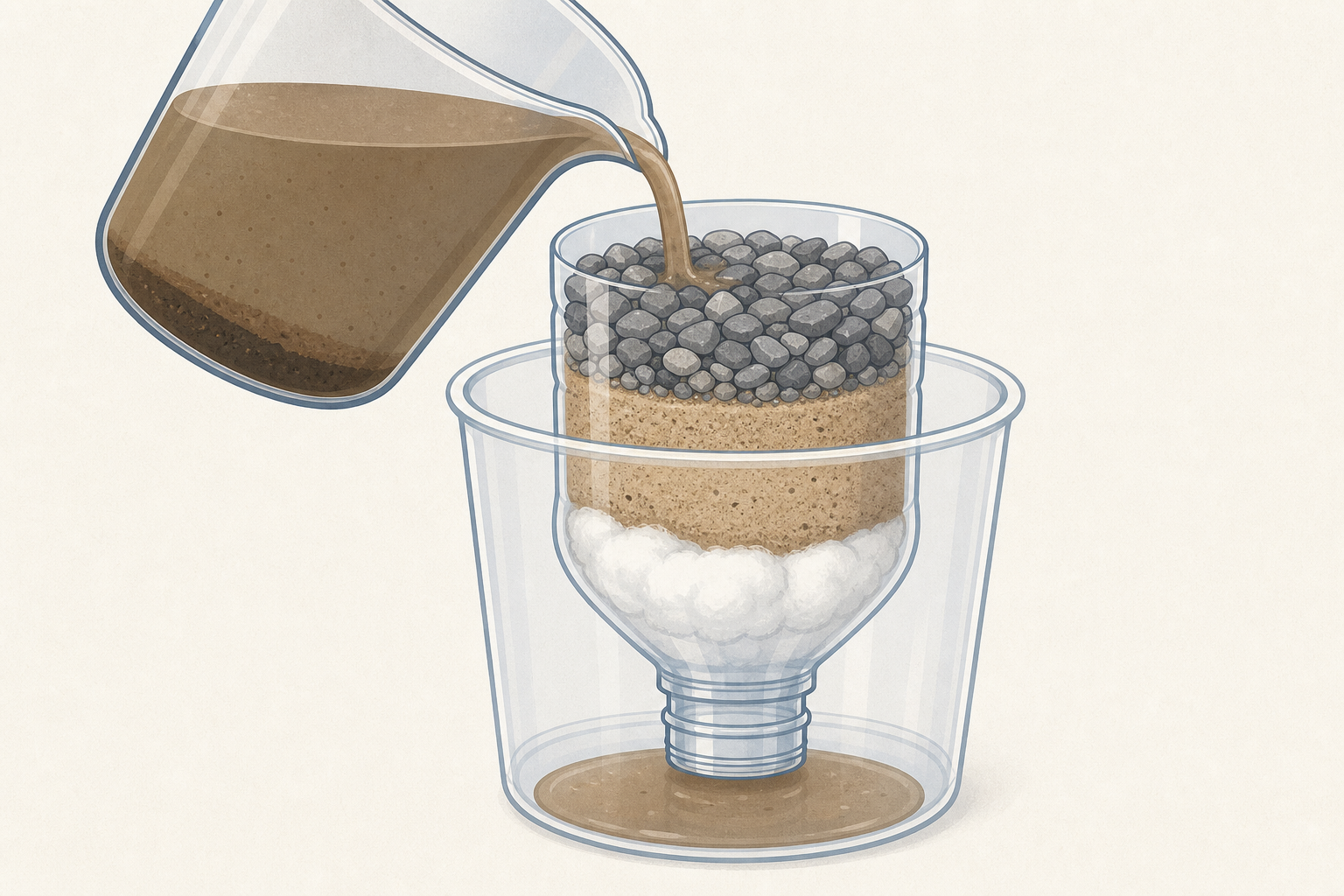
With one spare bottle at the front, show how to stand it neck-down over a cup on a tray, seat it in the stability support (jug, cut bottle base, or tray with a cut-out hole), add a thin cotton-wool base with a spoon, then a sand layer, and label the order on a sticky note. Keep it short: safe set-up and labelling only, not a full pour test.
One pre-cut bottle per group (adult cuts before the lesson), neck down over a clear cup or beaker, held steady in the group's stability support so it cannot tip. Kit per group: cotton wool, washed sand, washed gravel or small stones, optional filter paper, jug of stirred muddy water (kept closed until the test step), spoons, newspaper or tray for spills, sticky notes.
Circulate and ask: Why that order? What do you want the bottom layer to catch? If liquid will not pass, loosen the cotton wool slightly. If sand falls straight through, add a thin cotton-wool base first.
Safety: only adults cut bottles. Pupils may place layers with spoons or dry hands. Wipe spills at once. No tasting.
Differentiation: less confident groups start with cotton wool, then sand, then gravel. Confident groups deepen the design choice (finer bottom layer, different order, or an extra optional paper layer) still using one bottle and one collection cup, changing only design and keeping pour amount the same later.
Fair-test time. Each group pours the same measured amount of stirred muddy water into their own filter. Wait together on the class countdown. Score clearness on the shared board scale (1 very muddy to 5 almost clear) and write that score on your bottle sticky note straight away.
When scores are ready, one runner from each group holds up the collection cup. We line them from muddiest to clearest and call designs and scores so everyone can see the class evidence.
Trial one pour through a typical multi-layer cotton-wool and sand filter. Set the class countdown to a time when most designs have produced a scorable sample in the cup. Keep that same wait for everyone. If useful, groups can also note flow as free, slow or blocked beside the clearness score so a blocked filter still counts as fair data.
Groups pour at the same time on your signal. Run one fixed shared wait. Scores go on the bottle sticky immediately. Then a rapid cup line-up: one runner per group, rank roughly from muddiest to clearest, call each design and score once. That line-up is required so step 6 can use class evidence. Do not spend board time on optional repeats.
Optional second trial (teacher only, not on the board): only if a group's filter has already finished and spare minutes remain after the line-up. Never force a repeat for everyone, and never let a second trial squeeze out the class share.
Groups pour into their own filter, watch, then agree a clearness score. Capture immediately on the bottle sticky note next to the layer order, or a draft line on the Investigation Journal page. Remind them: record what they see first; save what they think it means for the journal conclusion.
If a filter blocks completely: that is useful data. Note "no flow" or "very slow" and still score what little liquid collected. Ask what they would change next time without breaking fairness mid-test.
Class share (required, quick): one runner from each group holds up the collection cup. Rank roughly from muddiest to clearest at the front. Say designs and scores aloud (or jot a simple board list) so every pupil can see class evidence before the journal conclusion. There is no on-screen results table; the sticky notes, journal drafts and front line-up are the record path.
Safety: mop spills immediately. Water from filters is never tasted, drunk, or used on skin near mouths. Wash hands after handling muddy water and sand.
You're previewing this lesson. Get full access to this lesson and hundreds more — each one ready to teach, with interactive activities, printable resources and pupil progress tracking built in.