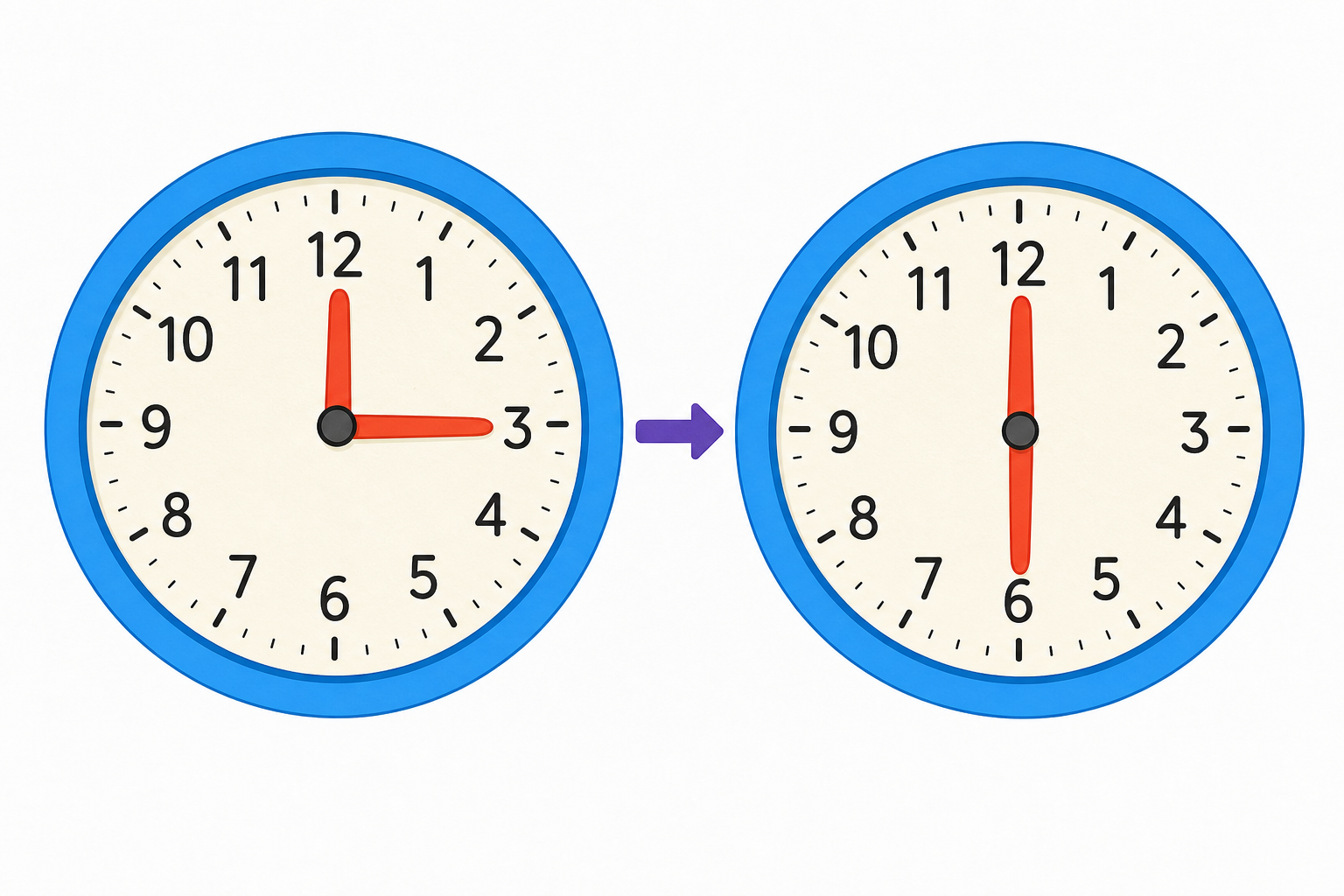
Look at the two clocks on the board. On the first clock, the minute hand points to the 12 and the hour hand points to the 3, making a neat square corner. On the second clock, the hour hand moves down to the 6, so the two hands make one flat, straight line.
That second one is completely flat. What kind of turn made the hour hand go all the way down to make a straight line?
Show the two clock positions side by side on the board as pupils settle. Take three hands-up answers, not open call-outs.
You are listening for the idea of a half turn. If a pupil says "it went halfway round", hold that thought, that is exactly the straight angle we meet later.
Four angles on the board, each already sorted into its group. Compare each one to a right angle (the square corner). Watch which are smaller, which fit exactly, which are bigger, and which open all the way to a flat line.
Look carefully at the last group. A straight angle is not a wide corner, it is a flat line, a half turn. How many right angles could fit inside a straight angle?
Point to each group in turn and hold your paper right-angle checker against the shape you name, so the class watches the compare-to-the-square-corner test happen live.
Do not confirm the two-right-angles idea fully yet, let the class carry it to the wrap step at the end.
Now we sort these angles together into their four groups: acute, right, obtuse and straight. One pupil comes to the board to drag each card into its group. The rest of the class agrees or corrects out loud before the card lands.
Before each card lands, we compare it to a right angle (the square corner) and decide which group it belongs to. Hold the paper right-angle checker against the angle: does the square corner fit exactly, is it too big to fit, does it slot in with room to spare while the arms still bend, or do the arms lie flat in one straight line?
Talk this one through together — no marking yet. Pupils take turns at the board and the class agrees or corrects out loud before each card lands.
Hand each pupil a moment to hold the paper right-angle checker against the card before they drag it. The whole test is: does the square corner fit exactly, is it too big to fit, or does it slot in with room to spare?
The straight angle is the one that catches people, some will want to call the flat line "obtuse". Head this off: an obtuse angle still has a bend in it; a straight angle has no bend at all.
In your maths copy, draw one angle of each kind and label each one: an acute angle, a right angle, an obtuse angle and a straight angle.
Use the corner of your copybook as your square-corner guide, and put a small square mark inside the right angle to show it is exactly square.
Walk the room glancing at the four labels and the square mark on the right angle. This is whole-class copybook practice, not marking.
Watch for the straight angle being drawn with a bend, remind that pupil it should be one flat line.
Now we make each kind of angle ourselves, using two strips joined at a point, then drag the matching card to its group. First we open them a little to make an acute angle. Then we open them to a right angle and check it against a square corner. Next we open them wider for an obtuse angle. Finally we open the strips fully so they make a straight angle, one flat line.
This is the practice round — pupils take turns at the board, check each answer, and the class confirms before moving on. Keep the board work brisk rather than over-explaining.
Pupils make each angle at their desks with their own joined strips, then a pupil drags the matching card to its group on the board. The class confirms the name by picturing the square-corner test.
If any pupil's strip pair is not working (a loose split-pin or a missing strip), they can pair up with the pupil beside them, or trace the angle in their copybook using the copybook-corner checker, so the beat holds together for everyone.
The final move, opening the strips fully, is the one to linger on: hold the strips up and show the class that the two strips now form a single straight line with no bend, that is the straight angle.
You're previewing this lesson. Get full access to this lesson and hundreds more — each one ready to teach, with interactive activities, printable resources and pupil progress tracking built in.