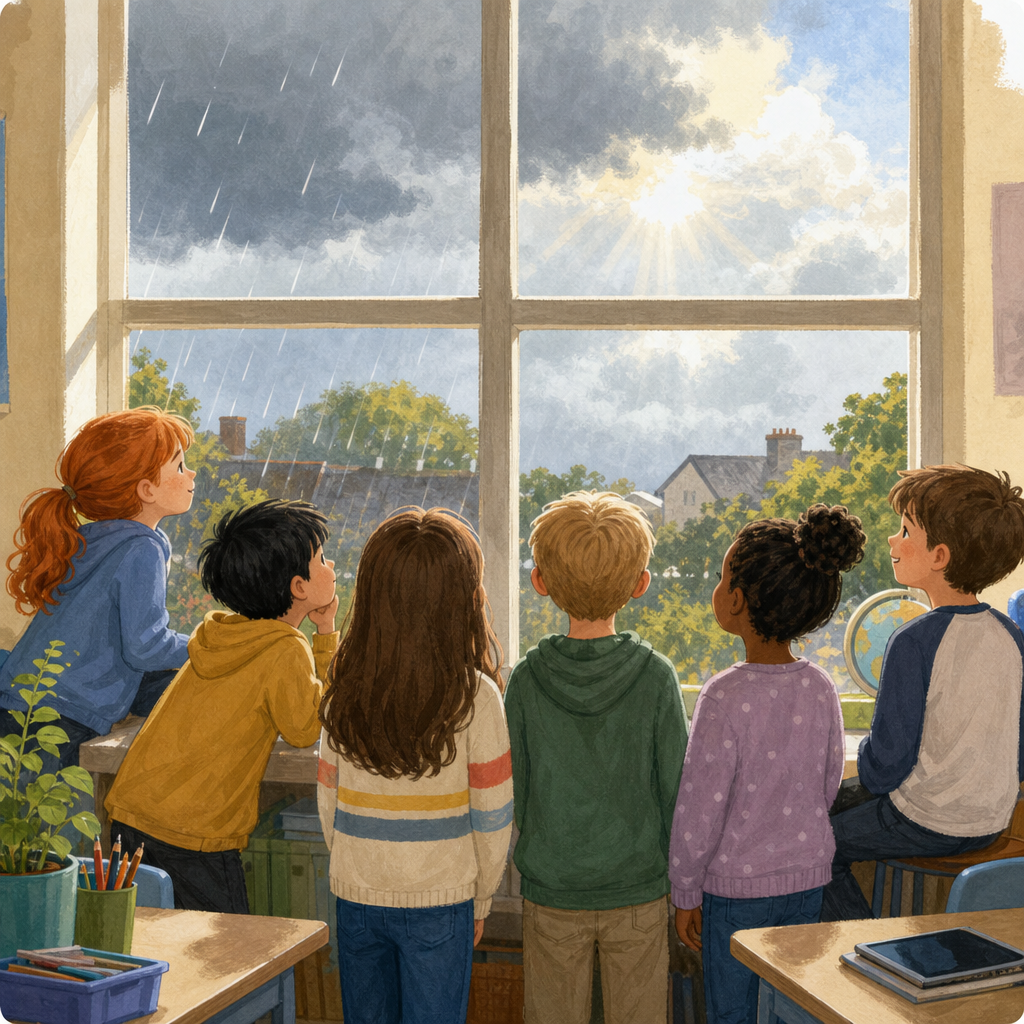
What is the weather doing right now? Say it in English in three words or fewer. Keep those three words in your head: by the end of this lesson you will name the same idea with a French weather word, and you will know whether it takes le or la.
Collect four or five three-word answers around the room (for example "grey and damp", "bright but cold"). Do not translate them yet. The flashcards in the next step will give the class the French they need. Glance out the window yourself so you can model one honest answer if the room goes quiet. Flag early that every French weather word on today's list carries le (masculine) or la / l' (feminine or before a vowel) — pupils will sort them later.
Here are today's eight French weather words. Watch the image, listen to the French, then repeat it with the class. Notice whether each word uses le, la, or l'.
Listen for the soft zh sound in neige and nuage, like the s in treasure. Words that start with a vowel sound take l' instead of le or la — but they still have a gender.
Model first — do not ask pupils to guess blind. Whole class on the IWB. For each card: show the image and French, play the audio (or read the phrase with the respelling), class repeats twice (once together, once by table), then optionally flip or cover the French and prompt from the English/image for a volunteer. Only after that first hear-and-say pass may you run English-front recall.
Chunk the eight: first four — Le soleil, La pluie, La neige, Le nuage — quick thumbs-up check, then the remaining four — Le brouillard, L'éclair, La tempête, L'arc-en-ciel.
Respellings: Le soleil (luh soh-LAY), La pluie (lah PLWEE), La neige (lah NEZH), Le nuage (luh noo-AHZH), Le brouillard (luh broo-YAR), L'éclair (lay-KLAIR), La tempête (lah tom-PET), L'arc-en-ciel (lar-kahn-SYEL).
Gender coach: after each chunk, ask "le or la?" Point out that L'éclair and L'arc-en-ciel use l' because they start with a vowel sound, and both are masculine (un éclair, un arc-en-ciel). Celebrate clean first attempts with a quick "Bravo!" or "Bien dit!"
A short French weather conversation is about to play. Listen all the way through twice before anyone answers, then choose the best option for each question.
Play the full clip twice on the class speakers, pens down and eyes on the board the first time. After the second play, take answers with fingers or a partner whisper, then check together and ask what clue gave each one away. The written text is shown on screen as well as spoken.
What the clip actually says.
Nina: Quel temps fait-il aujourd'hui? (What's the weather like today?)
Théo: Il fait beau! Le soleil brille. (The weather is nice! The sun is shining.)
Nina: Super! On peut jouer dehors! (Great! We can play outside!)
Théo: Oui, mais prends ta veste. Il fait un peu froid. (Yes, but bring your jacket. It's a bit cold.)
The questions the class will be asked, and the answers.
Before you start: the only word from today's list that is in this clip is le soleil. The rest of it is other vocabulary, so tell the class to catch what they can rather than hunt for today's words.
If the speakers or the interactive fail, read the lines above aloud yourself, twice, then ask the same questions.
Open your copy. In French, draw two columns headed le and la. Sort today's weather words under the right heading (put l' words in the column for their real gender — your teacher will confirm). Then circle the two words you would use most often in Ireland.
The word list stays on the board for spelling and accents.
Pause the board. Everyone writes; this is the only three minutes where every pupil's pen is moving. Keep all eight flashcards (French + image) visible so they can check spelling and accents (especially the accent on éclair and tempête, and the hyphens in arc-en-ciel).
Model one line on the board first, e.g. under le: Le soleil; under la: La pluie. Accept the set nouns with articles, not free sentences.
Answer key for the sort:
If a pupil parks L'éclair or L'arc-en-ciel in the wrong column, gently remind them that l' hides the gender and both of these are masculine. Do not collect the copies.
First we say all eight weather words together once more. Then the wheel lands on a word and that pupil says the full French aloud — article included. No peeking at the board once the wheel is spinning; trust what you have just practised. If you freeze, your partner can mouth the first sound, then you say the full word together. If you are still stuck, the class can join in on the second try.
Before the first spin: quick whole-class choral pass — you (or the audio) say each word with the article, class repeats. Optionally show a simple two-city strip on the board or in words: Brest: la pluie / Nice: le soleil, and say we are reading the French sky.
Spin on the IWB and cold-call the pupil whose turn it is. Prompt from the image or English; insist on the full form with article (La neige, not just neige). If pronunciation slips, model once with the respelling and have the table repeat before the next spin.
Respellings (keep visible beside the wheel): Le soleil (luh soh-LAY), La pluie (lah PLWEE), La neige (lah NEZH), Le nuage (luh noo-AHZH), Le brouillard (luh broo-YAR), L'éclair (lay-KLAIR), La tempête (lah tom-PET), L'arc-en-ciel (lar-kahn-SYEL).
Aim for eight to ten spins so most of the class gets a turn. A stronger pupil can add a gesture (shiver for snow, hands wide for storm, arc arms for rainbow) after saying the word. Partner mouthing of the first sound is allowed; the called pupil still has to produce the full form. After a clean full answer, throw a quick "Parfait!" or "Belle phrase!" before the next spin.
You're previewing this lesson. Get full access to this lesson and hundreds more — each one ready to teach, with interactive activities, printable resources and pupil progress tracking built in.