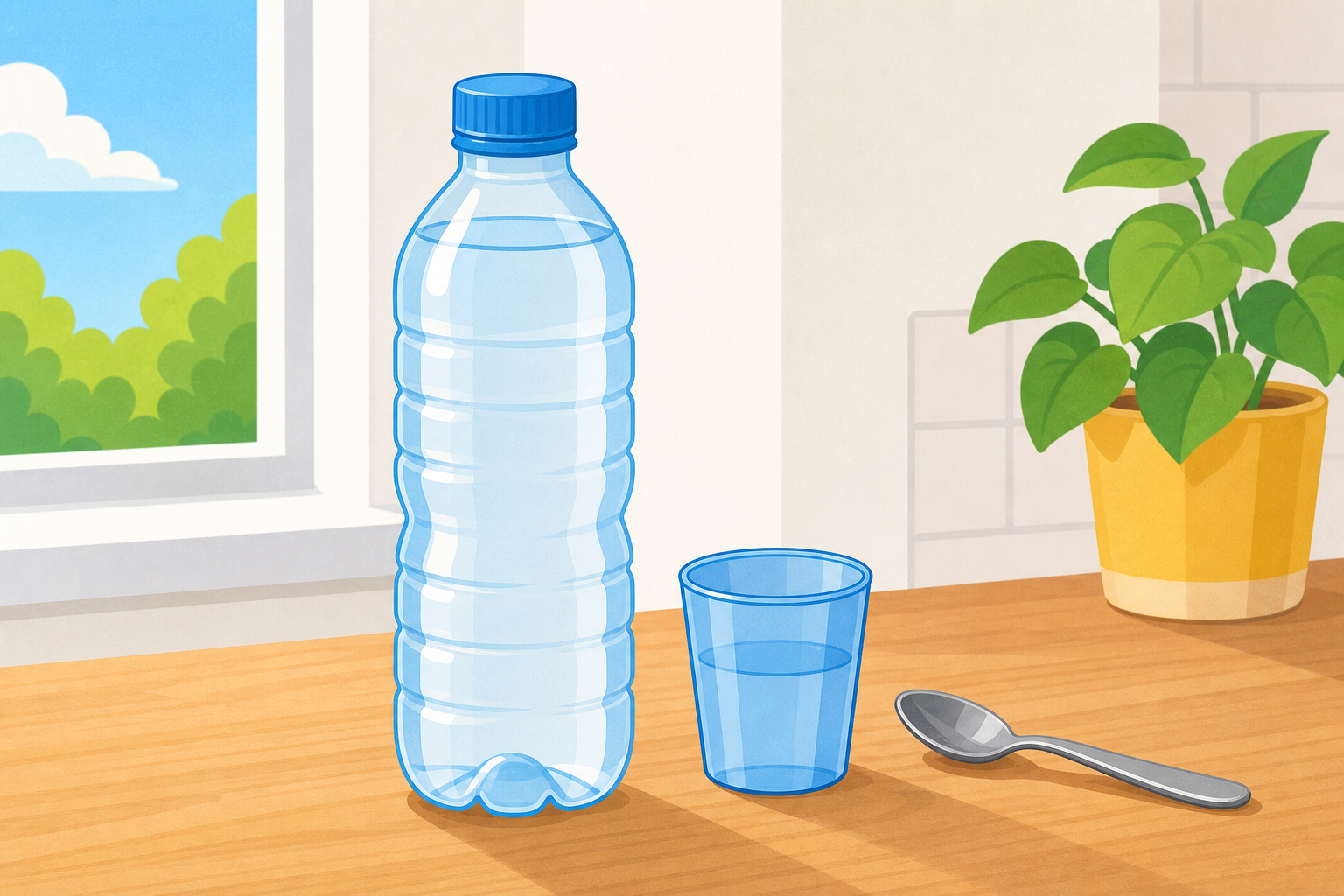
Here is a one-litre bottle of water, a cup and a teaspoon. About how many cups of water do you think it would take to fill the whole bottle?
Display the photo and take three hands-up guesses, not open call-outs. Don't confirm a right answer — the point is to get pupils comparing the sizes of the three containers before any measuring. Which one holds the most? Which holds the least?
Look at four capacity marks on the scales. Each scale is marked in millilitres, and the very top mark is one litre. Notice the level marked on each one, and how five hundred millilitres is exactly half way to the top.
Read each level aloud as the class watches: five hundred millilitres — half full, one litre — right to the top, two hundred and fifty millilitres — a quarter, seven hundred and fifty millilitres — three quarters. Hold out for the big idea: 1000 ml makes 1 litre, so the litre mark and the 1000 ml mark are the same line. Point to the level, not down from the top — mention reading at eye level.
Estimate how much each container holds, then pour it into the measuring jug and read the level in millilitres. If an exact number is hard, a rough guess like about 100 ml or about 200 ml is fine. We measure four containers today, in this order:
Talk this one through together at the water tray — pupils take turns and the class agrees or corrects out loud.
Real containers circulate. Before each pour, take a quick whole-class estimate (write the guess up) so the watching pupils stay with it; then the named pupil pours into the jug and the class reads the level aloud. Revoice the reader's answer each time so everyone hears it. Reconcile any disagreement by pointing to the mark the water sits on. Read at eye level, not looking down. Keep the pouring brisk. Listen for pupils naming millilitres for the small amounts and comparing to the 500 ml halfway line.
In your maths copy, write 1 litre = 1000 ml at the top. Then record four containers, writing your estimate in millilitres or litres first and the jug reading beside it.
Walk the room glancing for the estimate written before the reading, and for ml used on the small amounts. This is whole-class copybook practice, not marking.
Estimate then measure three more containers, in this order: an egg cup, then a mug, then a small lunch flask. Write each reading in millilitres in your copy. As a challenge, work out which two of your containers together would just fill the one-litre bottle.
This is the practice round at the water tray — real objects circulate around the room and pupils measure each one, checking the jug reading with the class before moving on. Keep the pass-on rhythm brisk; the class confirms each reading aloud at the end.
The egg cup is a small ml amount (well under 100 ml) — hold out for the smallest reading. The challenge pushes the 1000 ml = 1 litre link: pupils add two of their readings and check against a litre. Circulate and prompt is that closer to 500 ml or to 1 litre?
You're previewing this lesson. Get full access to this lesson and hundreds more — each one ready to teach, with interactive activities, printable resources and pupil progress tracking built in.