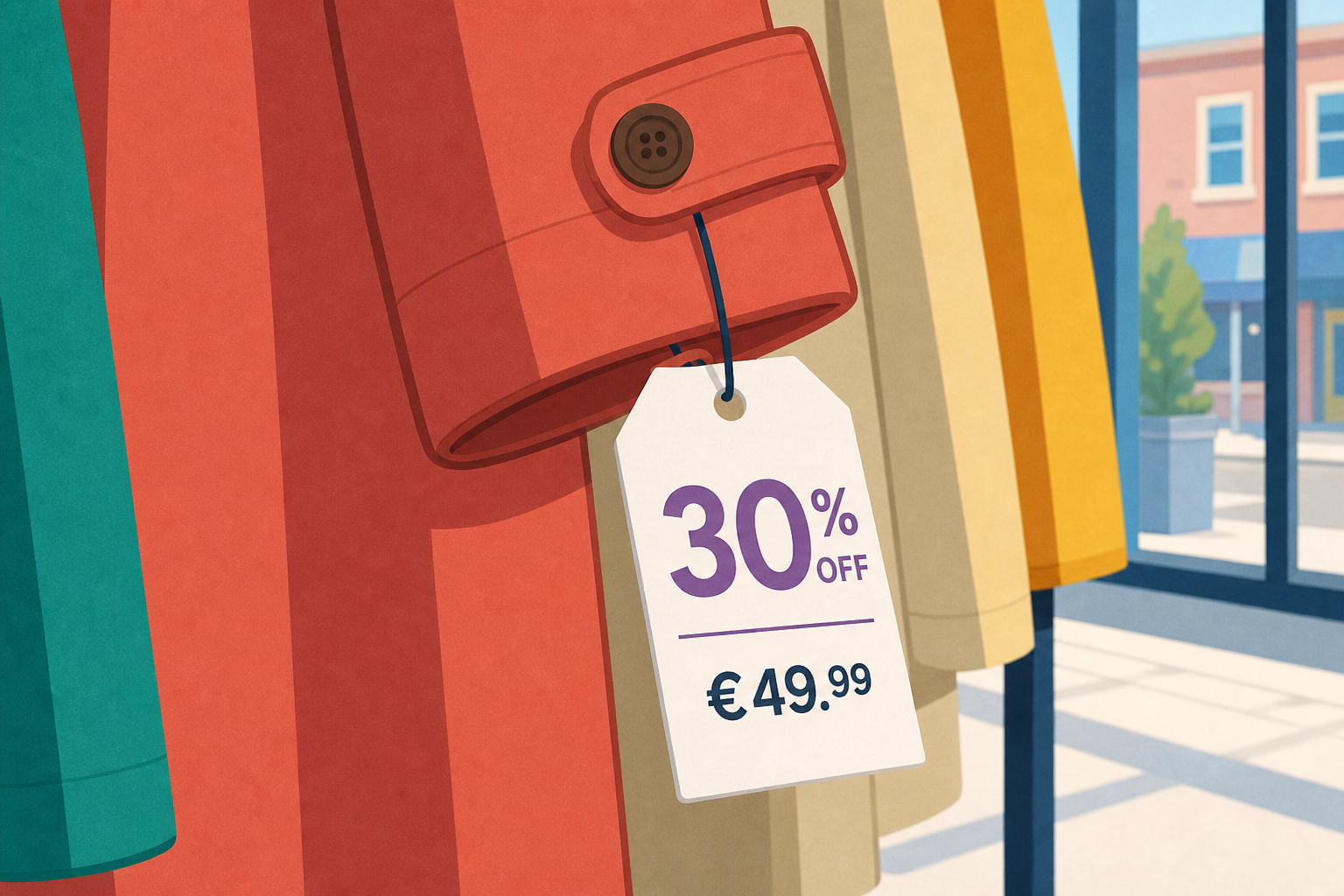
Here is a sale tag from a shop window: 30% OFF a coat priced €50.
Before we work anything out: roughly, do you pay a bit less than €50, half of €50, or nearly nothing? And what is the quickest way you can think of to find the actual price you'd pay at the till?
Take three hands-up estimates, not open call-outs. You want a rough sense ("a bit less than €50") before any method appears. Do not confirm an answer here. If a pupil blurts €35, acknowledge it as a good guess and hold it for checking later.
Look at each price bar split into its percentage parts. Look for where the discount lands, and how much of the price is left to pay. On the last one, notice that VAT is an extra part of the bar, making the total bigger, not taken away.
Now look at VAT going the other way, added on top:
Point at the first bar and hold out for the two names: the part taken off and the part still paid. Ask for the actual euro on each before revealing.
Here are three more price bars, one under the other. The first is a €40 jacket with 20% off. The second is a €120 bill with 10% off. The last is a €30 net price with 23% VAT added on top.
Read each bar together. For every bar, explain how the euro amount of each part comes from the percentage.
Talk this through together as a class, no marking yet — the aim is for everyone to say the euro amounts aloud and agree them against the labels on each bar.
Start with the €40 jacket. The save part is 20% = €8. Ask for the pay part as a percentage first: 20% off keeps 80%, so €32. Revoice it as "take a fifth off, keep four fifths." Then read the €120 bill: 10% = €12 off, pay €108. Finish on the €30 + 23% VAT bar so the class sees the total is more than the net price: €6.90 VAT, €36.90 in total. Watch for pupils who "take 23% off" on the VAT bar, stop and remind them VAT is added on, not taken away.
In your maths copy, for each example draw a price bar split into its percentage parts. Beside each bar write the percentage amount in euro and the final price you'd pay.
Walk the room glancing at whether the VAT bar's added part is drawn above the price, not inside it — that is the whole-class copybook practice, not marking.
Today we work through these together in your copy, each one a step harder:
Work out the price at the till for each shopping situation, showing your discount and VAT working.
Ways to start:
Stretch:
This is the practice round — pupils take turns at the board, check each answer, and the class confirms before moving on. Keep the board work brisk rather than over-explaining.
The first three are the access problems every pupil can begin with the 10%-first method. Hold the fourth for the stretch: the trap is applying VAT to the original €80. Make the class state aloud "the discount comes off first, so the VAT is 23% of €60, not €80." The €60 gives clean figures — 23% of €60 is €13.80 exactly, so nobody has to wrestle a half-cent.
You're previewing this lesson. Get full access to this lesson and hundreds more — each one ready to teach, with interactive activities, printable resources and pupil progress tracking built in.