1 - Introduction ~5 mins
Welcome
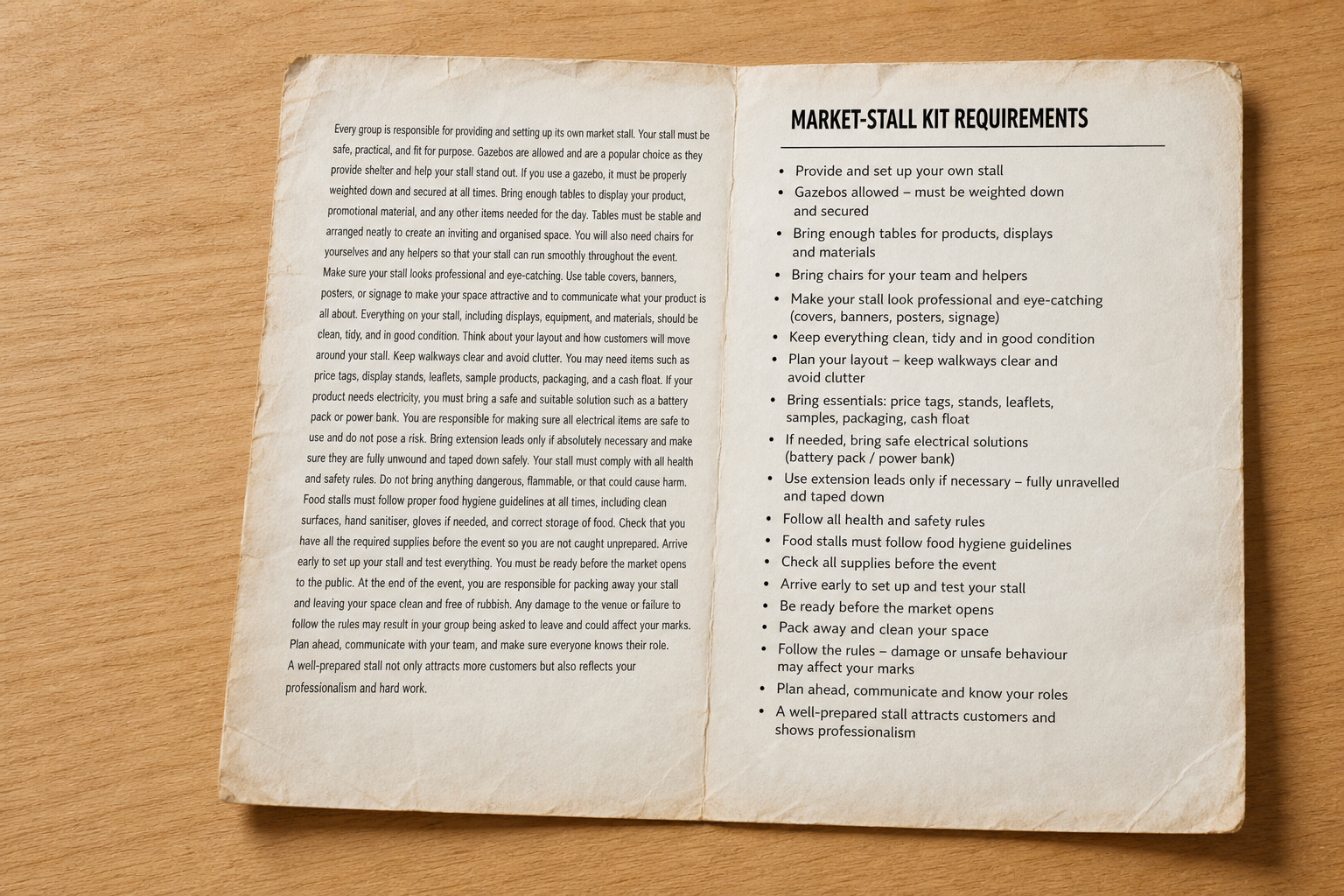 Your proposal already has real paragraphs about purpose, plan, and outcome. Today you learn when a wall of text should become a list, so a supervisor, club treasurer, or placement mentor can scan your points in seconds. Lists are not decoration: they are a readability tool you will reuse in reports, emails, and Student Task write-ups.
If {{code:03_proposal_draft}} is missing or only has story text so far, tell your teacher now. Later you will add a short What I need or First steps section and still complete the lesson.
By the end of this lesson, you will be able to:
- Choose bullets for scannable points and numbers for sequences
- Create indented sub-bullets without overcrowding the page
- Rewrite dense prose as a clearer list where it helps the reader
- Convert one proposal paragraph into a bullet or numbered list in {{code:03_proposal_draft}}
Warm-up
Think of the last long message or notice you skipped because it looked heavy. Would three short bullets have made you stop and read? Hold that answer in mind as you work today.
2 - Key Concepts ~6 mins
Use this table before you touch the document. The goal is not "more bullets". It is the right list type for the job, with enough space that the page still breathes.
| Concept | Why it matters | Example |
|---|---|---|
| Bullet list — unordered points where sequence does not matter | Readers scan equal items faster than a dense paragraph of the same facts | Work Experience pack: notebook, CV, USB |
| Numbered list — ordered steps or ranked items | Order is part of the meaning; numbers stop people guessing what comes first | Three steps to book an Intreo appointment |
| Sub-bullet (nested list) — a detail indented under a main point | Groups detail without a new wall of text, if nesting stays shallow | "Promo routes" then Instagram, noticeboard, Centra counter |
| Death by bullet point — turning almost every sentence into a bullet | Too many lists make a page feel like notes, not a proposal someone would trust | — |
Quick contrast
Materials (equal items) → bullets. First-month sequence (order matters) → numbers. Example: blank tees, vinyl, heat-press access as bullets; design logo → test-print → photograph → post → take orders as numbers.
Three edit moves (how you get from prose to list)
- Split lines with Enter — after you apply Bullets or Numbering, put the cursor after each item and press {{key:Enter}} so each point sits on its own line.
- Delete joining words — remove leftover commas and words such as "and", "then", or "first" so each line is one clean point.
- Bullets vs numbers — equal items with no required order use bullets; a real sequence or ranked order uses numbers. Exit a list with an extra {{key:Enter}} (or {{key:Backspace}} on an empty bullet). Nest one detail with {{key:Tab}}; move back out with {{kbd:Shift+Tab}}.
3 - Step-by-step Task ~20 mins
Follow the steps for your word processor. You will open a short practice document in your Project Portfolio, turn two short kit-and-sequence texts into a bullet list and a numbered list, add one level of sub-bullets, then leave the practice file so you can mirror the same moves on your real proposal.
If typing is slow, paste the practice sentences below (or the version your teacher shares), then focus on the list buttons and Enter splits.
Practice text to paste
Materials paragraph: I need a folding table, a cash box, printed price cards, three sample products, a phone for Tap to Pay, and a simple sign.
Sequence paragraph: Confirm the stall date, pack the kit the night before, set up 30 minutes early, photograph the display, then pack down and count the cash.
Your teacher may call out three mini-goals as you go: (1) bullet kit list done, (2) numbered sequence done, (3) one sub-point under item 1.
4 - Common Issues ~3 mins
Common Issues
| Issue | Solution |
|---|---|
| The whole paragraph became one giant bullet | Place the cursor where each new item should start and press {{key:Enter}}. Delete leftover commas and words like "and" so each line is one clean point. Also remove openers such as "I need a" so each bullet is only the item name. |
| Numbering restarts at 1 in the middle of my list | Right-click the number that restarted and choose the option to continue numbering (wording varies slightly by app). Or delete the break paragraph between items so the list stays one continuous list. |
| {{key:Tab}} moves the whole paragraph instead of making a sub-bullet | You must already be on a list item line. Click the bullets or numbering button first, then press {{key:Tab}} on the new item. Use {{kbd:Shift+Tab}} to move back out one level. If the page jumped, undo with {{kbd:Ctrl+Z}} ({{kbd:Cmd+Z}} on Mac) and try again on a real list line. |
| My page looks crowded with lists everywhere | Keep story and motivation in normal paragraphs. Use lists only for materials, steps, options, or short scannable facts. One or two lists per page of a short proposal is usually enough. |
5 - Independent Practice ~15 mins
Independent Practice
Working file: {{code:03_proposal_draft}} only. Leave {{code:03_list_practice}} closed.
Before you edit, check: materials, steps, options, or outcomes (not motivation or story); bullets if equal items; numbers if order matters; nest only one detail line if needed.
- Open your Project Portfolio folder (and {{code:03_documents}} if you use it), then open {{code:03_proposal_draft}}.
- Pick one paragraph that is materials, steps, options, or outcomes.
- Choose bullets if the items are equal, or numbers if order matters.
- Convert it with the same Enter-and-clean moves as the market-stall practice. Keep surrounding text as normal paragraphs.
- Fallback: if nothing fits yet, add a short real section headed What I need or First steps as ordinary sentences about your Something Real project, then convert that new section into a list.
- {{code:03_proposal_draft}} still opens from your Project Portfolio and clearly shows your Something Real project
- At least one former paragraph is now a bullet list or numbered list that is easier to scan than the original prose
- The list type matches the content (bullets for equal points, numbers for a real sequence)
- The page is not overcrowded: nesting stays shallow and nearby text still reads as proper paragraphs
- Your teacher can open {{code:03_proposal_draft}} and see the new list without opening {{code:03_list_practice}}
Unlock the full learning experience
You're previewing this lesson. Get full access to this lesson and hundreds more — each one ready to teach, with interactive activities, printable resources and pupil progress tracking built in.
This lesson is copyright of Coding Ireland 2017 - 2025. Unauthorised use, copying or distribution is not allowed.