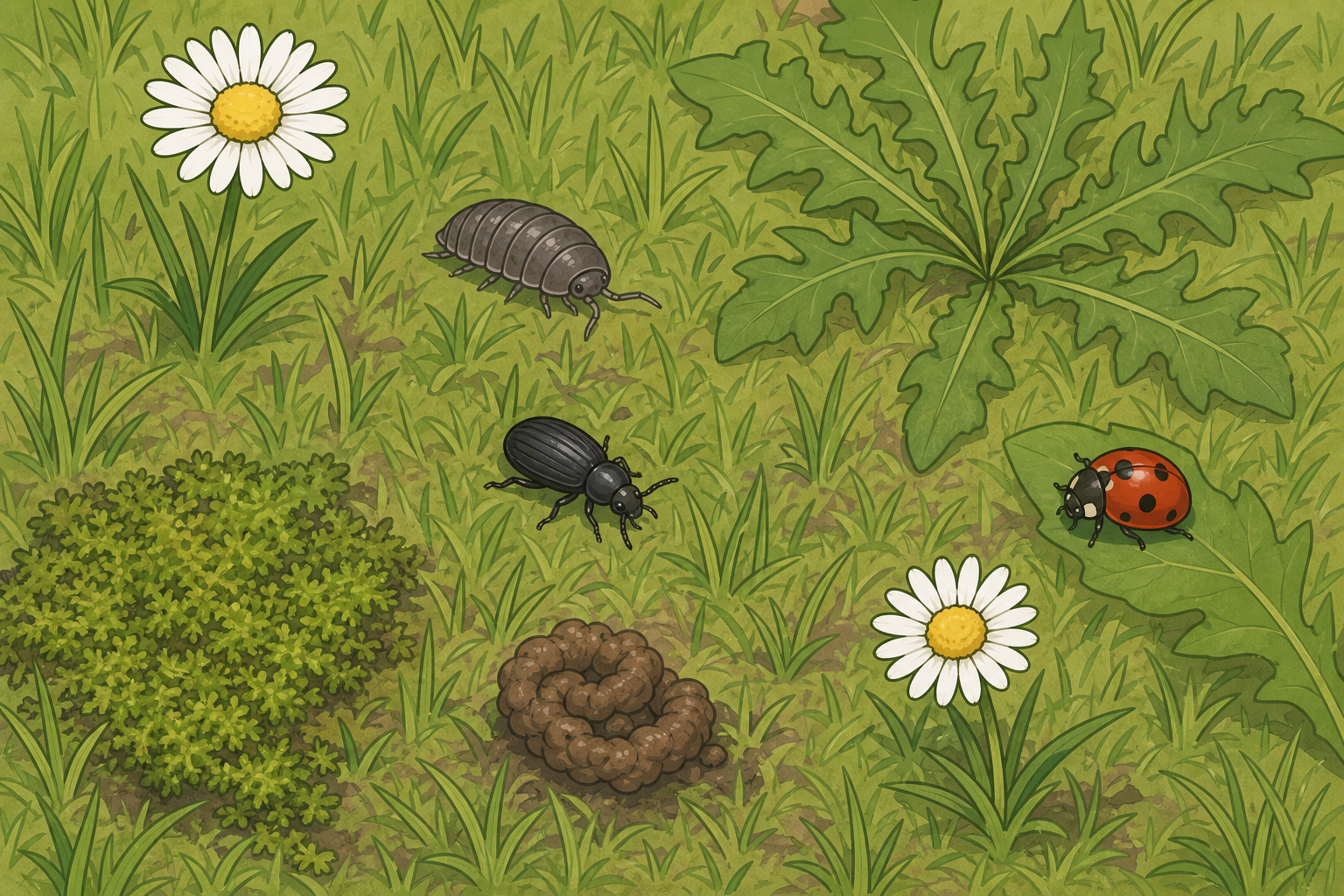
If we wanted to know how much life is really in our school grounds, how could we find out without counting every single creature?
Talk with a partner for thirty seconds. What would you look at first?
Keep this beat light. Do not hand out hoops or ID sheets yet. Take three or four quick ideas, then name the puzzle: scientists cannot count every living thing on a whole site, so they sample carefully and compare spots.
Bridge: today we work like ecologists. Before anyone plants a wild corner or builds a bug hotel, they survey what already lives there. That survey is called a biodiversity audit, and it is Part 1 of our school-grounds project.
Have coats and outdoor shoes ready for later, but stay in the classroom for the next two steps.
Biodiversity means how many different kinds of living things share a place.
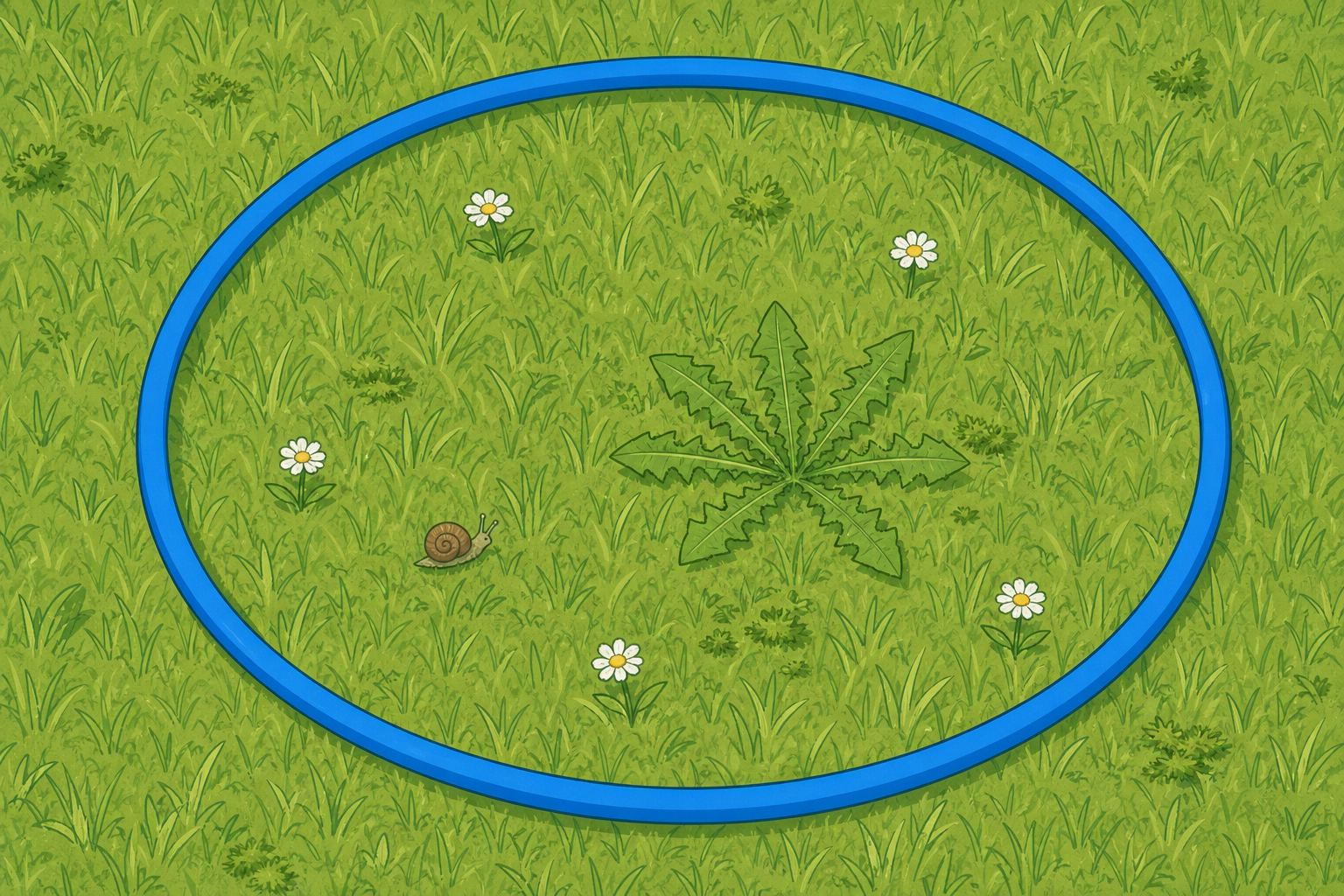
A microhabitat is a small spot with its own conditions, like under a log or on open grass.
Talk with a partner for thirty seconds: why sample two spots instead of only one favourite corner? Be ready to share one idea.
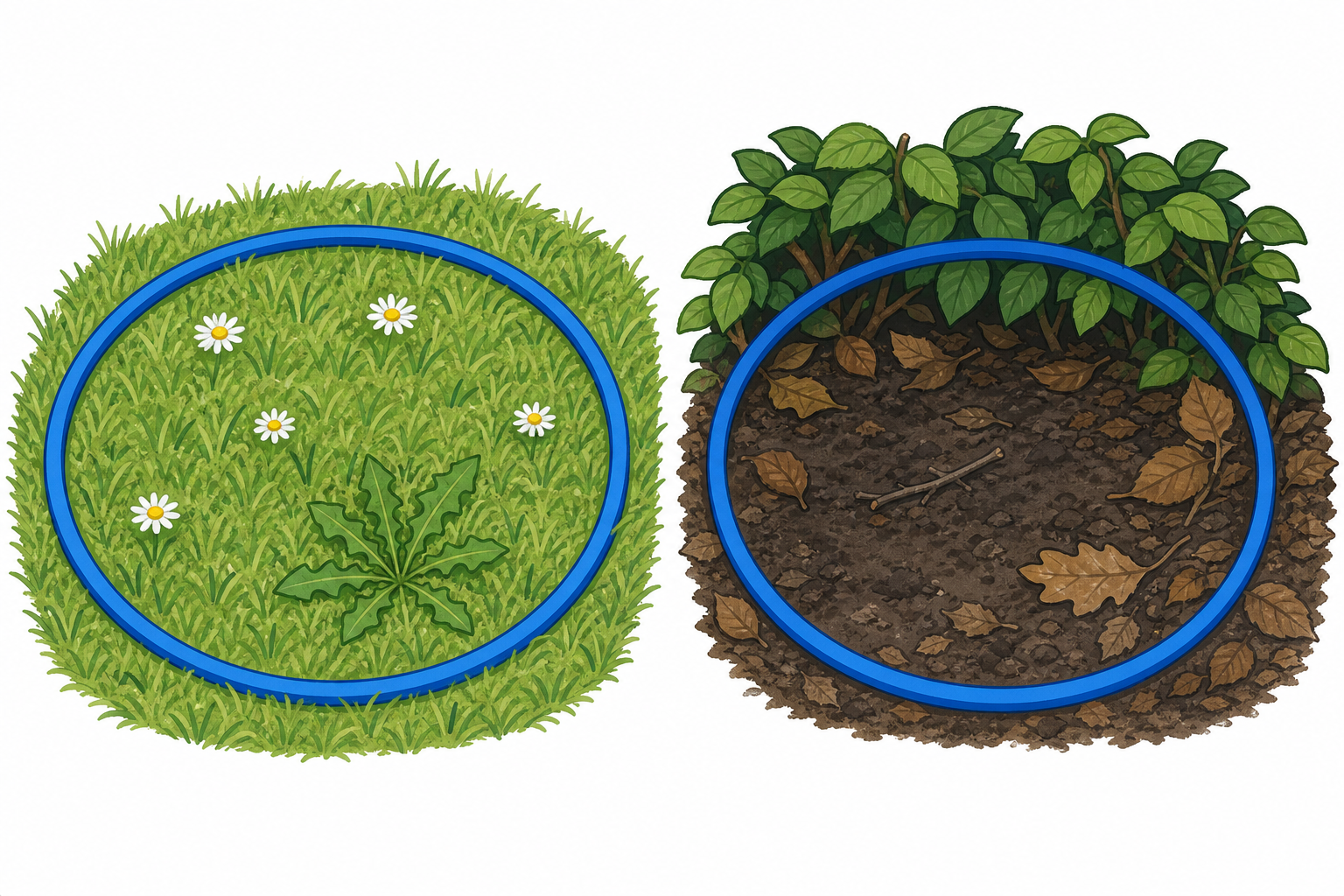
Watch the hoop model. A quadrat survey means we look inside the same-sized hoop in more than one spot so the comparison is fair.
Project only the short board text. Use the table below yourself; do not project the whole table.
Three words to land today: biodiversity, microhabitat, quadrat survey. Treat community lightly as a look-ahead word (living things that share a place and depend on one another). Pupils will ground that idea from their own tallies in the closing talk, not master a full definition now.
| Concept | Why it matters | Example |
|---|---|---|
| Biodiversity — the variety of living things in a place (how many different kinds, not only how many individuals) | A place can look green yet hold few kinds of life; variety is what we measure when we audit | A wild corner with daisies, woodlice, ants and a spider is more biodiverse than bare tarmac with one weed |
| Microhabitat — a small place inside a bigger habitat with its own dampness, light or shelter | Different conditions suit different living things, so one school field is really many mini-homes | Under a log is cooler and damper than open grass a few steps away |
| Quadrat survey — sampling life inside the same-sized hoop or square in more than one spot | Same sample size keeps the comparison fair, the way scientists survey a site before they act | One hoop on grass and one under a hedge, counting kinds inside each |
| Community — living things that share a place and depend on one another (look-ahead) | An audit is a first look at who lives where; later we link who relies on whom | Plants feed plant-eaters; spiders feed on smaller animals; rotting leaves feed woodlice |
Protect this beat: the carpet hoop model is non-negotiable before outdoor work. If the clock runs long, cut the partner share-back to one quick idea (or skip the share-back and move straight into the model). Do not shorten the model itself.
After a brief partner talk (optional share-back of one or two ideas on why two spots beat one favourite corner: fair comparison, different conditions, avoiding a lucky or unlucky single drop), run the model.
Misconception to head off: pupils often think biodiversity means "lots of animals" or "the biggest creature". Steer them to kinds. Ten woodlice of one kind is less varied than four different kinds with fewer individuals.
Nature of STEM: say plainly that this is how ecologists work in Ireland before a habitat project. Groups such as those linked to the All-Ireland Pollinator Plan start with what is already living on a site, not with a guess.
Modelled survey cycle (do this on the carpet or desk with one hoop so every pupil sees the method before going out):
Name the method as a quadrat survey while you model it. Optionally add one line: the living things that share a place form a community; we will notice who might need whom when we look at our finds later.
That full cycle is what groups will run outside on real ground.
Our question: which sample spots in our grounds hold the most variety of living things?
In your group, choose two different microhabitats you will survey (for example open grass and under a hedge). Predict which will have more kinds of living things, and say why.
On your Investigation Journal page, write the two spot names, leave a clear tally space for kinds at spot A and spot B, and note your prediction before we go out.
Show the outdoor map or simply name the allowed zones (garden, hedgerow edge, grassy patch, wall base). Groups pick two contrasting spots within the safe boundary. That choice is their design decision for Part 1.
Before anyone leaves the room, every group must have on the journal page:
You do not design the journal layout; say the headings aloud and check each group has those three things ready. Outdoors, one clipboard per group holds the recorder's journal page as the working group tally.
Predictions are never wrong; they start the science.
Differentiation: less confident groups may use your two suggested pairings (grass vs hedge edge). Confident groups may add a third spot if time allows later, but the core task is two fair hoop samples.
Outside, work in your group at the two spots you chose.
At each spot: place the hoop the same way, look carefully for one full minute, use the ID sheet to name what you find, and tally each kind on the group journal page on the clipboard. Move gently, put any minibeast back where you found it, and stay inside the boundary.
Keep the demo short: groups already saw the carpet model. Outside you only restate fair-sample rules and show one real drop.
One clipboard per group holds the group recorder's Investigation Journal page. That page is the working outdoor tally (spot A kinds list, spot B kinds list). Other group members spot, call names from the ID sheet, and help time the minute. Back in class, every pupil copies the group tallies onto their own journal page and finishes the close-out fields.
If a group has no spare clipboard hand, the recorder can write on a stiff card or plain paper under the same headings and transfer later — but the headings must match what was set in the predict step.
At the edge of the grounds, demonstrate one hoop drop so every group sees the outdoor method: same hoop size, look for one timed minute, only count inside the hoop, use the ID sheet, tally kinds (and a rough count of individuals only if useful as an extra note).
Fair-sample rules to keep saying: same hoop, same looking time, gentle hands, no chasing creatures in from outside the hoop. Look first. Only lift a leaf or log edge carefully if needed, then replace it. Do not pick up centipedes.
What "kinds" means on the tally: woodlouse, spider, ant, earthworm, snail, beetle, ladybird, centipede, slug, plant types they can name (daisy, grass, nettle). Unknowns go as "unknown A / B" with a tiny sketch, not a forced wrong name.
Each card below is the exact text pupils read outdoors. Put the title "Minibeast ID sheet" at the top, then these cards in order.
Card 1 — Woodlouse: grey or brown, oval, hard plates, seven pairs of legs; often under logs or stones; rolls or runs when lifted.
Card 2 — Spider: eight legs, body in two parts; may sit on silk or run across leaves; not an insect.
Card 3 — Ant: small, six legs, clear head-middle-rear; often in busy trails on soil or paving edges.
Card 4 — Earthworm: long, soft, no legs; pink or brown; in damp soil or under leaf litter.
Card 5 — Snail: soft body with a coiled shell; leaves a slime trail; on leaves, walls or damp ground.
Card 6 — Slug: soft body like a snail but no shell; on damp soil or leaves after rain.
Card 7 — Beetle: hard wing cases meeting in a straight line down the back; six legs; on soil, bark or flowers.
Card 8 — Ladybird: round beetle, often red or yellow with spots; on leaves hunting small insects.
Card 9 — Centipede: many legs, long flat body, moves quickly; under stones or logs; watch only, do not pick up.
Card 10 — Caterpillar: soft, many short legs, often on leaves; will become a moth or butterfly later.
Remind: wash hands after; no tasting plants; mind nettles and brambles; return every living thing; adult eyes on the boundary. Collection pots are optional for a brief look only, then release on the same spot.
If the grounds are very quiet: count plant kinds inside the hoop as well (grass, daisy, clover, moss, dandelion). Variety of plants still answers the audit question and feeds the food-web talk later in the project.
Teacher circulation look-fors: groups timing both spots the same way; tallies listing kinds not only totals; gentle release; prediction still visible on the journal; recorder writing under spot A and spot B.
Back in the classroom with coats off, open your group tally from outside.
Be ready to share your two spot names and the number of kinds in each when we pool on the board.
This beat runs indoors after return. Coats off, group tallies open (the outdoor recorder's page or the plain-paper transfer). Keep it brisk. Do not ask groups to rebuild messy pages before they can talk — the compare rests on the kind-counts already on the outdoor tally.
Pace the four bullets one at a time with a short pause after each so groups rehearse before whole-class share. Do not read them as one dense sentence.
Key questions (same order as the board):
Observation vs inference: "We saw four kinds under the hedge" is observation. "So the hedge is a better home because it is damper" is inference. Both matter; they finish separating these on the journal in the next step.
Dependence prompt (keep living things clear): pupils may name two living things, or one living thing and a resource it uses. Prefer at least one living–living pair when they can point to both on the tally (ladybird and small insects on leaves; spider and smaller minibeasts; plant and plant-eater). Woodlice and rotting leaves is fine if you label rotting leaves as a resource, not as a second living thing. This grounds the community idea in their own audit, not a lecture.
If one group's two spots match, that is still data. Ask what they would try next time.
The full oral share for the board pool is only two numbers plus spot names; the condition and dependence ideas stay in group talk and the journal finish, unless you invite one or two examples aloud.
You're previewing this lesson. Get full access to this lesson and hundreds more — each one ready to teach, with interactive activities, printable resources and pupil progress tracking built in.