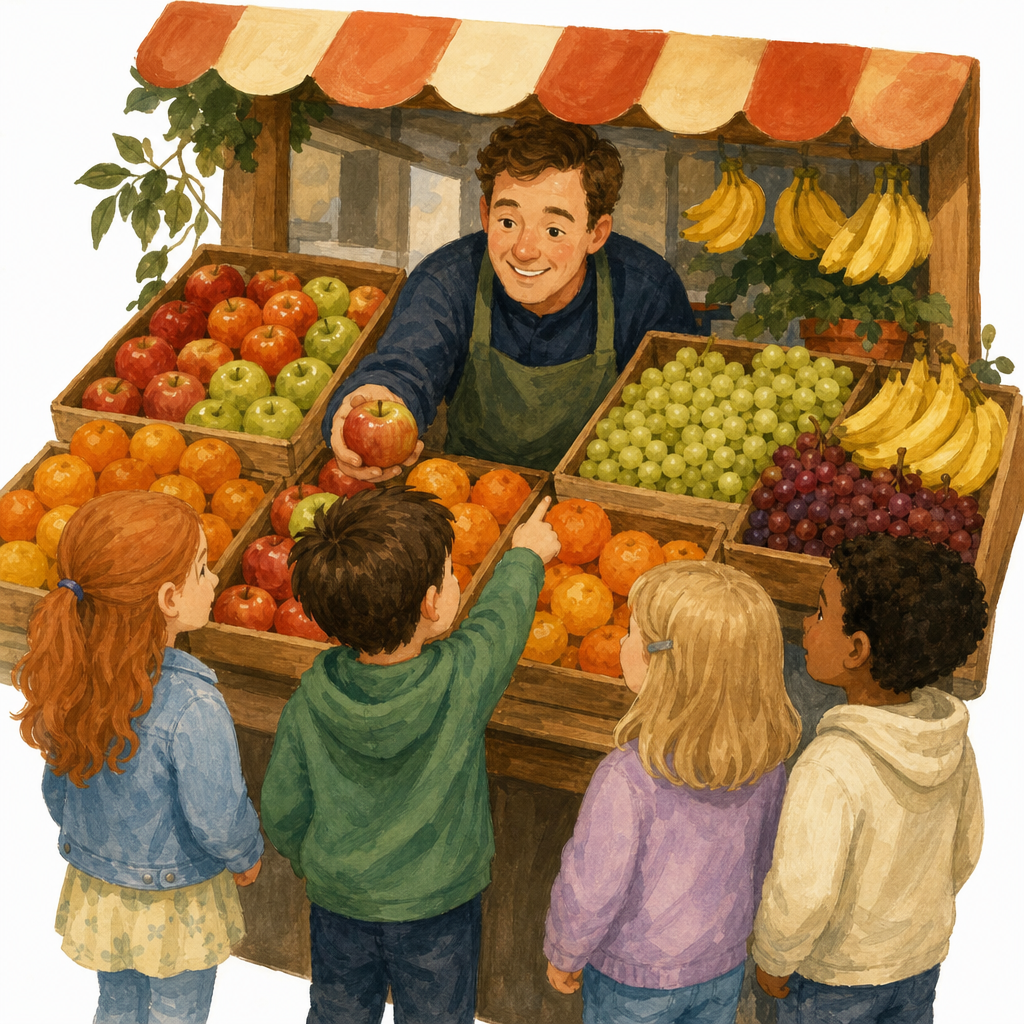
 Picture a busy neighbourhood mercado in Spain. You stop at the frutería counter and nobody speaks English. You need fruit for home. What do you actually need to say: the name of the fruit, how much you want, and a polite please?
By the end of this lesson, you will be able to:
- Name eight fruits in Spanish
- Ask for two of something and a kilo of something
- Make a short polite market request
Listen to each fruit on the table, then say it back together with la, el or las. We will meet them in two groups of four.
After dos or un kilo de, drop el/la/las and use the plural fruit word.
- Quiero dos manzanas, por favor (I want two apples, please)
- Un kilo de naranjas, por favor (A kilo of oranges, please)
Plurals for shopping: manzanas · plátanos · naranjas · fresas · limones · uvas · peras · melocotones
Listen carefully and mark each fruit as you hear it on your card. When every fruit on your card is marked, call Bingo! Say the Spanish quietly to yourself each time you mark a square.
Open your copy. Before you write, say both buying lines once more with the class. Then fill the gaps, choosing two different fruits from the plural bank on the board:
- Quiero dos ______, por favor
- Un kilo de ______, por favor
Keep accents careful. Prefer manzanas, plátanos, naranjas, peras or limones for your free choice if you are unsure.
- la manzana — apple
- el plátano — banana
- la naranja — orange
- la fresa — strawberry
- el limón — lemon
- las uvas — grapes
- la pera — pear
- el melocotón — peach
First, practise in pairs. Partner A is the shopper and reads one of the two buying lines from the board, choosing a fruit from the list of shopping plurals beside it. Partner B is the seller and answers only ¡Aquí tiene! (Here you are!). Swap roles once.
Then spin the wheel. When it lands on a fruit, that pair (or pupil) makes a full polite request using Quiero dos …, por favor or Un kilo de …, por favor. The class listens for a clear plural and a polite ending. The seller replies ¡Aquí tiene!, and the shopper can add Gracias.
Unlock the full learning experience
You're previewing this lesson. Get full access to this lesson and hundreds more — each one ready to teach, with interactive activities, printable resources and pupil progress tracking built in.
This lesson is copyright of Coding Ireland 2017 - 2025. Unauthorised use, copying or distribution is not allowed.