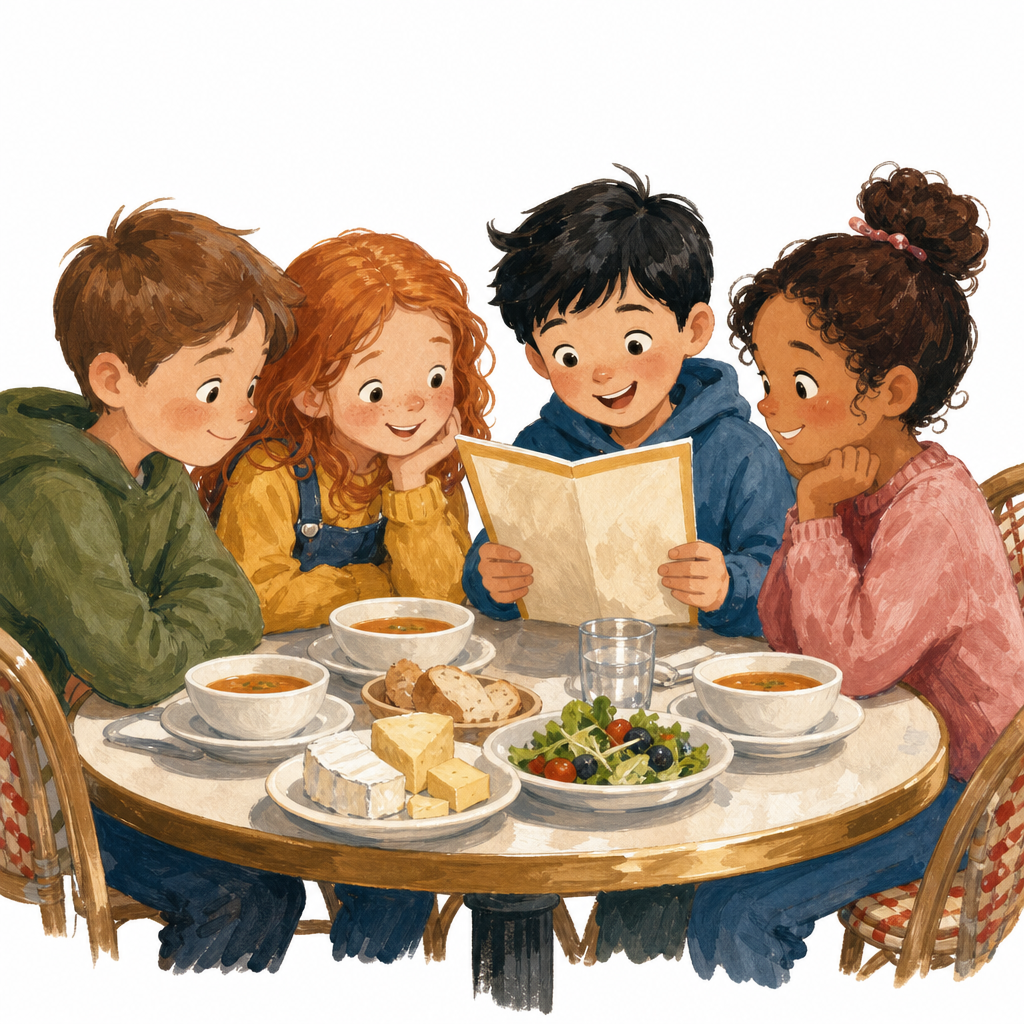
Imagine you are sitting in a French café. The menu is all in French and you cannot read a word. What would you order?
Take a moment to think. Today you will learn eight food words so you can recognise them on a menu and follow a short spoken order. By the end you will not be pointing helplessly at the menu: you will know eight foods by name, article and all.
Collect four or five quick answers about what pupils would order by pointing or guessing. Keep it light and do not teach any French yet; the word-table in the next step does that work. If someone already knows a food word from home or a trip, smile and park it until the list appears. The café hook is the energy of the lesson: smile at the helpless-menu idea and promise that eight words will change that.
Here are today's eight food words, in two sets of four. Listen to each word, then say it back together. Watch which ones take le, which take la, and which take les. You learn the article with the word, as a pair.
You tap each word on the IWB so the class hears the audio; pupils listen and repeat from their seats. Work in two sets so the load stays light.
Set A (hear–say each word twice: once all together, once by table): le pain (luh PA(n)), le fromage (luh fro-MAHZH), le poulet (luh poo-LEH), le sandwich (luh sahn-DWEESH). Quick thumbs-up check: hold up 1 finger for le, 2 for la, 3 for les as you call each word at random from Set A.
Set B (same pattern): les pâtes (lay PAHT), la soupe (lah SOOP), le gâteau (luh gah-TOH), la salade (lah sah-LAHD). Then a fast mix of all eight before you leave the step.
Point at the article every time you say the word so the pairing sticks. The zh in fromage is the fun one: get them to exaggerate fro-MAAZH once for a laugh, then settle it. Notice also the nasal n in pain.
First we warm up our ears with a few short orders, then you will hear a full order in a French café. Listen all the way through twice before you answer anything, then choose the best answers about what was ordered.
Before the lesson: open the listen-answer activity once on the IWB (scenario: ordering-food) and jot the on-screen questions and correct answers on a sticky note. That is your answer key for class.
Bridge (about 2 minutes): with the word-table still visible, say these short frames; the class echoes each one chorally (no writing):
Then play the full café-order clip twice on the class speakers with nobody answering yet. After the second play, let pupils work through the on-screen questions. Go through the answers together using your sticky-note key and replay any line that caused trouble straight away.
Foods from today's list to listen for: le pain, le fromage, le poulet, le sandwich, les pâtes, la soupe, le gâteau, la salade. Not every word may appear in the clip; pupils listen for whichever of these they hear. Remind them they are listening for food words they just met, not every single word in the clip.
Open your copy and write the three foods from today you would most like to eat, with their articles, and one you would not. Take care with the accents on pâtes and gâteau.
Pause the board. Everyone writes: this is the only three minutes where every pupil's pen is moving. Keep the word-table on screen while they copy. Check that the article is going in front of every word; a bare noun will not carry the gender pairing. Do not collect these.
This is a French school lunch tray (a cantine tray): starter, main and a little something sweet, all laid out. The labels are missing. Volunteers place the correct French word on each dish on the board. While a volunteer labels, everyone else holds up fingers for the article (1 = le, 2 = la, 3 = les) and whispers the full pair.
Run this on the IWB with volunteers. State the seated job clearly before the first label: fingers for the article, whisper the full pair. If a label is placed wrong, say the correct pair together (article plus noun) before moving on. Celebrate a clean first label out loud: Bravo, le fromage is on the board. This is recognition after listening, so keep the pace steady rather than racing. Ground the scene as a French cantine tray or bistro plat du jour, not a generic plate.
You're previewing this lesson. Get full access to this lesson and hundreds more — each one ready to teach, with interactive activities, printable resources and pupil progress tracking built in.