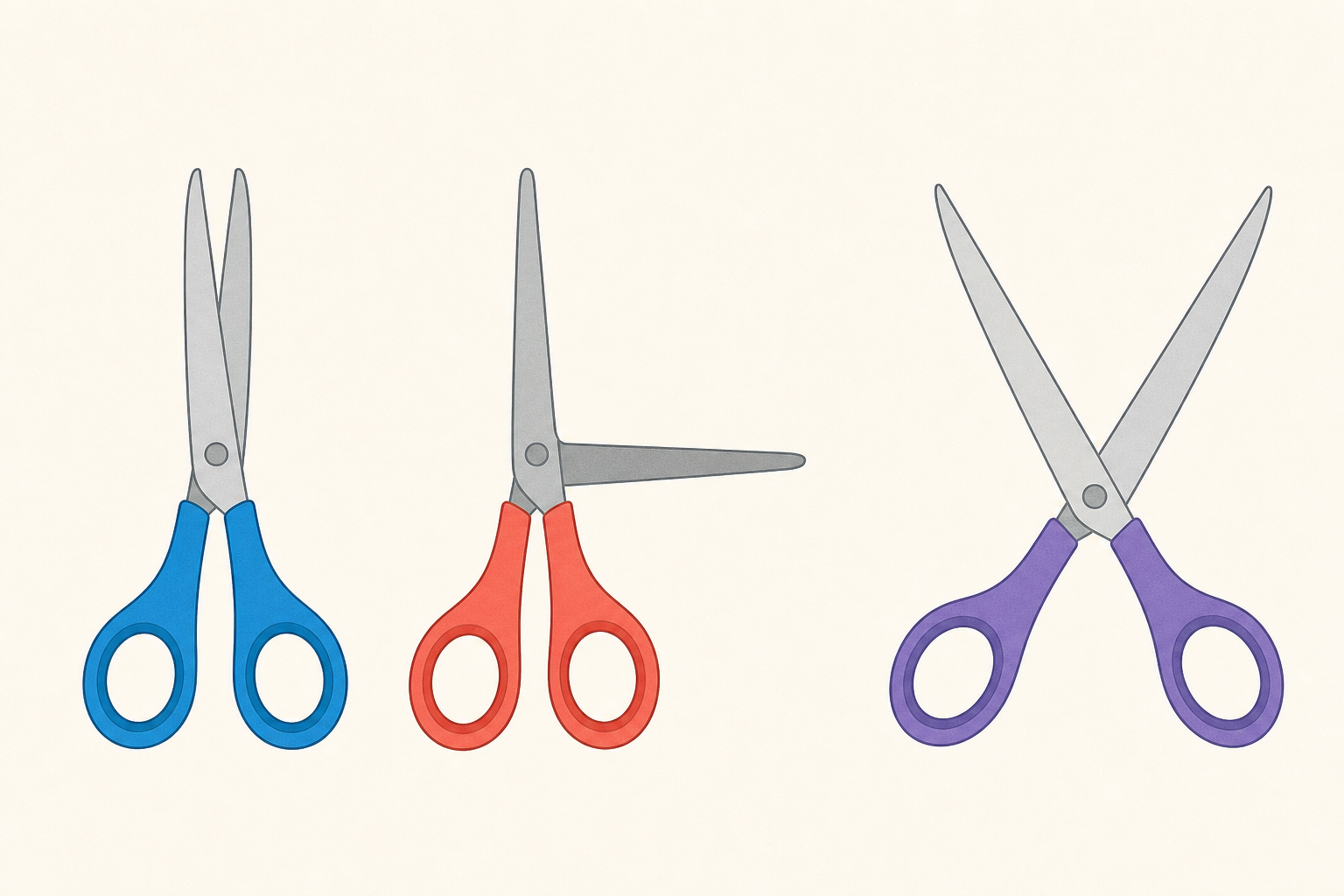
A square corner is the corner of your page or your book — that neat, straight corner. Watch these scissors as they open: first just a little, then out to a square corner, then really wide.
Which opening is bigger than a square corner, and which one is smaller?
Hold up the corner of a book and say the words aloud first: this straight corner is a square corner. Then open a real pair of scissors slowly to three positions: a narrow opening, a square-corner opening, then a wide opening. Take two or three hands-up answers only — don't settle the argument yet, the tester in the next step is how the class decides.
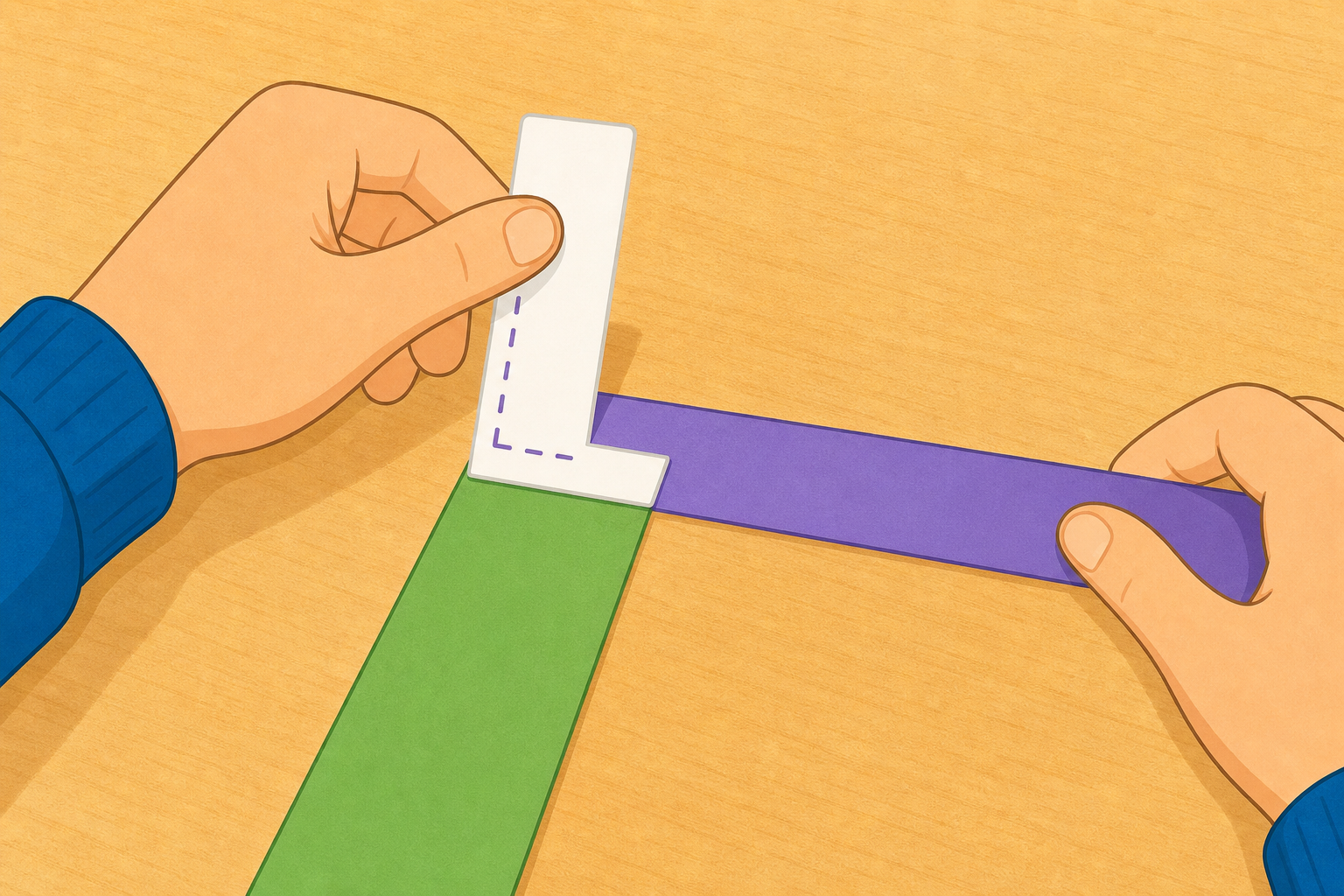
Here is our paper right-angle tester. It fits a square corner exactly.
Watch what happens when we hold it against three different openings. Look for whether the opening is narrower than the tester, fits it exactly, or is wider than it.
Fold an A4 sheet in half, then in half again, to make a sharp right-angle corner tester. Model four holds, working the discovery live — do not narrate the answers before the class predicts:
Three buckets only: smaller, exactly, bigger. No degrees, no protractor. Keep the pupil words 'smaller / bigger than a square corner'.
Today we sort angles into three groups on the board: smaller than a right angle, a right angle, and bigger than a right angle.
We'll sort the easy ones first, then test one that is very close to a square corner.
One pupil drags on the board. Everyone else, decide the group in your head, and thumbs up when you agree.
The IWB drag-sort is the canonical delivery here. If you have printed angle cards and a paper tester, you may run the same sort with physical cards on the board as an optional upgrade — but the interactive alone is enough; you do not need the cards.
Talk this one through together — pupils take turns at the board and the class agrees or corrects out loud.
Before a pupil drops each card, ask the class to predict with the paper tester in mind. Save the near-right-angle card for last — that is the one where the tester really earns its keep. If a pupil drops the near-square card wrongly, don't correct it yourself; hold the paper tester to the board card and let the class see the fit.
In your maths copy, draw one angle that is smaller than a right angle and one angle that is bigger than a right angle.
Label each one: write "smaller than a square corner" beside the first, and "bigger than a square corner" beside the second.
Walk the room glancing at the two openings and the labels — this is whole-class copybook practice, not marking. Watch for pupils who make both angles the same width; nudge them to open one clearly wider than the other.
Now sort these yourself.
The last one is very close to a square corner — test it carefully with your paper tester.
This is the practice round — pupils take turns at the board, check each answer, and the class confirms before moving on. Keep the board work brisk rather than over-explaining.
On the near-right-angle round, hold the paper tester up before the class calls it. On the final mixed round, let a pupil sort all four, then the class checks each drop in turn. Callout to weave in: when an angle is nearly a square corner, use the paper tester before you decide.
You're previewing this lesson. Get full access to this lesson and hundreds more — each one ready to teach, with interactive activities, printable resources and pupil progress tracking built in.