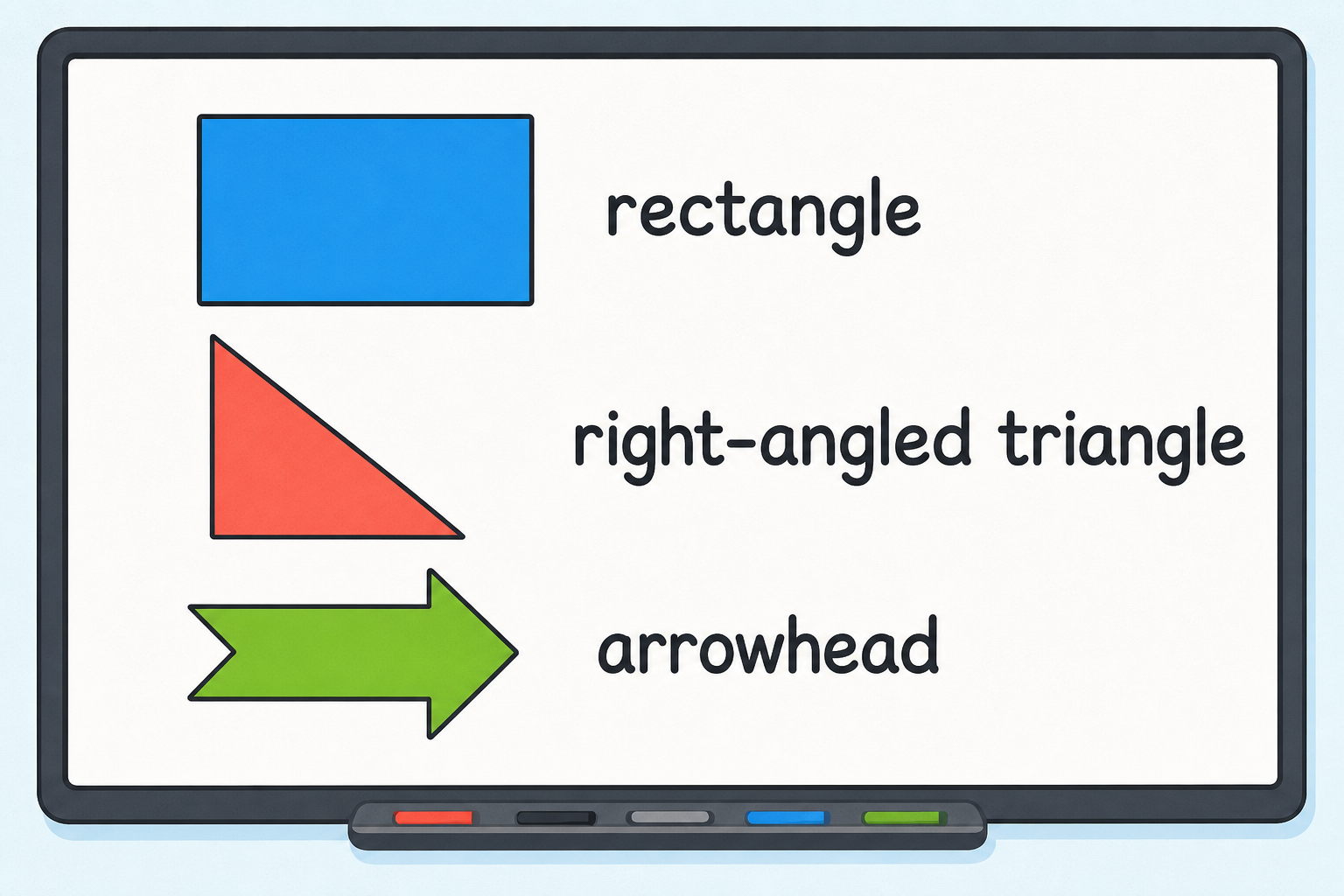
On the board are three shapes, each with its name beside it: a rectangle, a right-angled triangle, and a wide arrowhead. Look only at their corners.
First: which shape has square corners, like the corner of your copybook?
Now hold that square corner in your mind and look again. One shape has a corner that opens out further than a square corner does. Which shape is it, and which corner do you mean?
Show the three labelled shapes on the IWB at a size readable from the back so every pupil can see the corners. Take three hands-up answers to the first question, then three to the second, not open call-outs. Steer the class to look at the corners, not the number of sides. Hold the corner of a book against a rectangle's corner so they feel what a 'square corner' means before any naming. Then settle the second question out loud before moving on: it is the arrowhead, at one of its outward points, and that wider-than-square corner is the one we will call obtuse in a moment. Do not leave it hanging.
Note on the arrowhead: the wide open corner they should look at is one of the two outward points. The arrowhead also has an inward notch (a corner that folds back into the shape) — do not point the class at the notch. That inward corner is a reflex corner and the right-angle checker cannot measure it sensibly, so keep all attention on the outward points.
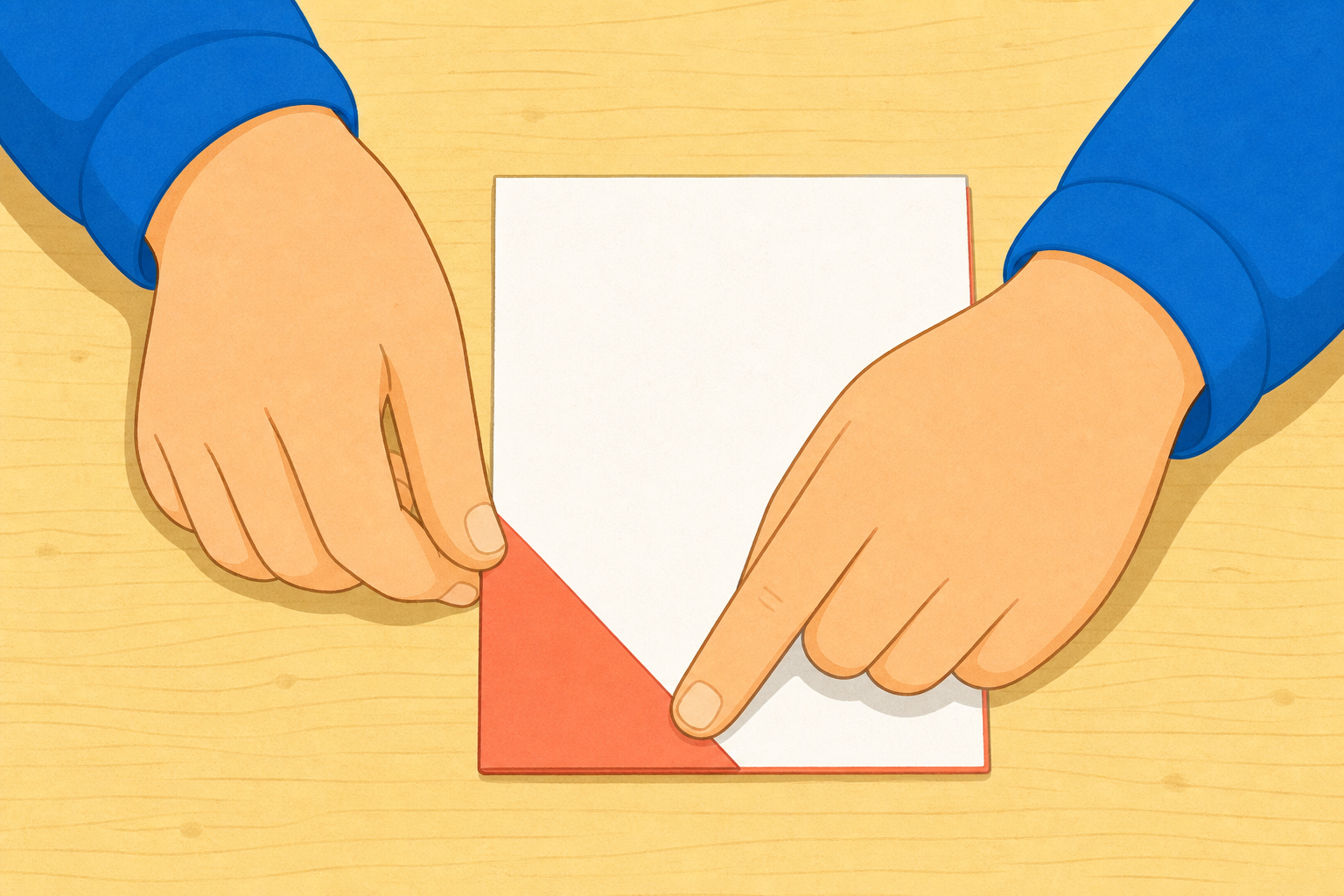
We will test the corners of real paper shapes with a folded-paper corner that makes an exact square corner. Every time we push it into a corner, ask one question: does it fit exactly, or is the corner smaller, or wider? Watch the fit at each corner and be ready to say acute, right or obtuse.
Fold makes an exact right angle. Same question at every corner: does the square corner fit exactly? Fits exactly = right angle; gap too small for the checker = acute (sharper than the copybook corner); checker slips in with room to spare = obtuse (wider open).
Let the class call acute / right / obtuse before you confirm.
Square: all four fit exactly, every corner a right angle.
Right-angled triangle: one fits exactly (right angle), other two smaller and sharper (acute).
Equilateral triangle: all three smaller and sharper (all acute).
Arrowhead: test only an outward point — wider open than the square corner (obtuse). Let them predict before you confirm.
Do not test the inward notch — it is a reflex corner that folds back and gives a misleading reading. If asked, say we only test corners pointing outwards today.
Push the checker into each corner, and name what you find: acute, right or obtuse.
Now we test corners together. Each of you has your own paper shapes and a folded paper corner.
We will work through the same five shapes:
Say what you expect each corner to be before you test it.
Pupils test at their own desks with their own paper shapes and folded right-angle checkers, working through the five shapes in the order on the board. Circulate and catch alignment slips on the spot. Call each shape in turn so the whole class stays roughly together, and take a few hands-up answers to name each corner aloud, reconciling any disagreement as you circulate.
Arrowhead notch: on the arrowhead, tell pupils to test only the two outward points, not the inward notch. The notch is a reflex corner and the checker gives a misleading result there — watch for pupils trying to push the checker into the inward corner and redirect them to the outward points.
Watch for two slips: pushing the checker in crooked (so a right angle looks acute), and calling a corner 'right' just because it looks tidy without testing. Revoice a strong answer: so a shape can have some right corners and some acute corners at the same time.
In your maths copy, draw a square and a triangle. Inside each corner, write whether it is acute, right or obtuse. Use the corner of your copybook as a right-angle checker if you are not sure.
Walk the room glancing at the corner labels — this is whole-class copybook practice, not marking. Look for pupils using the copybook corner to test rather than guessing from how the corner looks.
Testing round. Use the folded paper corner on your shape cards to find:
Find a triangle with one right angle and explain how you know.
This is the practice round. Each pair has its own small set of shape cards, so pupils test near-continuously rather than waiting for a set to reach them. The class confirms the findings aloud at the end.
If an arrowhead card is in the set, remind pupils to test its outward points only, not the inward notch. Watch for the count-the-right-angles task: a pupil who says 'four' should be able to point the checker at each of the four corners in turn. On the stretch, listen for a pupil naming that the right angle is the make-or-break corner: a right-angled triangle has exactly one right angle and the other two are acute. Revoice: you tested it, you didn't just look at it.
You're previewing this lesson. Get full access to this lesson and hundreds more — each one ready to teach, with interactive activities, printable resources and pupil progress tracking built in.