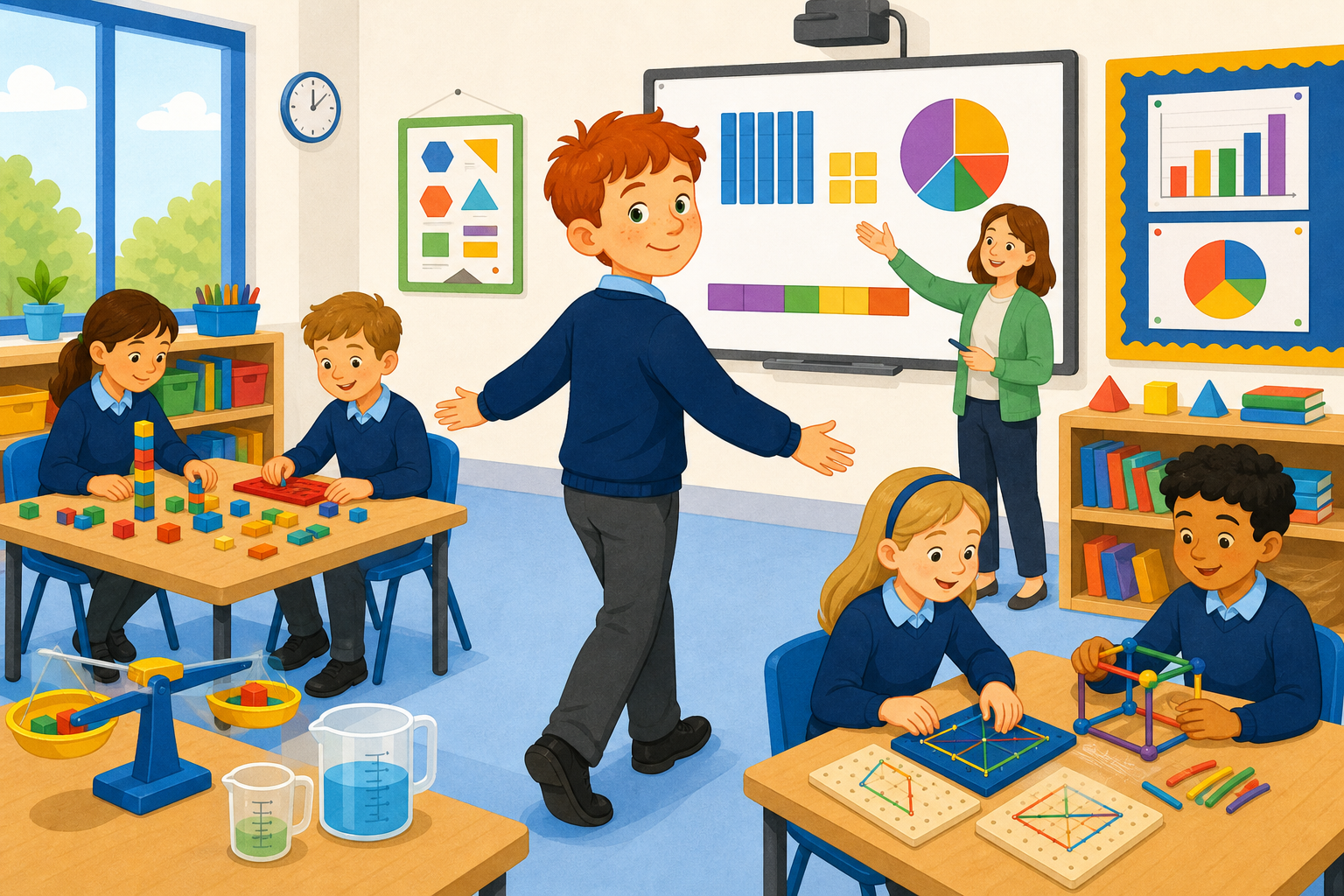
Look at the front. Your teacher will turn slowly all the way around, back to the start. Then only halfway. Then only a quarter of the way.
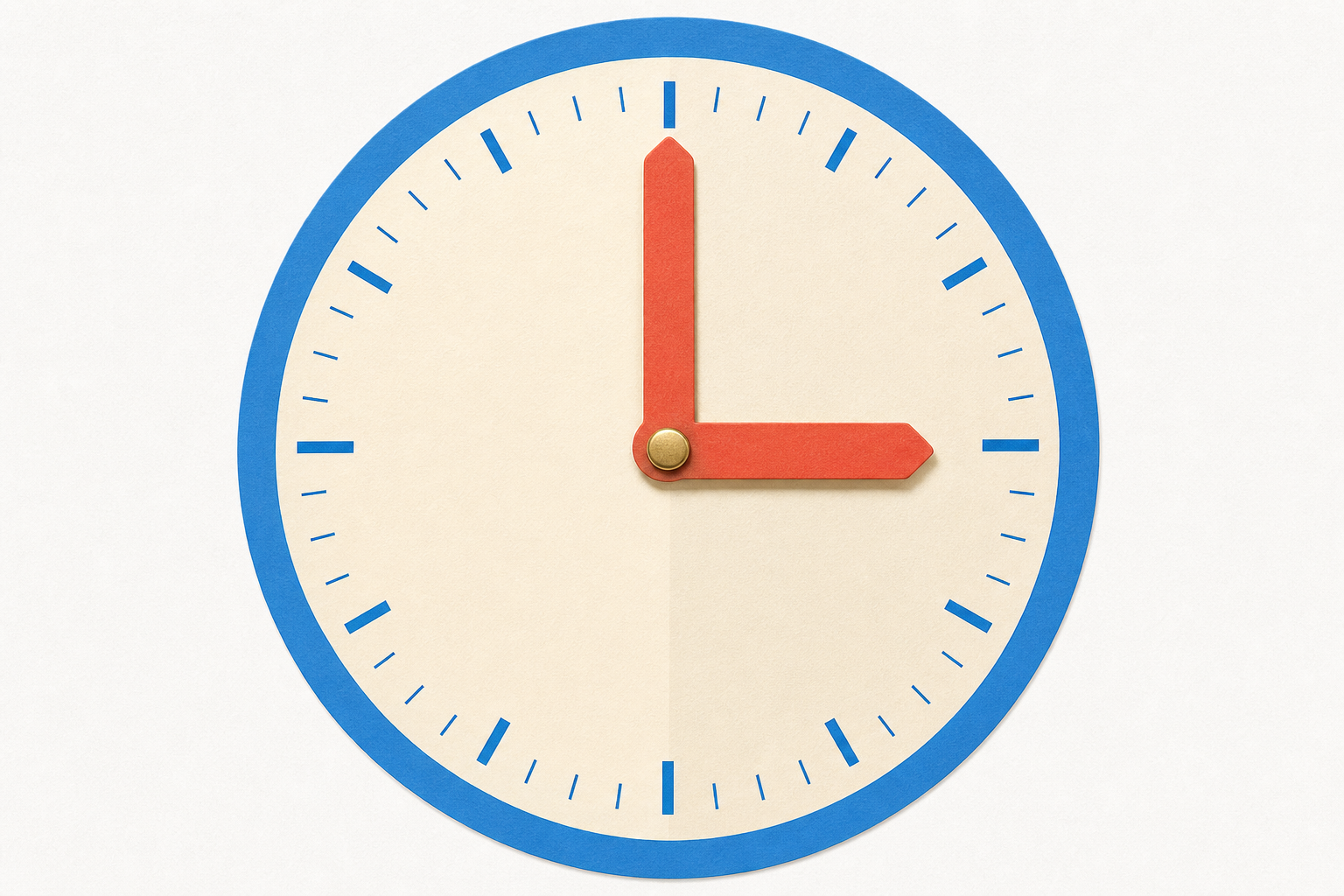
How much of a full turn was each one? Which way is your teacher facing now?
Stand and demonstrate the three turns yourself, pausing after each so the class can name where you face. Take two or three hands-up answers, not open call-outs.
The word to draw out is turn — an angle is about how far you turn, not how far you walk.
Watch the card clock hand at the front. It is pinned at the centre, so it can only turn around that one fixed point. Watch each turn and notice where the hand ends up:
Watch for how far the hand travels each time, and where it stops.
Use a real card pointer pinned at one end so it can only swing round a fixed point (or the large demonstration clock hand from your prep). Make the turns on the clock hand slowly, naming each one aloud:
Then repeat the idea on a door. Open a classroom door wide and close it — same thing, turning around one fixed point, the hinge.
Hold out for pupils to notice the pointer only ever moves around the pin — it never slides. That fixed point is what makes it a turn.
You each have a turning arm, two strips joined with a split pin so they swing around a fixed point.
Today we work through four turns together, in this order. First a quarter turn. Then a half turn. Then a full turn. Last a three-quarter turn.
For each one: say where the arm will end up pointing, then make that turn on your own arm, then compare it to the board pupil's arm to check.
Talk this one through together — pupils take turns at the board and the class agrees or corrects out loud.
Each pupil has a split-pin turning arm at their desk. One pupil shows each turn at the board with a turning arm while the class makes the same turn with their own arm and checks against the board pupil. Call the turns in order (quarter, half, full, three-quarter) so a pupil who loses track can follow along.
In your maths copy, draw a clock face. Mark with an arrow where the hand points after a quarter turn from twelve. Then draw a second clock face and mark where the hand points after a half turn from twelve.
Walk the room glancing at where the arrows land — a quarter turn from twelve points to the three, a half turn points to the six. This is whole-class copybook practice, not marking.
Today we fit pattern blocks into gaps by turning them the right amount. Each gap is a paper outline drawn around a block that was placed turned to one side, so the block only slots in once you turn it to match the outline.
Fit each block into its gap by turning it the right amount. Last, fill a frame where each block needs a different amount of turn.
Each time, say how much of a full turn you used before you slide the block in.
This is the practice round — pupils take turns at the board, check each answer, and the class confirms before moving on. Keep the board work brisk rather than over-explaining.
Making the gaps: on plain paper, place a pattern block turned a quarter (then a half, then three quarters) from its upright position and draw around it. That outline is the gap — the block only fits when a pupil turns it back to match. For the mixed frame, draw around three blocks each set at a different turn. Use triangles or trapezoids for every outline. Squares look the same after a quarter turn, and squares, hexagons and rhombi look the same after a half turn, so those blocks fit without turning. Have these outlines ready before the lesson (also listed in Before the Lesson).
Real pattern blocks circulate at the desks. One pupil turns a block at the front to fit each gap while the class predicts. Before each block is slotted in, ask the class how much of a turn it needs, take two hands-up answers, then let the board pupil check. The four tasks rise in difficulty: a plain quarter turn, then a half, then a three-quarter, then a frame mixing all three.
You're previewing this lesson. Get full access to this lesson and hundreds more — each one ready to teach, with interactive activities, printable resources and pupil progress tracking built in.