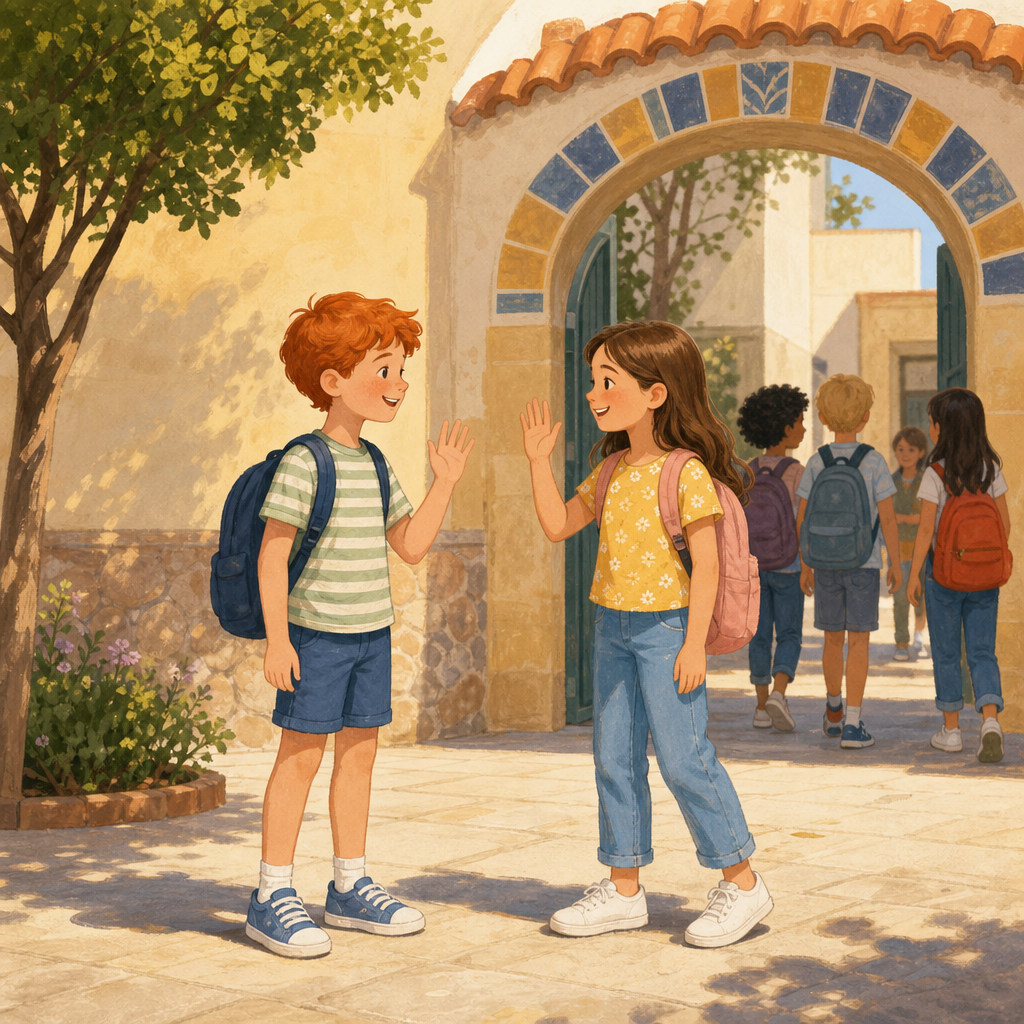
You can already say your name in Spanish. What else does someone want to know after that?
Think of two things people often ask next. We will collect a few ideas, then learn how to say them, just as new classmates do on the first day at a school in Valencia.
Take three or four ideas (age, where you live, favourite colour or food, pets, hobbies). Do not teach the Spanish yet; the flashcards do that next. If anyone offers Me llamo (meh YAH-moh), praise the recycle from introductions and park it for the partner game. Keep the Valencia first-day image in mind so the chat feels like meeting real classmates, not a word list.
Here are today's eight about-me builders. Your teacher will play the audio first. Listen, then repeat together. See the English, hear the Spanish, then flip to check.
Pass 1 — name and age (the heart of today's chat):
Listen for the soft ny sound in años, like the ni in onion.
Pass 2 — one extra fact (finish every stem):
Word bank (use these endings, or a well-known place name): el fútbol, el baloncesto, la música, el chocolate caliente, el azul, la pizza, Irlanda, Dublín, Cork, Madrid.
A full mini chat on the first day in Valencia sounds like this:
A: ¿Cómo te llamas? ¿Cuántos años tienes?
B: Me llamo Lucía. Tengo diez años. Me gusta el chocolate caliente.
(What is your name? How old are you? / My name is Lucía. I am ten years old. I like hot chocolate.)
Whole class on the IWB. Run two short passes rather than one long blast: (1) name + age, (2) fact builders. For every card: play audio first, then class repeats twice (once together, once by table). Never ask them to "try the Spanish" before they have heard it.
Pronunciation guides: Me llamo (meh YAH-moh); Tengo … años (TEN-go … AH-nyohs); diez (dee-ETH); once (OHN-seh) for eleven-year-olds; Me gusta (meh GOOS-tah); No me gusta (noh meh GOOS-tah); Vivo en (VEE-boh en); Mi color favorito es (mee koh-LOHR fah-boh-REE-toh es); Mi comida favorita es (mee koh-MEE-dah fah-boh-REE-tah es); Tengo una mascota (TEN-go OO-nah mas-KOH-tah).
The ñ is the fun one — hold your nose lightly and say onion, then try años. They will giggle and it sticks. Point out that Spanish uses tengo (I have) for age: pupils swap in their real number (diez or once cover most of 5th class). Insist on a full ending whenever a stem is used aloud; pupils may finish with a bank item or a well-known proper noun. Model the sample Valencia exchange once at the end of the step.
Your teacher will play the clip twice on the class speakers. Listen for two things, then we will answer the questions together:
Keep those two targets in your head while you listen. No need to catch every word.
Play the full audio twice before anyone answers. On the second play, ask pupils to raise a hand when they hear a number (the age) and again when they hear an extra fact (like, live, colour, food, pet). Then work through the multiple-choice questions together. If a question stalls the class, replay just that section rather than translating every line. Where the audio matches today's builders, point briefly at the matching flashcard idea so the listen pass reinforces the set rather than floating free of it.
First, say these three lines together with your teacher. Then open your copy and write them about you. You may copy the pattern from the model and finish the like-line from the word bank.
Model:
Me llamo Seán. Tengo diez años. Me gusta el fútbol.
Word bank for sentence 3: el fútbol · el baloncesto · la música · el chocolate caliente · or try Mi color favorito es el azul / Tengo una mascota.
Pause the interactive board clutter. Keep the model and word bank on screen for the whole copy moment. Run a quick whole-class oral chorus of the three model lines first (hear → say → write). Then pupils write their own version. Using a bank phrase is expected; do not require unaided Spanish nouns. Check accents on años and that age uses tengo, not an English-style "I am". Accept diez or once for age. Do not collect these. Quiet cheer for anyone who risks a second fact.
Imagine it is your first day at a primary school in Valencia. You have just met in the playground.
How this works:
Full model (read together first):
Partner A: ¿Cómo te llamas? ¿Cuántos años tienes?
Partner B: Me llamo Lucía. Tengo diez años. Me gusta el chocolate caliente.
(What is your name? How old are you? / My name is Lucía. I am ten years old. I like hot chocolate.)
Your turn — use this script:
Partner A (asks): ¿Cómo te llamas? ¿Cuántos años tienes?
Partner B (answers): Me llamo … Tengo … años. [one extra fact]
Extra-fact stems (pick a different one each turn):
Word bank: el fútbol, el baloncesto, la música, el chocolate caliente, el azul, la pizza, Irlanda, Dublín, Cork, Madrid.
Recycled question prompts (not on today's flashcard list — model clearly before pairs start): ¿Cómo te llamas? (KOH-moh teh YAH-mahs); Me llamo … (meh YAH-moh); ¿Cuántos años tienes? (KWAN-tohs AH-nyohs tee-EH-nes); Tengo … años (TEN-go … AH-nyohs) with diez (dee-ETH) or once (OHN-seh).
Delivery on a single IWB (no devices, no half-screens): Both roles are fully visible on the board for everyone. Pairs stand shoulder-to-shoulder facing the board. Partner A reads the two questions from the script. Partner B answers from memory plus the word bank kept visible. The partner-practice interactive may show asking prompts; treat those as a support for Partner A, not as a secret half. Do not tell pupils that each person sees only their own side.
Sequence: (1) Choral-read the full Lucía model once with the class. (2) Model one live exchange with a volunteer, pointing at each line. (3) Pairs read-and-say from the visible script for two turns. (4) After about five minutes, pairs swap who asks so both roles are practised. Nudge pairs to rotate the extra fact through like / don't like / live / colour / food / pet.
Circulate and listen for the age pattern with tengo and a finished fact stem (not a bare Me gusta). Celebrate any full three-part answer out loud — name, age, fact — even if pronunciation is wobbly.
You're previewing this lesson. Get full access to this lesson and hundreds more — each one ready to teach, with interactive activities, printable resources and pupil progress tracking built in.