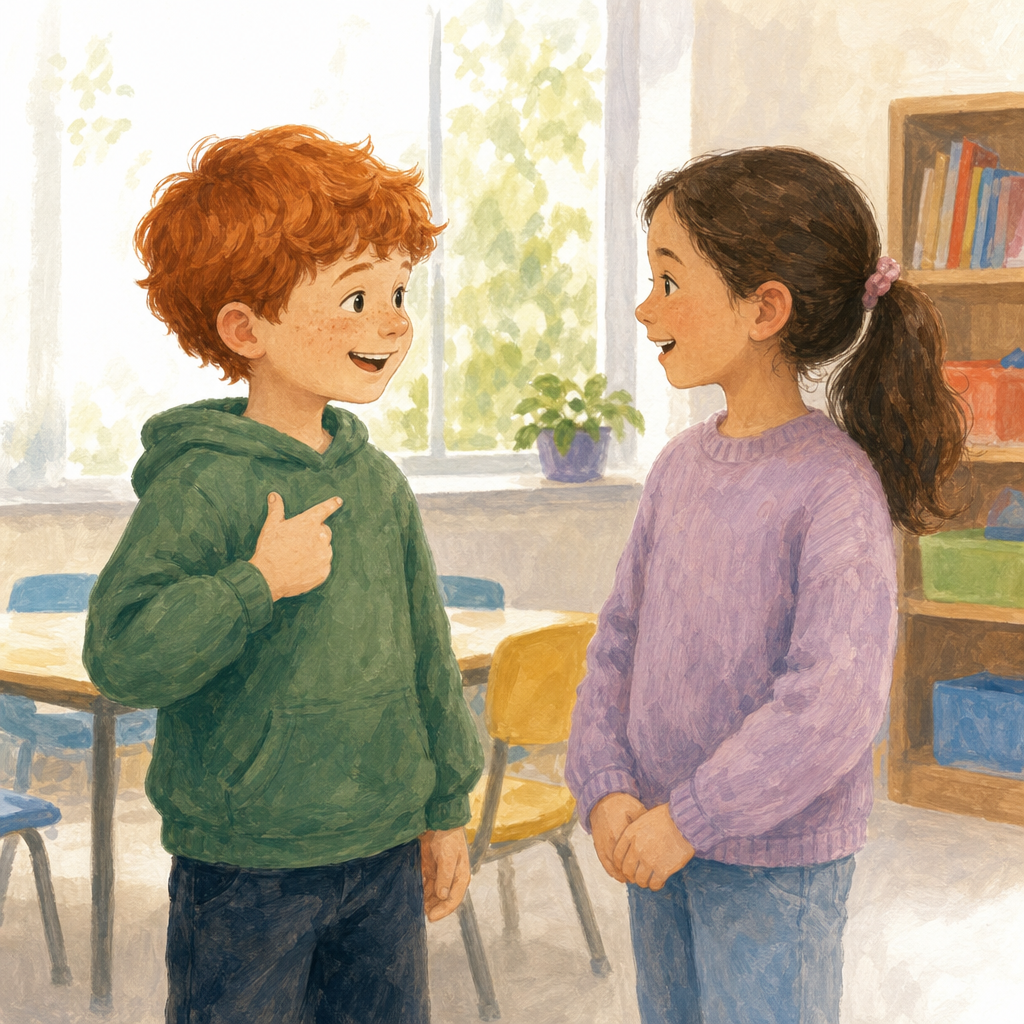
You can already say your name in French. After someone hears your name, they usually want to know a little more about you: how old you are, where you live, or something you like.
Today you get to tell the class who you are, in French!
Collect three or four quick ideas from the class (age, home town, a sport, a pet). Do not teach the French yet. Remind them they already know how to say their name from earlier in the unit; today they add age and one more fact. Keep this beat snappy so the flashcards land while curiosity is still high. You can set the scene lightly: imagine the first day back at a French school (la rentrée), when new classmates swap a few facts about themselves.
Here are today's about-me phrases. Listen to the audio first, then repeat as a class, then flip the card to check the English.
Listen carefully for age: j'ai dix ans means "I have ten years", not "I am ten".
Whole class on the IWB. Work the five core frames first so every pupil leaves this step able to say them:
For each card: play the audio → class repeats twice (once together, once by table) → then flip for English. Do not ask pupils to guess the French before they have heard it.
Age number bank (show beside J'ai ... ans and choral-drill each):
Point out that French uses avoir (to have) for age. Model a full mini-exchange set on la rentrée (first day back) so pupils hear the shape they will use later:
A: Je m'appelle Sam. J'ai dix ans. J'aime le football. (My name is Sam. I am ten. I like football.)
B: Je m'appelle Ava. J'ai onze ans. J'habite à Dublin. (My name is Ava. I am eleven. I live in Dublin.)
If time remains, flip the three stretch cards quickly (Ma couleur préférée est..., J'ai un animal de compagnie, Mon anniversaire est le...) and flag them as optional extras for partner work. Encourage real likes and dislikes rather than textbook defaults.
Two French children meet on the first day back at school (la rentrée). Listen all the way through twice on the class speakers, then answer the questions. What facts did each person share?
Play the full clip twice on the class speakers, pens down and eyes on the board the first time. After the second play, take answers with fingers or a partner whisper, then check together and ask what clue gave each one away. The written text is shown on screen as well as spoken.
What the clip actually says.
Émilie: Bonjour! Je m'appelle Émilie. Et toi? (Hello! My name is Emilie. And you?)
Antoine: Salut! Moi, je m'appelle Antoine. J'ai neuf ans. (Hi! My name is Antoine. I am nine years old.)
Émilie: Moi aussi, j'ai neuf ans! Où habites-tu? (Me too, I am nine years old! Where do you live?)
Antoine: J'habite à Paris. Et toi? (I live in Paris. And you?)
Émilie: J'habite à Lyon. Qu'est-ce que tu aimes faire? (I live in Lyon. What do you like to do?)
Antoine: J'aime jouer au football et lire des livres. (I like to play football and read books.)
Émilie: Super! Moi, j'aime dessiner et nager. (Great! I like to draw and swim.)
The questions the class will be asked, and the answers.
Before you start: today's words in this clip are Je m'appelle, J'habite à, J'aime.
If the speakers or the interactive fail, read the lines above aloud yourself, twice, then ask the same questions.
This is the fun bit: tell your partner three things about you in French. Use this script on the board, and fill the blanks with your real facts.
Partner A:
Je m'appelle ______.
J'ai ______ ans.
J'aime ______. (or J'habite à ______ / Je n'aime pas ______)
Partner B:
Je m'appelle ______.
J'ai ______ ans.
J'habite à ______. (or another fact from today's phrases)
Take turns, then swap roles. Listen carefully to each other.
Pair pupils so they face each other. Keep the two-role script large on the IWB. Model one full exchange with a volunteer first using the three-beat shape: name → age → one fact.
Exact model to perform before pairs:
Teacher: Je m'appelle Sam. J'ai dix ans. J'aime le football.
Volunteer: Je m'appelle Ava. J'ai onze ans. J'habite à Dublin.
Then Partner A goes, Partner B answers, and they swap. Pairs pick one fact from the theme for the third line (like, dislike, town, or a stretch card). They do not need all eight phrases.
Circulate and listen for j'ai ... ans rather than an English-style "I am". Offer the pronunciation quietly if a pair freezes: J'ai dix ans (zhah deez ahn), J'aime (zhem), J'habite (zha-BEET). Allow about eight minutes of pair talk, then invite two pairs to perform for the class.
Open your copy and write the three sentences you just said to your partner: your name, your age, and one thing about you. You may copy from the model and change the blanks to your real facts. Take care with the accents and the apostrophes.
Model on the board:
Je m'appelle Sam.
J'ai dix ans.
J'aime le football.
Pause the board on the model above. Everyone writes the exchange they have just spoken (name, age, one fact). Accept copying from the model with personalised blanks; unaided spelling comes later. Walk the room and check accents on préférée if used, and the apostrophe in j'ai, j'aime and m'appelle. Pupils use their real name, real age and a real fact. Do not collect these.
You're previewing this lesson. Get full access to this lesson and hundreds more — each one ready to teach, with interactive activities, printable resources and pupil progress tracking built in.