In this lesson, you'll explore the fundamentals of Artificial Intelligence (AI) and Machine Learning (ML), technologies that are transforming industries from healthcare to gaming.
Through hands-on activities, you'll:
scikit-learn library (provides tools for machine learning in Python) and the matplotlib library (library for creating visualisations in Python) during the lesson.
Artificial Intelligence (AI) refers to the capability of a machine or computer system to perform tasks that would normally require human intelligence. This includes activities like understanding natural language, recognising patterns, learning from experience, solving problems, and making decisions.
AI can be divided into two main types:
AI powers many everyday technologies, from self-driving cars that navigate roads to chatbots that provide customer support. It leverages computing power to process vast amounts of data quickly, enabling solutions to complex problems that would be difficult or impossible for humans alone.
Consider contexts where AI might be used: in healthcare for diagnosing diseases from scans, in finance for detecting fraud, or in education for personalised learning tools.
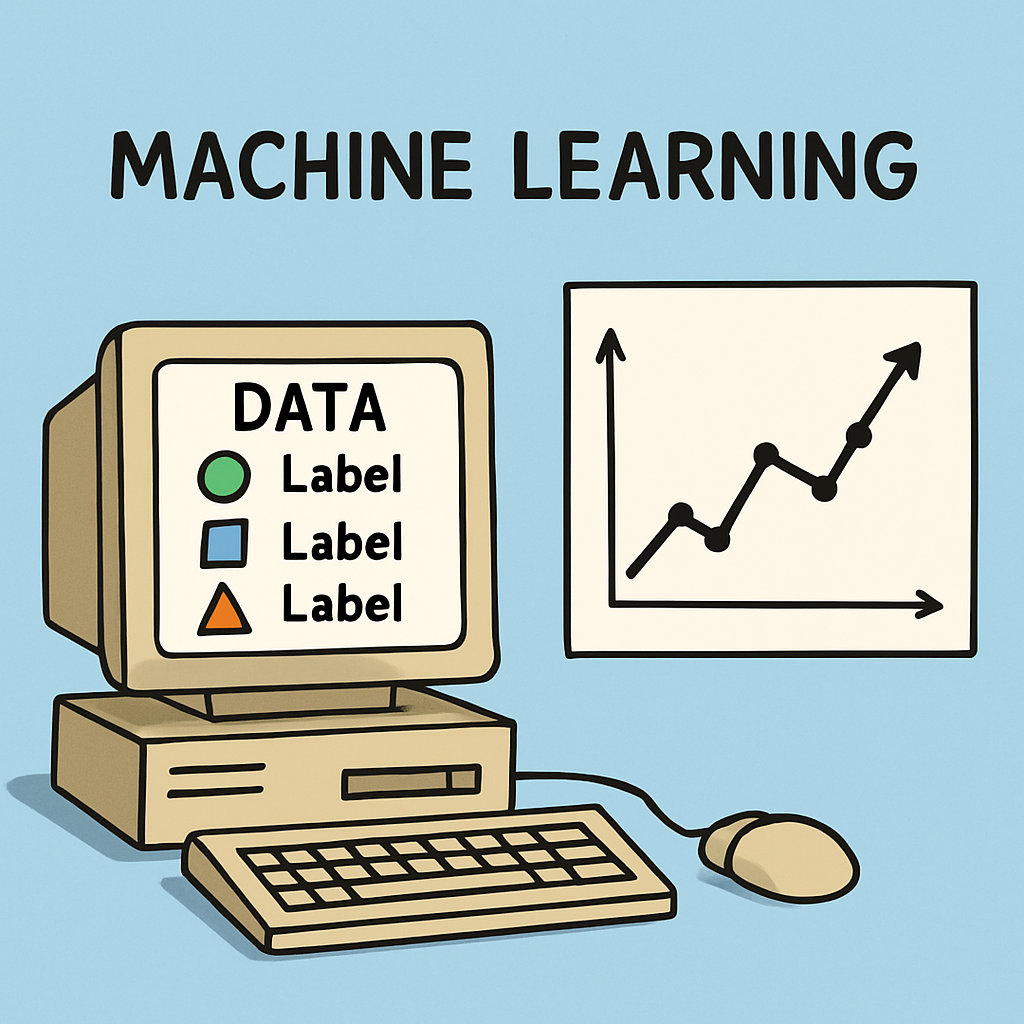
Machine Learning (ML) is a subset of artificial intelligence (AI) that focuses on the development of algorithms and models that enable computers to learn from and make predictions or decisions based on data. Instead of being explicitly programmed with rules, ML systems improve their performance on a task through experience, by analysing patterns in data.
ML can be categorised into three main types:
ML is used in various contexts: in recommendation engines (e.g., suggesting movies on Netflix), image recognition (e.g., identifying objects in photos), predictive maintenance in manufacturing, or even in healthcare for predicting patient outcomes from medical data. It leverages computing power to process large datasets, enabling solutions to problems that are too complex for traditional programming.
First, you need to create a new folder for this lesson's project and set up the environment.
AIMLLesson'.File > Open Folder).Next, create a virtual environment to manage your project's dependencies.
View > Command Palette.Python: Create Environment' and select it.Venv'..venv' folder.Next, open a terminal in VS Code to install the required libraries.
View > Terminal.pip install scikit-learn. This library provides tools for machine learning in Python.pip install matplotlib. Matplotlib is a library for creating visualisations in Python, which we'll use to plot data and display graphs, such as showing regression lines in our ML demo.You're previewing this lesson. Get full access to this lesson and hundreds more — each one ready to teach, with interactive activities, printable resources and pupil progress tracking built in.