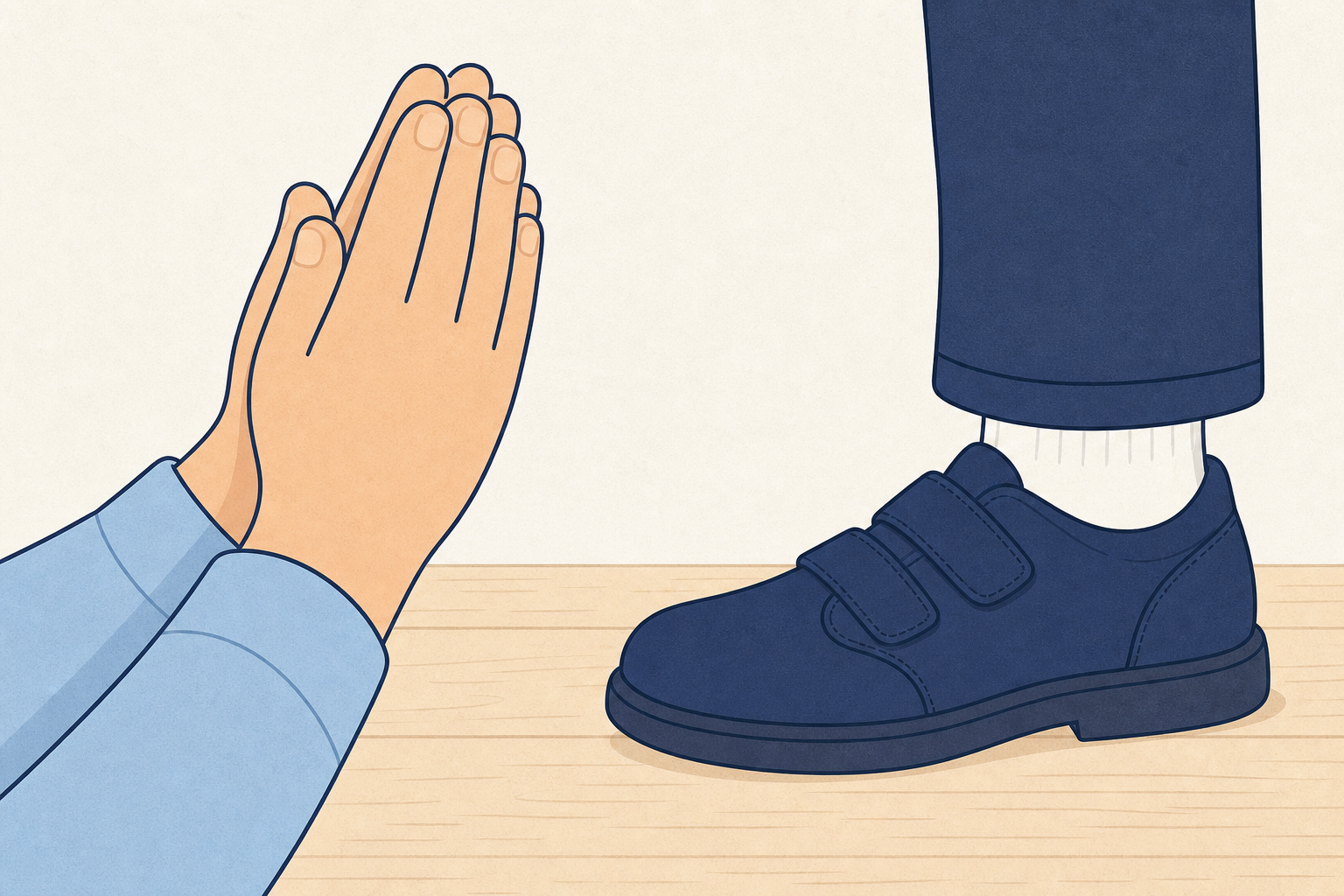
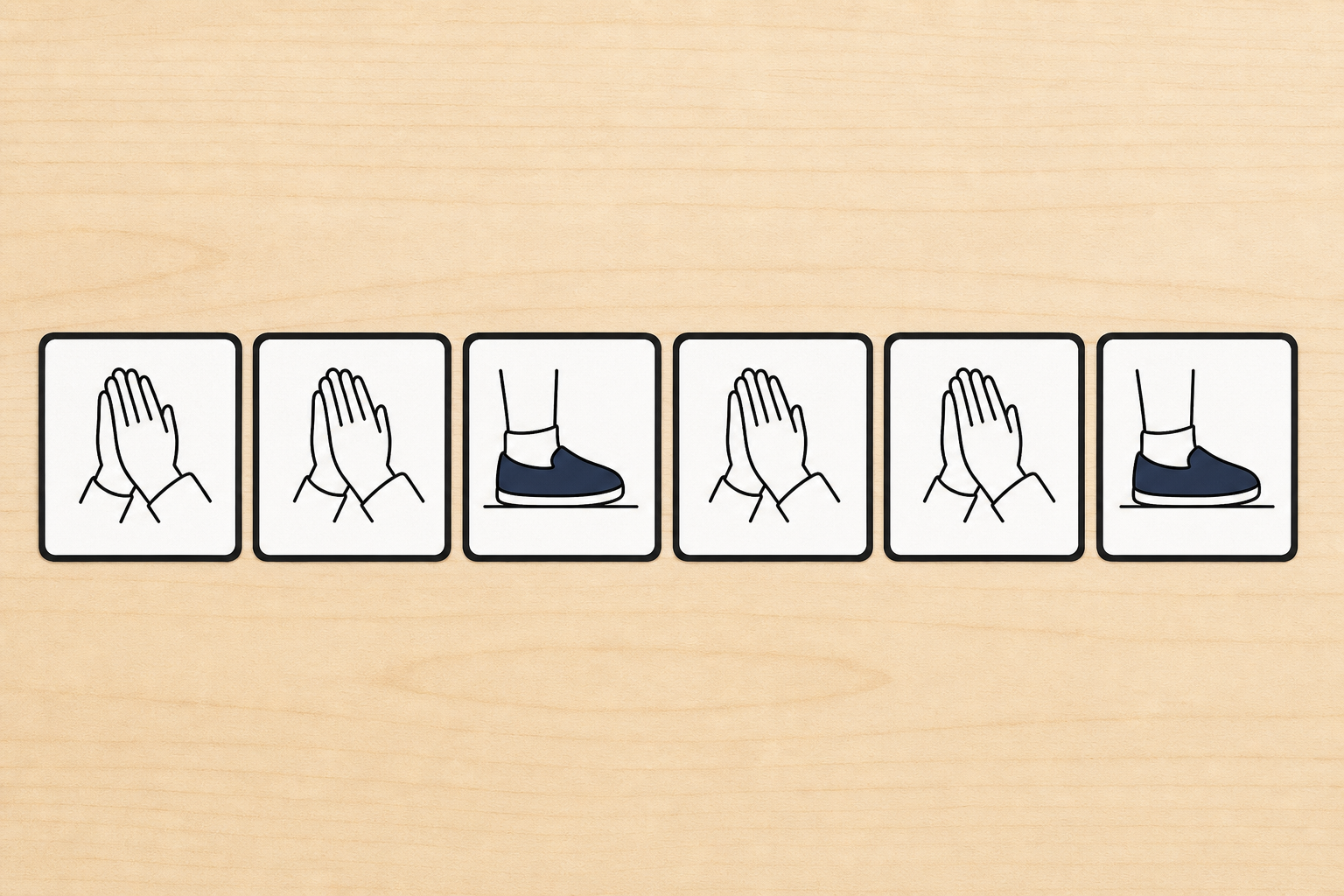
Listen carefully while I clap and stamp. I will do clap, clap, stamp, then clap, clap, stamp again. Something came back again and again. Can you hear which bit it was?
Stand where the class can see your hands and feet. Do clap, clap, stamp twice, slowly and clearly. Do not name the word repeat yet. Invite one or two children to call out what came back. Keep the beat gentle and joyful.
Before the lesson: push chairs back so there is a clear patch of floor; make large floor-visible action picture cards, one word or stick figure each (one class set with multiples: 2 clap, 2 stamp, 2 pat knees, 1 wave).
Key question: Which bit came back again and again?
Today's word is repeat. A repeat is a part that happens again and again.
When a bit comes back, we can point to it and say, "That bit again!"
| Concept | Why it matters | Example |
|---|---|---|
| Repeat — a part of a sequence that happens again and again | Songs, dances and robot steps often use a bit that comes back so we know what is next | Clap, clap, stamp — then clap, clap, stamp once more. The clap-clap-stamp bit is the repeat |
Misconception to head off: children may think the whole long run of actions is "the repeat". Help them point to the short chunk that comes back (for example clap-clap-stamp), not every single clap on its own.
Say it simply: A repeat is the bit that happens again and again.
If useful in your own talk, you may say "pattern", but keep the board and pupil talk on plain phrases: the bit that comes back, clap, clap, stamp again.
Link gently later to a song or rhyme the class already knows: a bit that comes back makes it easy to join in.
Watch carefully. Which part do you think will happen again and again?
Model the full noticing cycle out loud so children hear every beat before they try it themselves.
I wonder: I wonder which bit of my actions comes back.
I think: lay three large cards in a row on the floor where everyone can see — clap, clap, stamp — and say I think clap, clap, stamp will come back. Keep that three-card chunk laid out as the shared pointing target.
I try: perform clap, clap, stamp / clap, clap, stamp / clap, clap, stamp while the class watches in silence the first time.
I noticed: I noticed the clap-clap-stamp bit came back three times.
I think now: So that short bit is our repeat. Point to the three laid-out cards as a group, then gesture back to the start of the row to show "again".
After the reveal, invite the class to join you once, still following your lead. Keep stamps soft so toes stay safe.
Make enough cards so every modelled chunk can sit fully on the floor at once:
Use only clap and stamp in this modelled sequence so the repeating chunk is easy to spot. Lay clap, clap, stamp in a clear row the whole class can see and point to.
Now it is our turn. We will do short action games together. Join in, then show with your finger which bit came back again and again.
Run this as two or three short bursts with a quick sit-between, never one long stretch. Stay whole-class; fold everyone in by asking watchers are we right? and what comes next?
Keep the repeating chunk laid out as large floor cards the whole circle can see. Do not reuse a single card mid-air; children need a fixed row to point at.
Sequence: clap, clap, stamp — again and again (three times). Lay three large cards in a row: clap, clap, stamp. Count one, two, three for each full chunk. After the third time, freeze and ask children to point to the three cards that made the repeating bit.
New sequence: pat knees, pat knees, wave — again and again. Lay three large cards: pat knees, pat knees, wave. Same routine: do it three times, then point to the repeating chunk on the floor.
Optional stretch if the class is steady: stamp, clap, stamp, clap — again and again. Lay four large cards: stamp, clap, stamp, clap. Help them see the pair stamp, clap as the bit that repeats (you can group the cards in pairs with a small gap).
Look-fors:
If it gets muddy: slow down, do only two actions (clap, stamp / clap, stamp) with two pairs of cards laid out, and point together as a class before asking individuals.
Differentiation: less confident children may clap only while you stamp; confident children may lead one short sequence for the class after you agree the cards.
Well done joining in. Let's look at our cards. Which short bit came back again and again?
Sit in a circle. Hold up or re-lay the clap-clap-stamp cards again as a memory hook. This step is display-only and oral: no typing, no writing.
Focus: children point to or say the repeating chunk in their own words. Accept again, same bit, or pointing without needing the word repeat from every child. You may revoice with repeat when you echo their answers.
Draw out:
Gentle real-world link (after the pointing, oral only): name one song or rhyme the class already knows and ask which bit comes back so everyone can join in. Keep it concrete and familiar. If you weave Nature of STEM lightly: people who make music often use a bit that comes back; keep this in your talk, not on the board.
Sentence stems to say aloud: The bit that came back was… / I spotted it when…
You're previewing this lesson. Get full access to this lesson and hundreds more — each one ready to teach, with interactive activities, printable resources and pupil progress tracking built in.