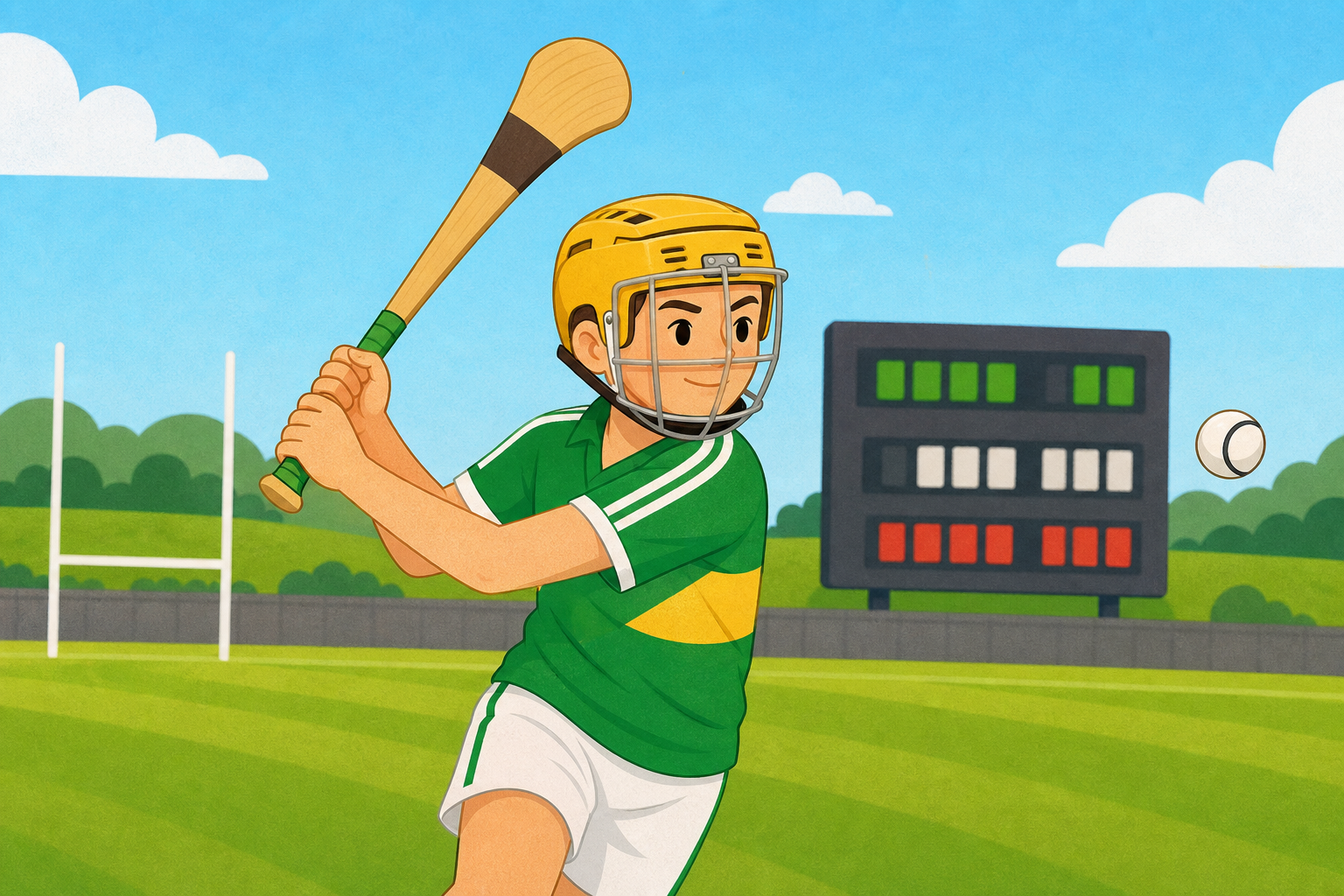
Listen to this story: a hurler scored 24 points in one match and 18 points in the next match. How many points did she score altogether?
You don't have to work out the answer yet. Just tell me one thing: was that story asking us to add the two scores together, or to take one away from the other? Which word in the story told you?
Read the story aloud once, slowly, then again. Take three hands-up answers, not open call-outs. Steer the class toward the word altogether as the signal to add. Don't work out 42 yet; the point of this hook is spotting the action, not doing the sum.
Listen as I read four short stories. Each one hides a number sentence. Listen for the action: is something being joined together, or taken away? Spot the words that give the game away.
Story 1: join words gives her, altogether. Add. 12 + 8 = 20.
Story 2: remove word left. Take away. 15 - 6 = 9. Then ask the class to predict: when a story says someone needs more, do we add or take away?
Story 3: the trap. Let them predict before revealing. Club needs 20 tickets, sold 14 - a gap story. Sounds like adding but the gap is found by taking away: 20 - 14 = 6. Land it: the gap is what is still missing.
Story 4: back to solid ground, bigger numbers. Team scored 24 then 21, altogether means join. Add. 24 + 21 = 45.
Now we read fresh stories together and decide the action before we work anything out. Each story appears on the board as we reach it. For each one we say the action out loud, then build the number sentence, then find the answer.
This round is for talking it through together — pupils take turns at the board and the class agrees or corrects out loud.
Before choosing add or take away, ask a pupil to point to the action words and say them aloud. On the medals story, watch for pupils who want to add because it says needs; revoice: a gap is still found by taking away — how much is missing?
Every interactive number now matches the story text exactly, so the board and the screen always agree. Every answer is a full sentence with its units — 29 points, 13 apples, 12 medals, 35 loaves.
In your maths copy, write the number sentence for two of the problems we worked on the board. Work each one out, then write the answer as a full sentence with its units — for example, They scored 29 points altogether.
Walk the room glancing for the correct sign (+ or −) and for a full-sentence answer that names the units — this is whole-class copybook practice, not marking. Prompt any pupil who wrote a bare number to add what was counted.
Now we tackle four more stories, one at a time as they appear on the board. For each one, spot the action, build the number sentence, and give the answer with its units. Watch for the gap story hiding in the middle.
These are the practice questions — pupils take turns at the board, check each answer, and the class confirms before moving on. Keep the board work brisk rather than over-explaining.
The order swings between operations on purpose: add (conkers), take away (money), gap (tickets), add (apples). The tickets story is the gap-trap again at bigger numbers; make the class predict the operation before the pupil chooses. Insist on full-sentence answers with units: 63 conkers, €25, 24 tickets, 83 apples.
You're previewing this lesson. Get full access to this lesson and hundreds more — each one ready to teach, with interactive activities, printable resources and pupil progress tracking built in.