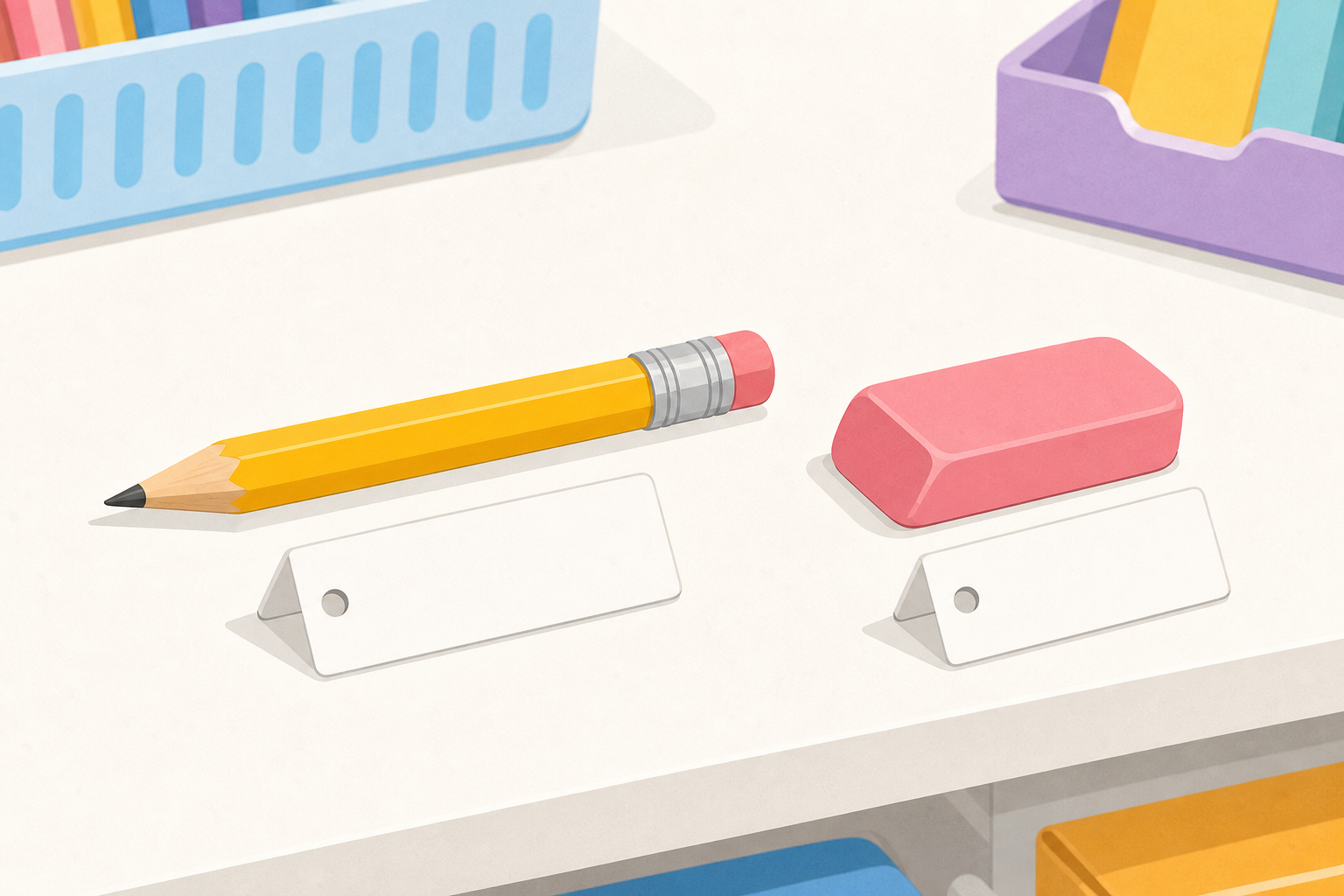
Here is a shop list: a pencil costs 30c and a rubber costs 20c.
Hands up: how much do the two cost altogether, and how did you work it out?
Take three hands-up answers, not open call-outs. Listen for whether pupils add the cent straight away or count on. Do not correct yet — this is just to surface how they already add small money amounts.
Here are four totals on the coin-counter. Each one shows two prices joined together to make one total. For each one, notice whether the cent stay under a euro. Look at the last total closely: the cent have added up past one hundred and turned into a whole euro.
Talk through each tray on the board. Name the first price, then the second, then the total. Before each total, ask the class to predict it and take two hands-up answers, so the beat keeps moving.
Add the cent, then the euro is the phrase to keep saying over every tray.
Today we build these totals together on the board: 25c + 25c, then 60c + 40c, then €1 + 30c, then €1.50 + 50c. We build each price, join them, and read the total in euro and cent.
Talk this one through together. Pupils take turns at the board and the class agrees or corrects out loud.
For each pair, one pupil drags coins for the first price, another adds the second, and the class reads the total. Watch 60c + 40c and €1.50 + 50c — both tip exactly to a full euro. Point at the coins visibly combining into a whole euro coin on the tray so pupils see where the cent went, not just the number changing. A whole-euro total is written €1.00 or €2.00 and read aloud as 'one euro' or 'two euro'. Ask where did the cent go? before revealing. Keep the board work brisk.
In your maths copy, work out these three sums. Write each total in euro and cent, keeping the euro and the cent lined up.
Walk the room glancing for the euro and cent kept apart in each answer — this is whole-class copybook practice, not marking. In the first sum the cent are 35 + 45 = 80 (under 100, so 80c). In the middle sum the cent are 10 + 80 = 90 (under 100, so €1.90). The last sum is the one to watch: the cent are 60 + 70 = 130, which pass 100, so one whole euro carries over and the total is €2.30.
Four shop totals to work through together. We read each story, decide to add, and find the total:
This is the practice round. Pupils take turns coming to the board, and the class agrees on each answer before Check is tapped once. Keep the board work brisk rather than over-explaining. For each answer, have the class read the total back in euro and cent.
Pupils type the total in cent, then the class reads it back in euro and cent so the two ways of writing it stay joined up. The class agrees before Check is tapped once.
You're previewing this lesson. Get full access to this lesson and hundreds more — each one ready to teach, with interactive activities, printable resources and pupil progress tracking built in.