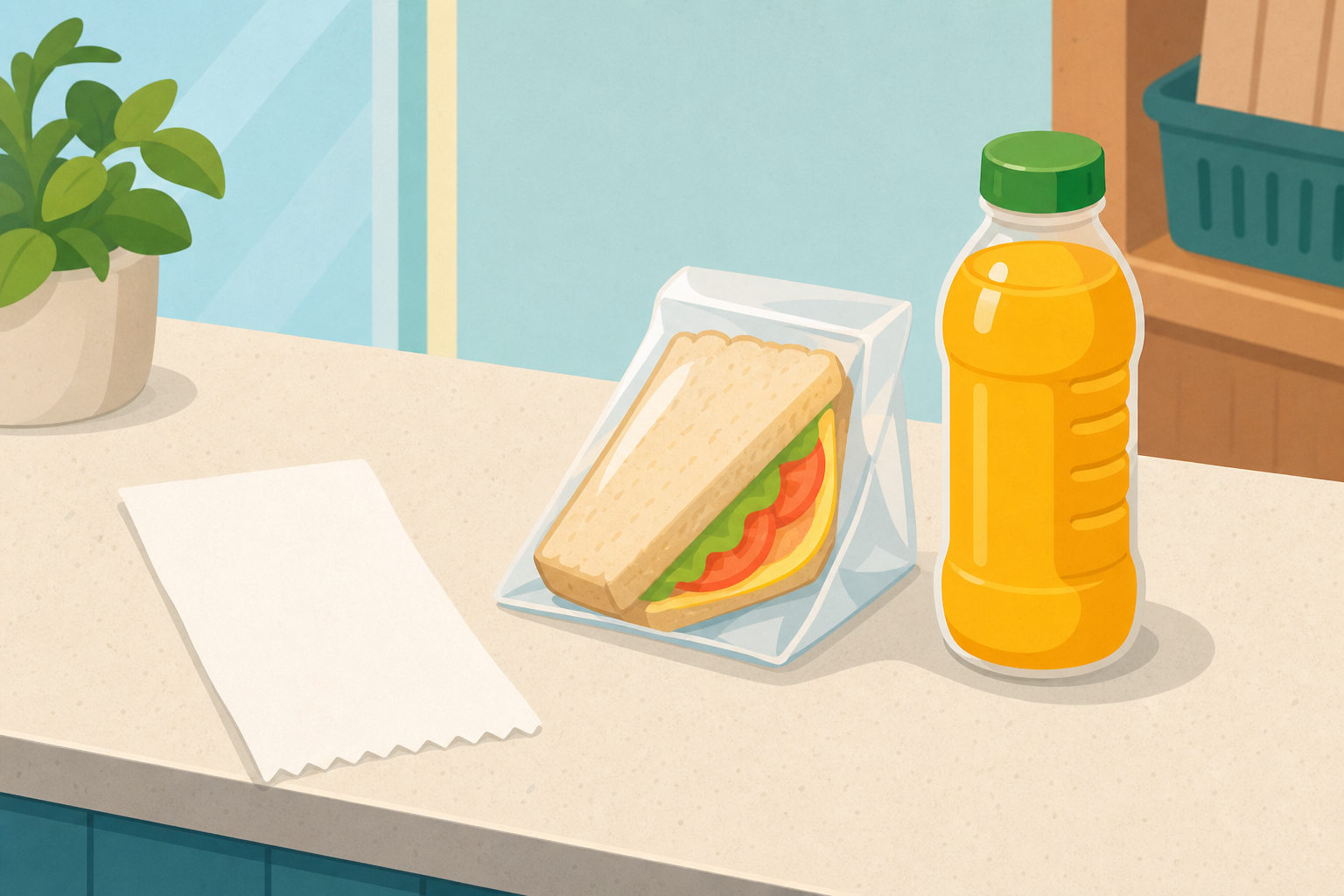
Here is a receipt from the shop: a sandwich for €4.85 and a bottle of juice for €2.35.
Hands up: what is the total, and how would you set it out so you get it right?
Take two or three hands-up answers, not open call-outs. Do not confirm the total yet — the setting-out is the whole point, and the next step models it.
Listen for anyone who says "just add the numbers" without mentioning lining up the points — that is the slip this lesson heads off.
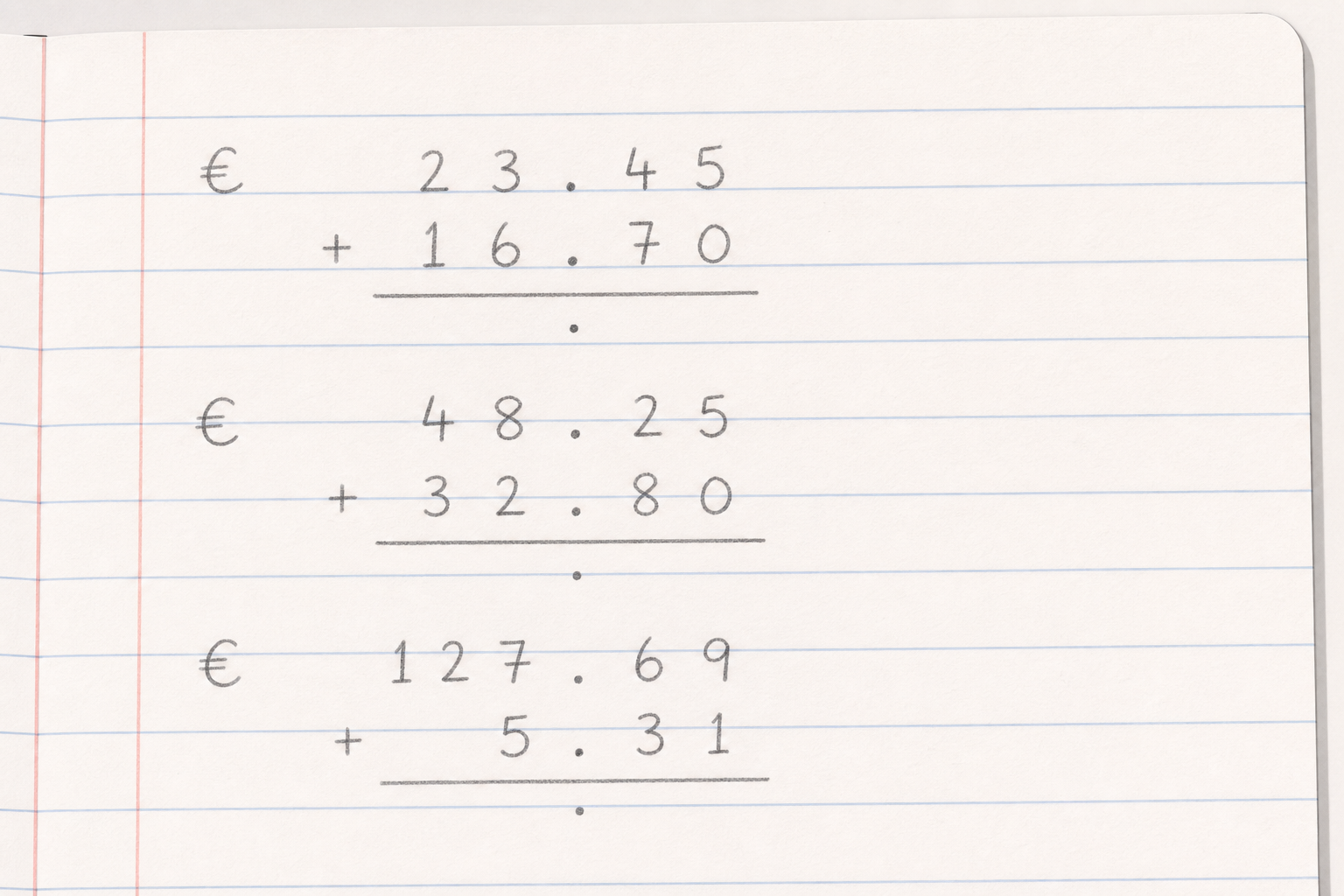
Three money calculations are worked on the board. Watch where the decimal points sit — they line up straight down the middle so the cent column stays over the cent column and the euro column stays over the euro.
Now watch the other two. Read them aloud and be ready to say what you notice in each one.
Point at each decimal point in turn and say "the points line up, always". Pause between sums and turn-and-name one pupil to say what they noticed, so the beat does not run on. The round-euro take-away (the trickiest case) is built in full in The Empty-Zero Take-Away step, so do not introduce it here.
First we make each amount real with coins and notes so we can see what we are adding. Then we set the sum out in columns and work it one column at a time.
On the screen we add these together:
On the board we work one take-away together:
Say each carry or borrow aloud before we check it.
Talk this one through together — pupils take turns at the board and the class agrees or corrects out loud.
Use the interactive to build €4.85 and €2.35 with coins so the amounts are concrete, then set both additions out in columns on the board to line the points up. Hold out for the carry on €4.85 + €2.35 before writing it.
The take-away €6.50 − €2.85 is worked on the board alongside — it is not on the interactive, so set it out in columns on the IWB pen and hold out for the borrow before revealing.
Keep the watching class with you on every sum: before each reveal, ask the whole class to predict the carry or borrow, take two hands-up answers, and revoice one pupil's reasoning so the room hears a classmate think it through. That prediction is your pacing lever across the step.
Watch for pupils lining up the right-hand edge of the digits rather than the decimal point — reset them onto the point.
In your maths copy, set up each money sum vertically with the decimal points lined up straight down the page. Work each column with the class and write the euro sign (€) at the answer.
Walk the room glancing at the decimal-point alignment — this is whole-class copybook practice, not marking. The single thing to catch is a sum where the points do not line up straight down.
You pay for a €4.55 lunch with a €10 note. How much change?
Here is €10.00 − €4.55 worked as a column subtraction. There are no cent to take from, so the borrow has to travel from the euro column all the way across the two zeros.
This is a single worked walk-through of the empty-zero case — the one pupils trip on when the top amount is a round euro amount. It is the first time this case appears in the lesson.
Say the borrow chain aloud once: "nothing in the cent column, so we borrow across from the euro — a euro becomes ten 10c, one of those becomes ten 1c, and now we can take away". Then ask one pupil to talk it back before moving on. Do not turn it into a script; a cue and a talk-back is enough.
You're previewing this lesson. Get full access to this lesson and hundreds more — each one ready to teach, with interactive activities, printable resources and pupil progress tracking built in.