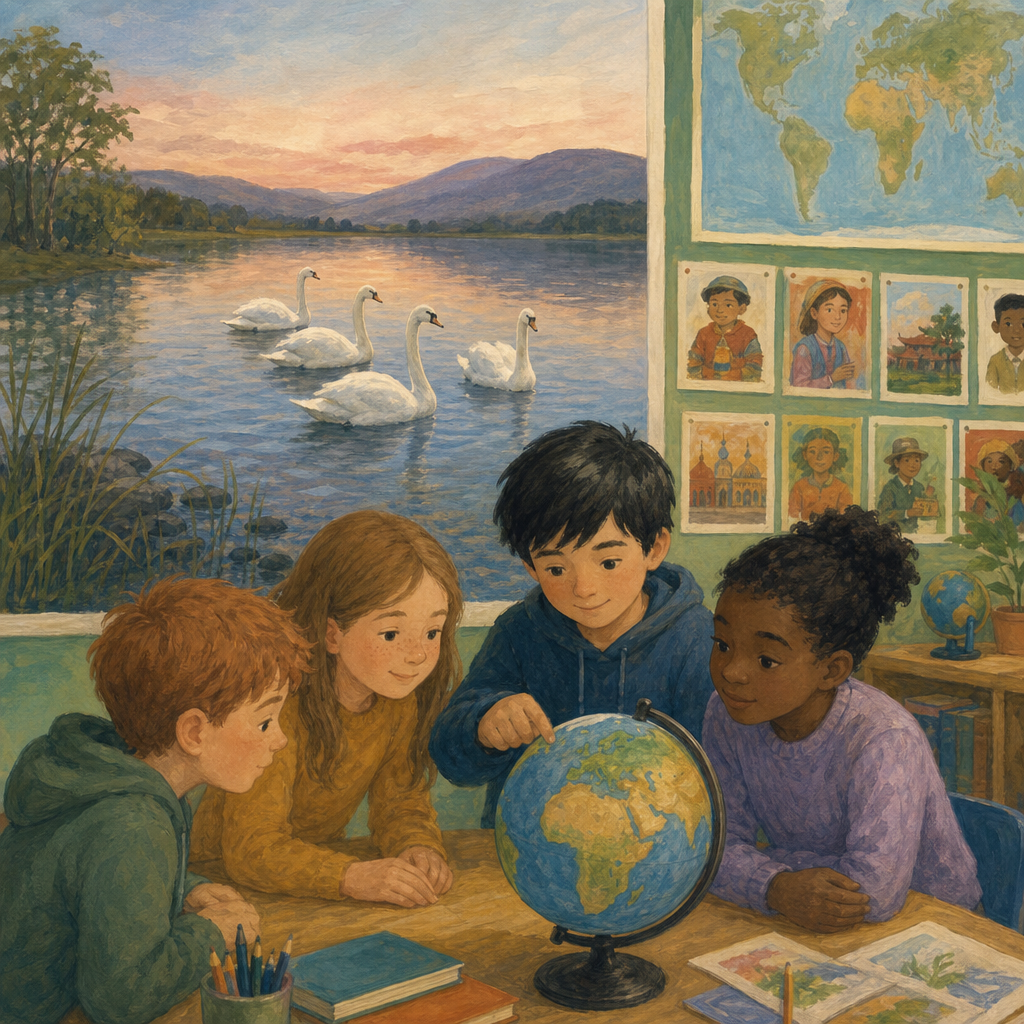
 Have you ever heard a story about children turned into swans? Thumbs up if yes, thumbs down if not yet. Either answer is perfect.
Today we hear that tale told two ways. If two people finish it, they may not say the same last page. We will find out why, and whether that means one of them is wrong.
By the end of this lesson, you will be able to:
- Hear a story told two ways
- Compare how the endings differ
- Discuss if both can be right
Listen carefully. You will hear the same scéal (shkayl, story) twice. Notice where the tellings stay together, and where they part.
1. The shared story
Long ago in Ireland, King Lir loved four children.
Fionnuala · Aodh · Fiachra · Conn
Their stepmother turned them into four white swans. A swan is an eala (AL-ah). They kept their minds and voices on the loch (lokh, lake) and far seas. People came to hear them sing.
Say the four names with me once.
2. One traditional ending
Near the end of the long years, the swans hear a Christian bell. A holy man cares for them. When the spell breaks they are human again, but very old. They ask to be baptised, die almost at once, and are buried together.
Take a quiet breath: here is another telling.
3. A gentler children's ending
After the long years a kind hermit finds the four swans. He cares for them until the spell breaks. They become children again, weaker and older, but they are held and comforted, and the story ends with them at peace together by the water.
Quick check (call out)
- Same four children in both tellings?
- Where did the two endings part?
Our story lake is in Westmeath. Storytellers also pinned this tale to real water and islands: Lake Derravaragh, the Sea of Moyle, and Inish Glora off Mayo.
Now you will open other Irish place names the same way — words that describe land and water. The names you open come from Connacht, including Mayo, where Inish Glora sits.
Volunteers may choose which name we open next. Each time a name opens, everyone shows thumbs: water, hill, or old settlement in the meaning?
Open your copy. Write about the ending you remember — or the moment that stayed with you most. There is no single correct choice.
Use this scaffold:
- Who was in the ending?
- What happened last (or what moment do you remember most)?
- One feeling word
You may use the traditional ending, the gentler children's ending, or an ending you already knew from home.
The older telling of this scéal was carried in Irish for centuries before many English versions were written down.
Listen to four short clips. After each clip, wait for the count of three, then hold up fingers for the language you hear:
- 1 French
- 2 German
- 3 Spanish
- 4 Irish
One of them is Irish. Hold up 4 fingers when you are sure you hear it.
Unlock the full learning experience
You're previewing this lesson. Get full access to this lesson and hundreds more — each one ready to teach, with interactive activities, printable resources and pupil progress tracking built in.
This lesson is copyright of Coding Ireland 2017 - 2026. Unauthorised use, copying or distribution is not allowed.