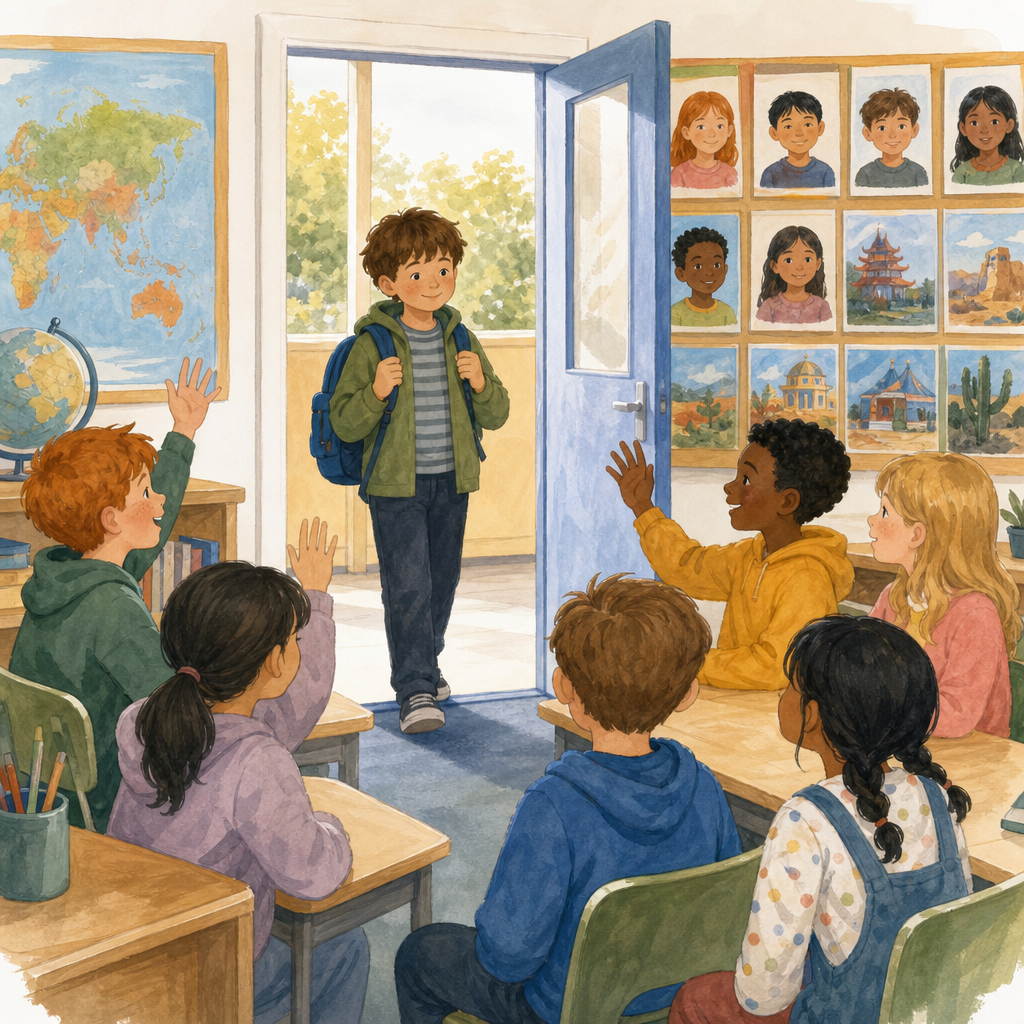
 A new pupil joins this class tomorrow and speaks none of your languages. What is the first thing you do?
Not the clever answer. The honest one. Hands up for a smile, a wave, a seat pulled out, a word you already know how to say.
By the end of this lesson, you will be able to:
- Talk about Ireland's big airport welcome and what it counts
- Read what a Leinster placename quietly tells a new arrival
- Write the welcome you would actually give, and name one thing you can notice now that you could not in September
1. The three words
Ireland uses a traditional greeting in airports, on signs, and in tourism materials: céad míle fáilte.
Said aloud: kyd MEEL-uh FAWL-chuh. Listen, then say it with the class.
2. What it counts
It counts a hundred thousand welcomes. Not one hello. A number so large it feels huge on purpose.
3. Where strangers arrive
A welcome is not only a feeling. It is also the words a country puts up where new people walk in.
A new arrival reads the road signs before anyone speaks. We will open Leinster place names on the board. Watch each name split into its pieces. What picture is the name painting?
Think of ordinary pictures: a fort, a church, a river, a plain.
Open your copy. Write the welcome you would actually give, in whichever language you choose, and why that one.
It can be one word, a short phrase, or a sentence. It can be Irish, English, a language from home, or no words at all if you explain the gesture. What matters is that it is yours.
Stuck? Start from the hook: a smile, a wave, a seat pulled out, or one word you already know.
Short clips from languages you have met all year. Each clip plays twice. Then we name the language together (hands up or call out). No writing.
This is the last listen of the course. Notice if guessing feels easier than in September.
Unlock the full learning experience
You're previewing this lesson. Get full access to this lesson and hundreds more — each one ready to teach, with interactive activities, printable resources and pupil progress tracking built in.
This lesson is copyright of Coding Ireland 2017 - 2026. Unauthorised use, copying or distribution is not allowed.