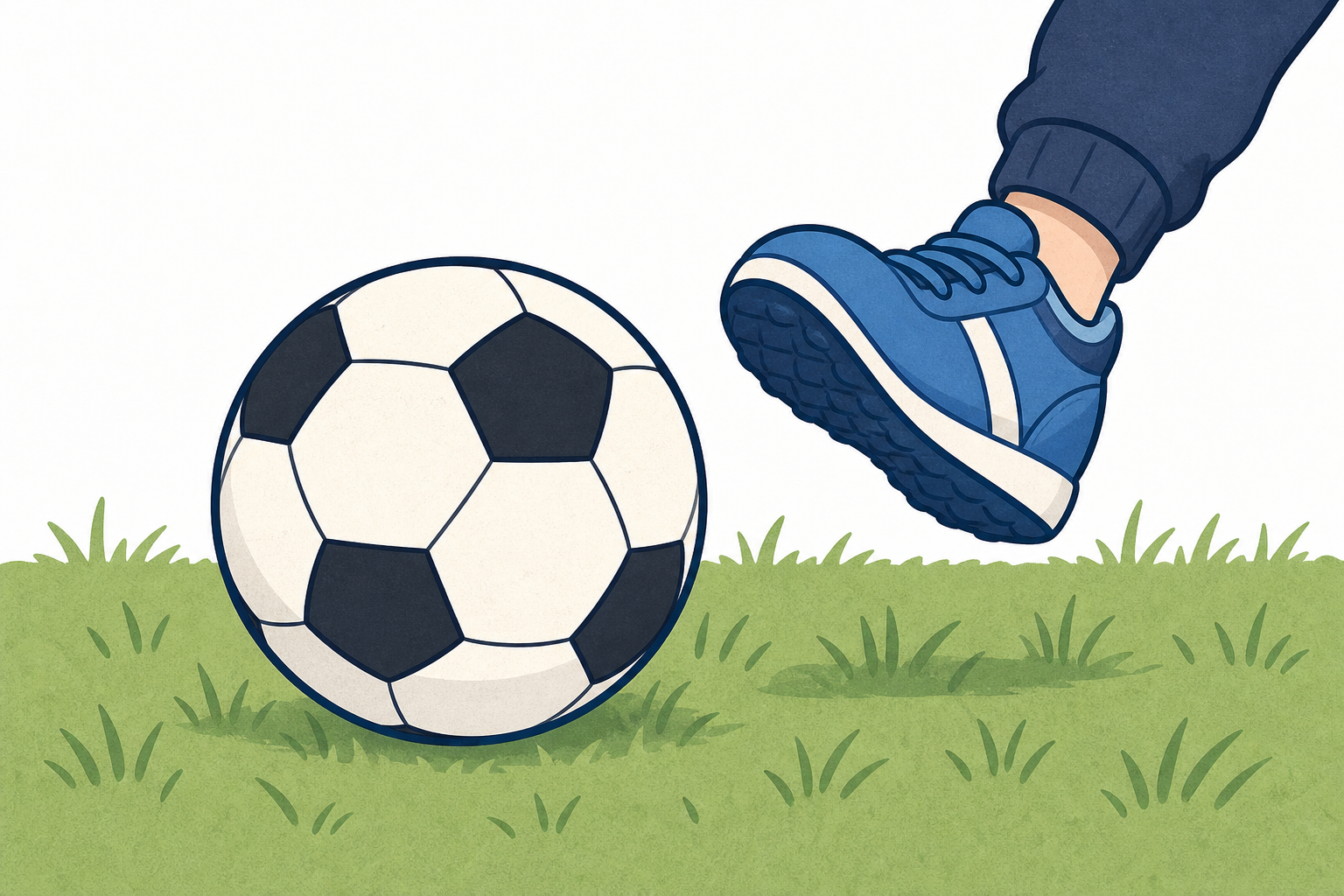
Imagine a footballer about to kick a ball. Sometimes they give a little kick. Sometimes they give a big kick.
Which kick do you think sends the ball further? Show me with your hands: small kick or big kick?
Keep this light. No cars or tape yet. Stand where everyone can see you and mime a soft kick, then a strong kick.
Key question: Which kick sends the ball further? Accept every idea. Guesses are never wrong.
Think of a footballer choosing a little kick or a big kick to send the ball just right. We will try the same idea with a car or ball on our floor lane.
Before the lesson: Clear as many short straight floor lanes as space allows (aim for 4–6 if you can, each about 2–3 metres), spaced so groups will not bump. Stick a start line with masking tape on each lane. Have one toy car or soft ball and two stop markers ready per lane for later, not now. Plan pairs so every child will push at least once.
You already know a push makes something move.
Which push will send our car further — a small one or a bigger one?
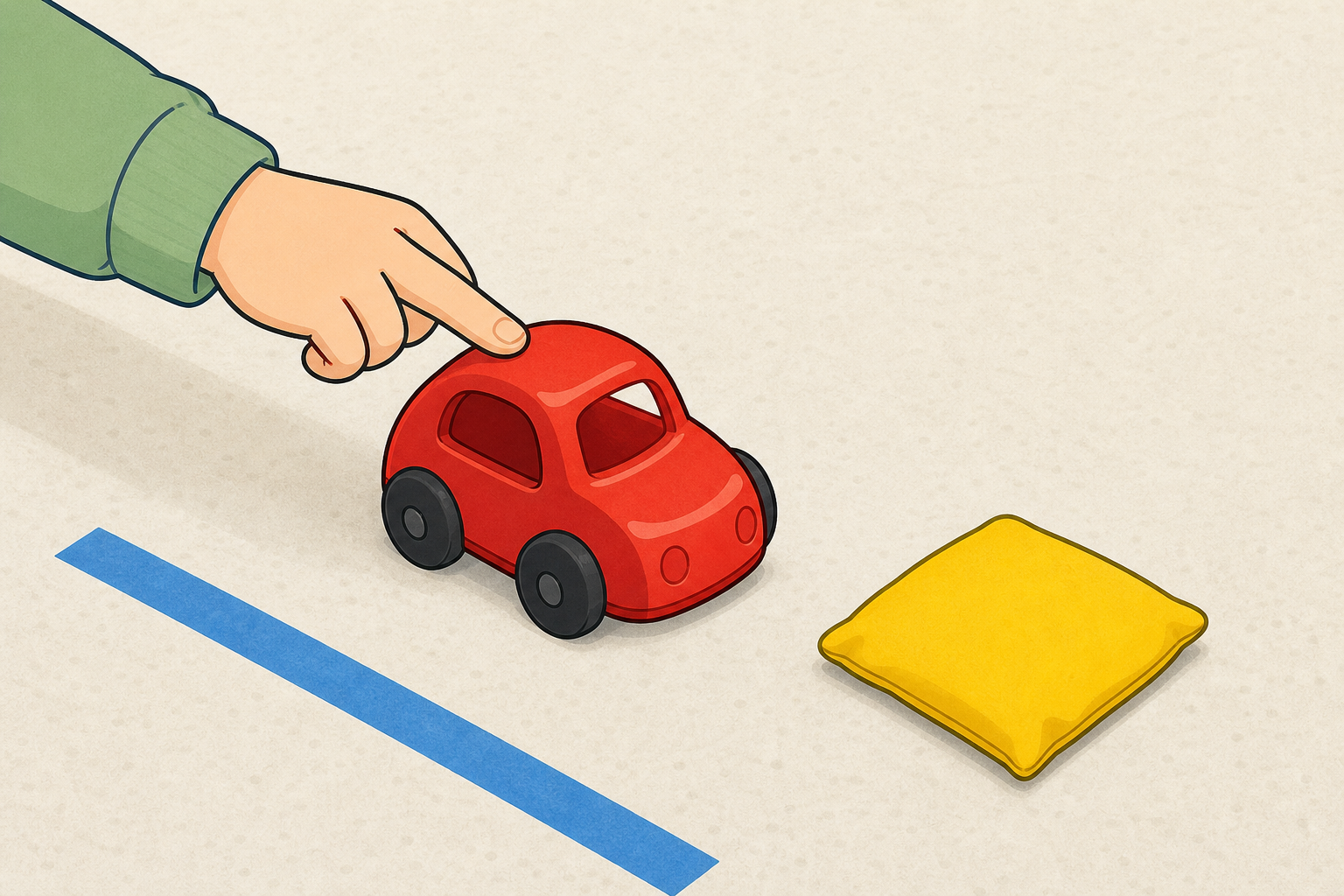
Show one toy car at a start line briefly so children can picture the job. Do not roll it yet. Say the words as you show the car: small push, bigger push, further.
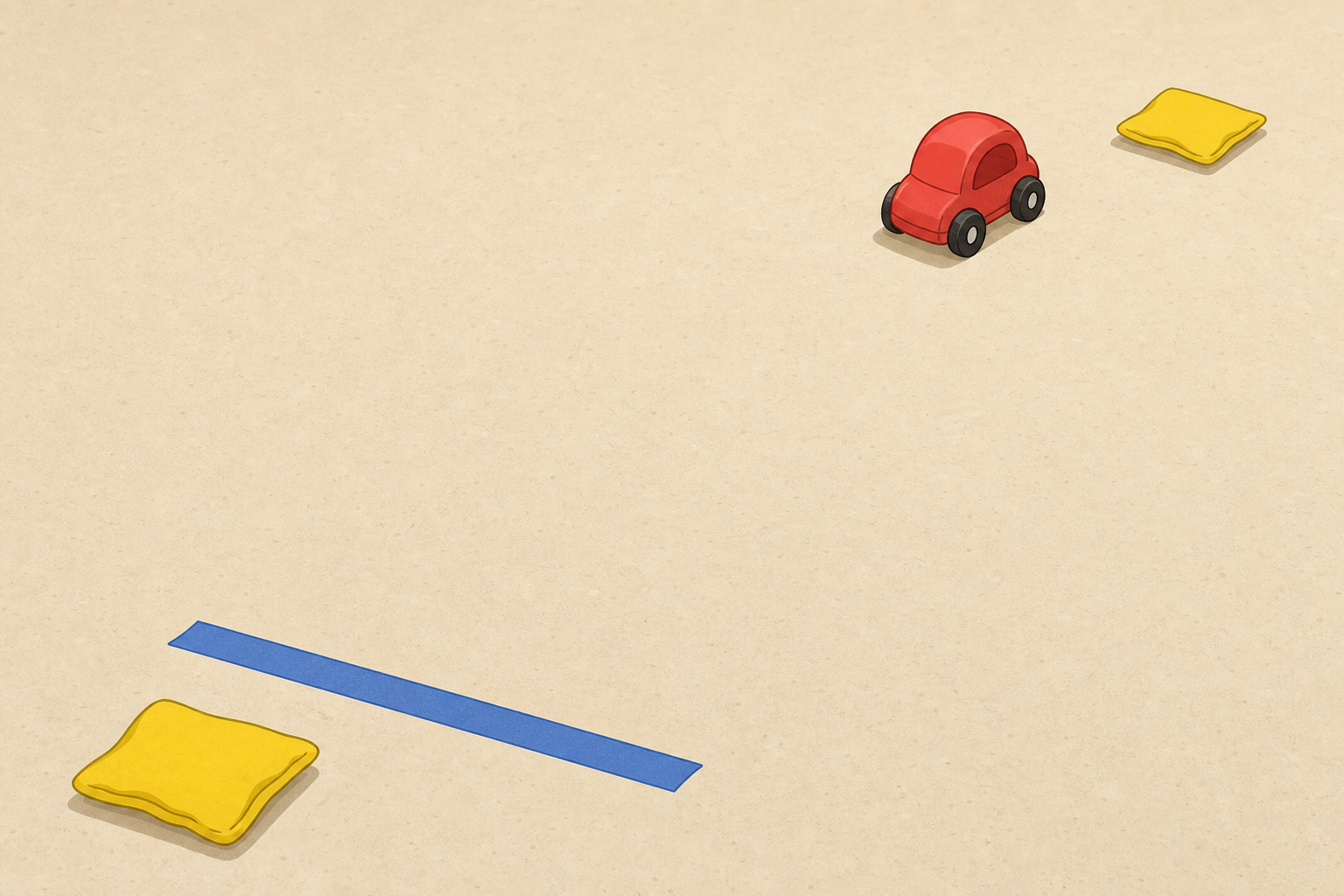
When you say further, use a simple gesture: point near the start for a short stop, then slide your hand a longer way along the imaginary lane. You can also place two sticky notes — one close, one further along — so children see that further means stops a longer way from the start.
| Concept | Why it matters | Example |
|---|---|---|
| Bigger push — a harder shove that makes something travel a longer way | Knowing how hard to push helps us send toys and balls the right distance | Same car, same start line: a harder shove stops further along the lane |
Keep oral language light: Use push and further in talk (children met push already). Do not turn them into extra formal terms today. One big idea only: a bigger push makes it go further.
Misconception to head off: Children may say the car goes further because it is "faster" or "heavier". Keep the talk on the push: same car, same lane, only the push changes.
Model aloud (one short cycle): I wonder if a bigger push will send it further. I think the bigger push will go further. Later we will try both and see. Do not give the answer away with a full demo yet.
Thumbs up for "bigger push goes further", thumbs sideways for "not sure". Note a few guesses to return to at the end.
One pair works at each floor lane. Everyone else watches and helps say small or bigger.
Pusher: give a small push from the start. Partner: put a marker where it stops.
Same car, same start: pusher gives a bigger push. Partner marks that stop too.
Look together. Which push went further? Then swap so every child gets a turn to push.
Set up as many short lanes as space allows (ideally 4–6; minimum 2–3), each about 2–3 m, each with its own taped start line, one car or soft ball, and two markers (cones, beanbags or sticky notes). Space lanes so feet and bags stay clear. One adult stays near the far end of the busiest lane.
Board reveal tip: Show one short beat at a time, then pause for doing or watching before the next line appears: (1) who pushes and who watches; (2) small push and mark; (3) bigger push and mark; (4) which went further, then swap so every child pushes.
Look-fors: children say "small" and "bigger" before they push; markers show two different stops; talk like the bigger one went further; every child has pushed at least once by the end of the rotation.
Differentiation: Offer a soft ball if a car sticks on the floor. Confident pairs who finish early may try one more bigger push and add a third marker if time allows. Keep language oral; no measuring in centimetres needed.
Safety: Roll only along the lane, away from feet and faces. Gentle pushes only. Kneel or sit at the side so nobody stands in the path.
Look at the two markers on the lane nearest you.
Point to the stop after the small push. Point to the stop after the bigger push.
Which marker is further from the start? Tell the child beside you what you noticed.
Stay at the lanes for a quick observation beat before tidy-up of spare markers. Walk the groups and ask children to point, not just say the answer. Watchers point from the side at the lane nearest them — they do not need "their own" markers.
Prompts: Show me the small-push stop. Show me the bigger-push stop. Which is further from the start line?
What to expect: Almost every pair will see the bigger push travel further. If not, check they used the same start and a truly gentler first push.
Link back briefly: a footballer looks at how far the ball needs to go, then chooses a little kick or a big kick.
Sit where you can see the front floor lane. We will watch and guess together.
First a small push. Guess where it will stop, then watch. The teacher leaves a marker there.
Now a bigger push with the same car from the same start. Guess again, then watch the second marker go down.
Look at both markers. Which push went further?
Whole-class revisit on the front floor lane only. No board ramp and no interactive. Stay on push strength: same car, same start line, only how hard you push changes.
How to run it:
Link the language: Same car, same start. Only the push changed. The bigger push went further — just like the markers on your lanes.
Fold watchers in: Do you agree with that guess? What do you think the new marker will do?
Do not switch to a ramp or talk about slope. That would change a different thing from the floor work.
Leave the two front markers in place for the next step so children who mainly watched have a clear shared picture to draw from.
You're previewing this lesson. Get full access to this lesson and hundreds more — each one ready to teach, with interactive activities, printable resources and pupil progress tracking built in.