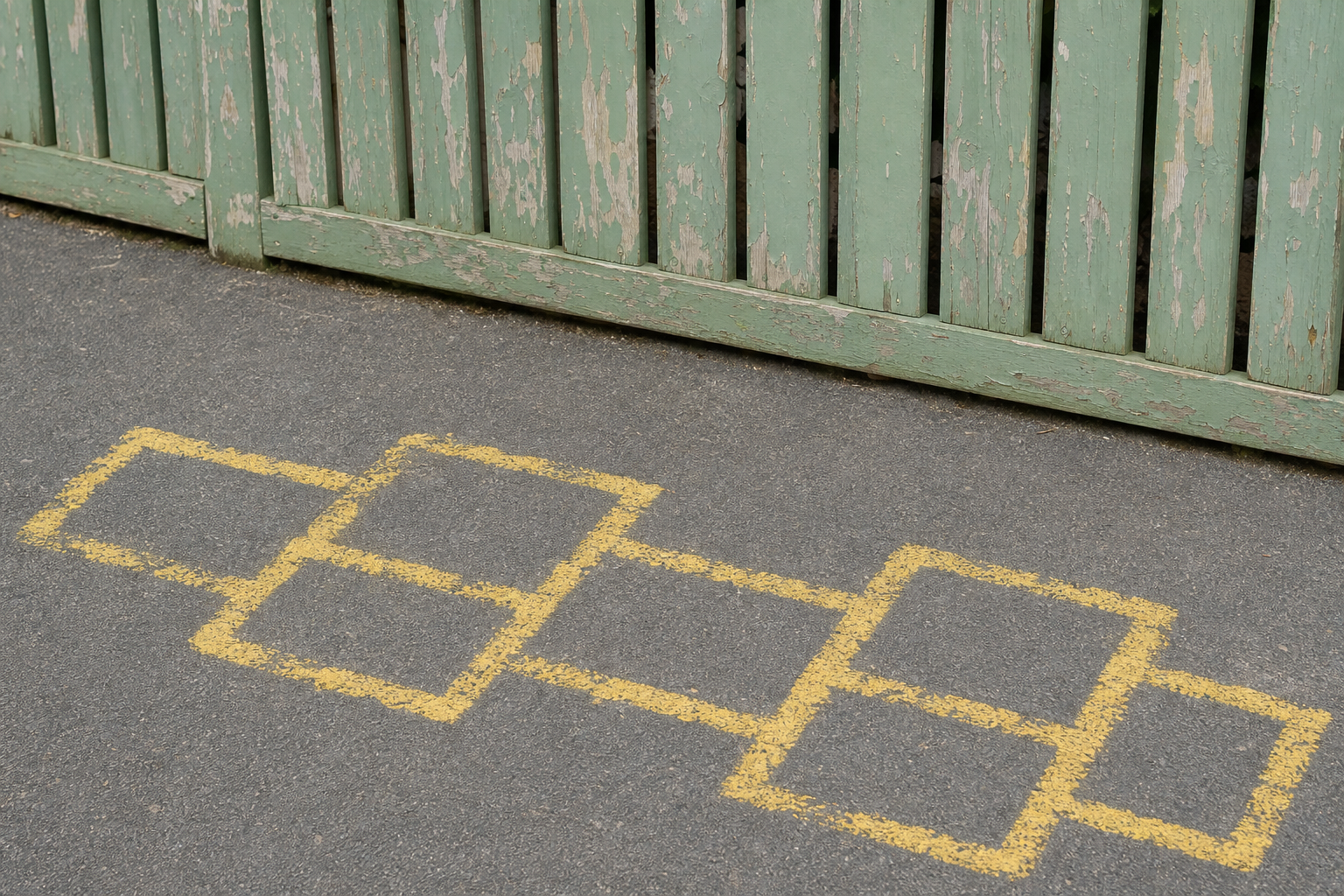
Look at this worn playground marking and the peeling paint on a school fence. Irish weather has been at work. What do you think rain, sun and wind do to materials left outside for a long time?
Advance prep (essential — book this lesson only if samples are ready): at least one to two weeks ahead, leave matched pairs of samples outdoors in a safe, open spot and keep identical twins indoors in a dry cupboard. Label both sets Outside and Inside. Core set that still runs the lesson: paper, fabric scrap, foil and chalk. A leaf is optional for dramatic looking (see step 4 notes). If weather has been very dry, a few days of real Irish rain and wind still show useful differences; chalk and paper usually change fastest. Minimum runnable kit: one shared class set of weathered samples and one matching sheltered set if group trays are not ready.
Emergency fallback (substitute teacher or late booking — no full outdoor sets): still run the compare/record/chart arc. Use clear photo pairs on the IWB of real Irish weathered versus new materials (faded playground lines beside fresh paint marks; pale peely fence paint beside a newly painted patch; outdoor chalk marks washed thin beside a fresh stick). If you can, prepare one live pair that week (for example wet crumpled paper versus dry paper, or outdoor chalk versus fresh chalk) so pupils still handle a real comparison. Groups then score and chart from the photo pairs plus any live pair, using the same 1–2–3 difference language. Keep the investigation question and journal notes the same.
Keep this beat light. Show one clear example only: a photo on the IWB of faded playground lines or peeling outdoor paint, or one real weathered object if you have it handy. Do not lay out the full sample trays yet.
Take three or four quick ideas from hands. Revoice everyday noticing: the colour has gone pale, it looks cracked, it feels soft. Tell the class that today they will check samples that have been waiting outside, and matching ones that stayed safe indoors.
Irish weather can slowly change things left outside. We call that weathering.
That is why paint on a school fence can go pale and peely after many wet days. Look back at the worn marking or peeling paint. What might rain, sun or wind have done to it?
| Concept | Why it matters | Example |
|---|---|---|
| Weathering — rain, sun and wind slowly change materials left outdoors | It helps us understand why outdoor things wear, fade or fall apart, and why we choose strong materials for outside jobs | Paint on a school fence that has gone pale and peely after many wet Irish days |
| Sheltered — kept indoors or under cover, away from rain, sun and wind | A sheltered twin is our comparison: if only the outdoor one changed, the weather is the likely cause | The same kind of paper kept dry in a classroom cupboard |
Name weathering only on the board in this step. Hold sheltered and the idea of looking side by side until the trays appear in step 4, and use them as plain talk with the real pairs rather than a third glossary term to memorise.
Misconception to head off: children may say outdoor samples are "dirty so they look different". Dirt can sit on a surface, but weathering is the material itself changing (fading, softening, tearing, crumbling). Ask: If we gently brush the dirt off, does it still look or feel different?
Link STEM eyes to the immediate environment: walls, fences, playground markings and outdoor furniture around the school all show weathering if you look carefully.
Our question: What does Irish weather do to materials left outside?
Think about paper, fabric, foil and chalk. Which ones do you think changed the most outside? Tell your partner why.
Pose the question on the board. Quick think-pair-share, then take a few class predictions. Predictions are the start of the science, never wrong.
What to expect: many children will pick chalk as "most changed" (they are often right). Some will say foil "never changes" because it is metal; foil often dulls or crinkles rather than disappearing. If you included a leaf, children often pick that too.
Ask why: rain soaking, sun fading, wind tearing or drying. Do not reveal the real samples' results yet.
Optional: jot three prediction words on the board (for example chalk soft, paper torn, foil dull) so the class can check them later.
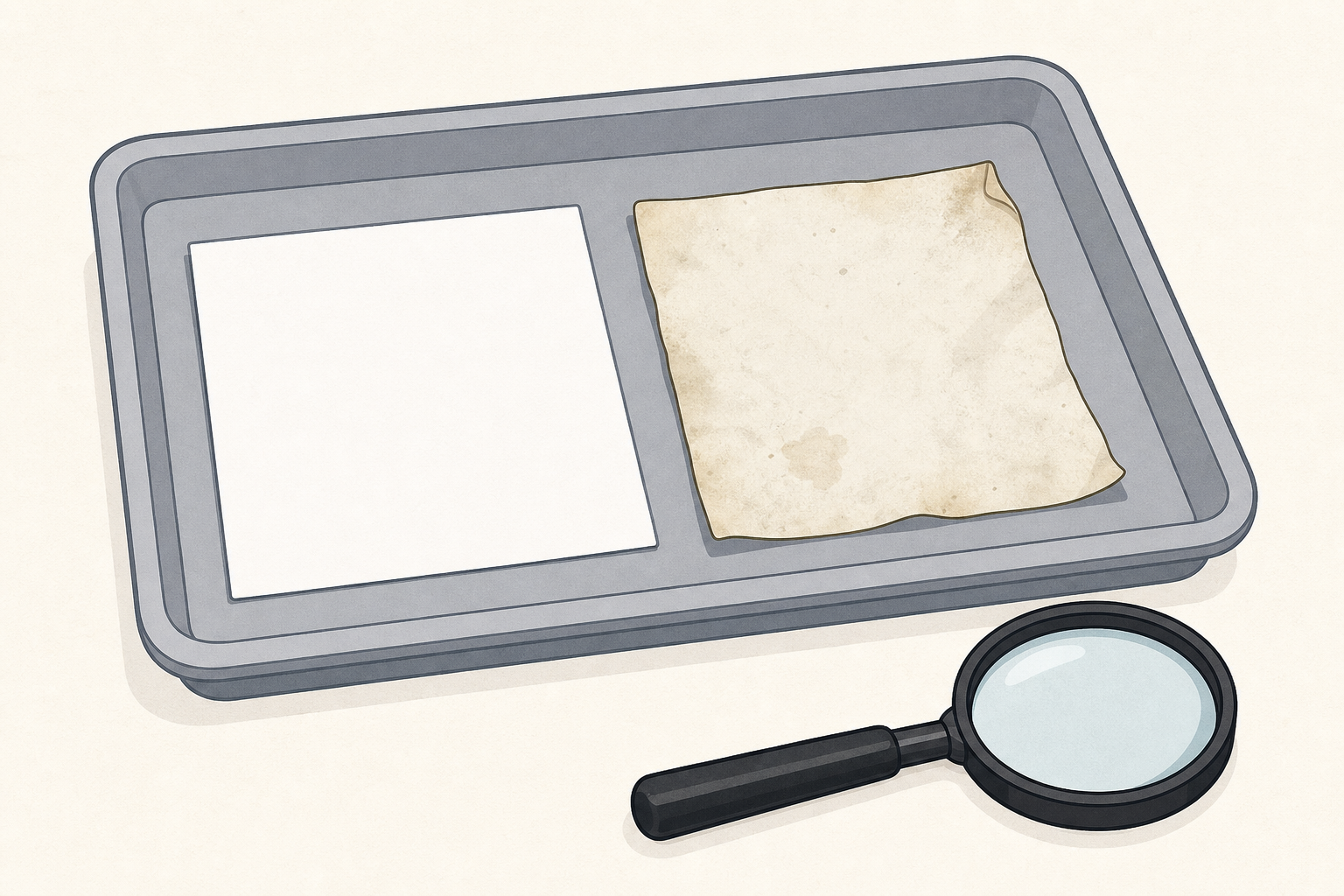
Each group has outside samples and matching sheltered ones indoors: paper, fabric, foil and chalk.
Word bank: colour · tears · soft · stiff · shiny · dull · crumbled
Trays must be staged before pupils sit: one tray per group with weathered samples and matching sheltered twins, clearly labelled Outside and Inside. Core pairs: paper, fabric, foil, chalk. One magnifier per pair (not per pupil). Journals already on desks for the light capture jot.
Optional leaf: a leaf left outdoors mainly browns, dries and crumbles because it was once living (desiccation and decay), and an indoor leaf often browns too, so it is a weaker control. Keep a leaf only for dramatic careful looking; when you sum up weathering of materials, lean on chalk, paper and fabric.
Emergency fallback: if full outdoor sets are missing, use IWB photo pairs plus any one live pair prepared that week (see step 1 notes). Keep the same ordered beat: look → say one difference → jot → next pair.
Reveal the board list one beat at a time so pupils do not stack jobs. Model one pair at the front first (full cycle, think aloud):
Introduce plain language here: the indoor twin is sheltered (kept under cover). We compare by looking side by side to spot what is the same and what is different.
Then groups work through the pairs using the board order. Circulate and push precise talk: not just "yuck" — is it faded, cracked, softer, smaller? Nudge anyone who skips the jot while the tray is still out.
Light capture (essential): while trays are still out, each pupil jots one word or tiny sketch per sample on the Investigation Journal page (for example soft, torn, shiny). This is not the full write-up; it is memory support for step 7.
What to expect (typical after real Irish weather): chalk often smaller, powdery or partly dissolved; paper wrinkled, faded or torn; fabric duller or stiffer; foil duller or more creased. Exact results vary with how long samples sat outside — use whatever your set shows as genuine evidence.
If both sets look almost the same: say so honestly. Ask what weather the samples actually had, and what the class would try next time (longer outside, wetter spot). Unexpected results are still data.
Use what you noticed to answer our question: What does Irish weather do to materials left outside?
Watch the board first: your teacher will score one pair as an example (1 almost the same, 2 a bit different, 3 very different) and say why.
As a class we will score chalk, paper and fabric in our groups. For each one, agree 1, 2 or 3, and be ready to say one change you saw. We will take a quick class vote for foil (and any sample only a few groups scored) so every sample has a class score for the chart.
This beat turns careful looking into an answer. Groups stay with their trays.
Model first (about 30–40 seconds): hold up one clear pair (often chalk). Show what each number means in plain talk: 1 almost the same as the sheltered twin, 2 a bit different, 3 very different. Give one example score with a reason, for example chalk is a 3 because the outdoor stick is smaller and powdery.
Three-sample group scores (intentional): every group scores the same three materials — chalk, paper and fabric — so leaving foil out of the group debate is planned, not a mistake. They may glance at foil but do not need a full score debate on it.
Time-boxed path so all four chart rows are filled before you leave this step:
Fold the whole class in while groups decide: Do you agree chalk is a 3? What evidence makes you sure? Watching and challenging another group's score is real participation.
Conclusion language to model: I observed that the outdoor chalk was smaller and powdery, so I think rain weathered the chalk. Separate what we saw from what we think it means.
You're previewing this lesson. Get full access to this lesson and hundreds more — each one ready to teach, with interactive activities, printable resources and pupil progress tracking built in.