Listen for a moment. What is the quietest sound you can hear right now? What is the loudest sound you have heard today?
Today we will find out what makes a sound louder.
Keep this light. Hands up for quietest and loudest. Accept classroom and home examples (a whisper, a football cheer, a fire-drill bell, rain on the window). Do not set out drums or rice yet.
STEM eyes: volume is all around us in school and at home. We will link back to everyday loud and quiet sounds at the end.
Our question today: what happens to the sound if we tap a drum gently, then strongly?
Volume means how loud or quiet a sound is.
Predict with a partner: will the sound get louder, quieter, or stay the same? Why do you think that?
| Concept | Why it matters | Example |
|---|---|---|
| Volume — how loud or quiet a sound is | We use volume every day to hear a whisper or a fire-drill bell safely | A whisper is quiet; a school bell is loud |
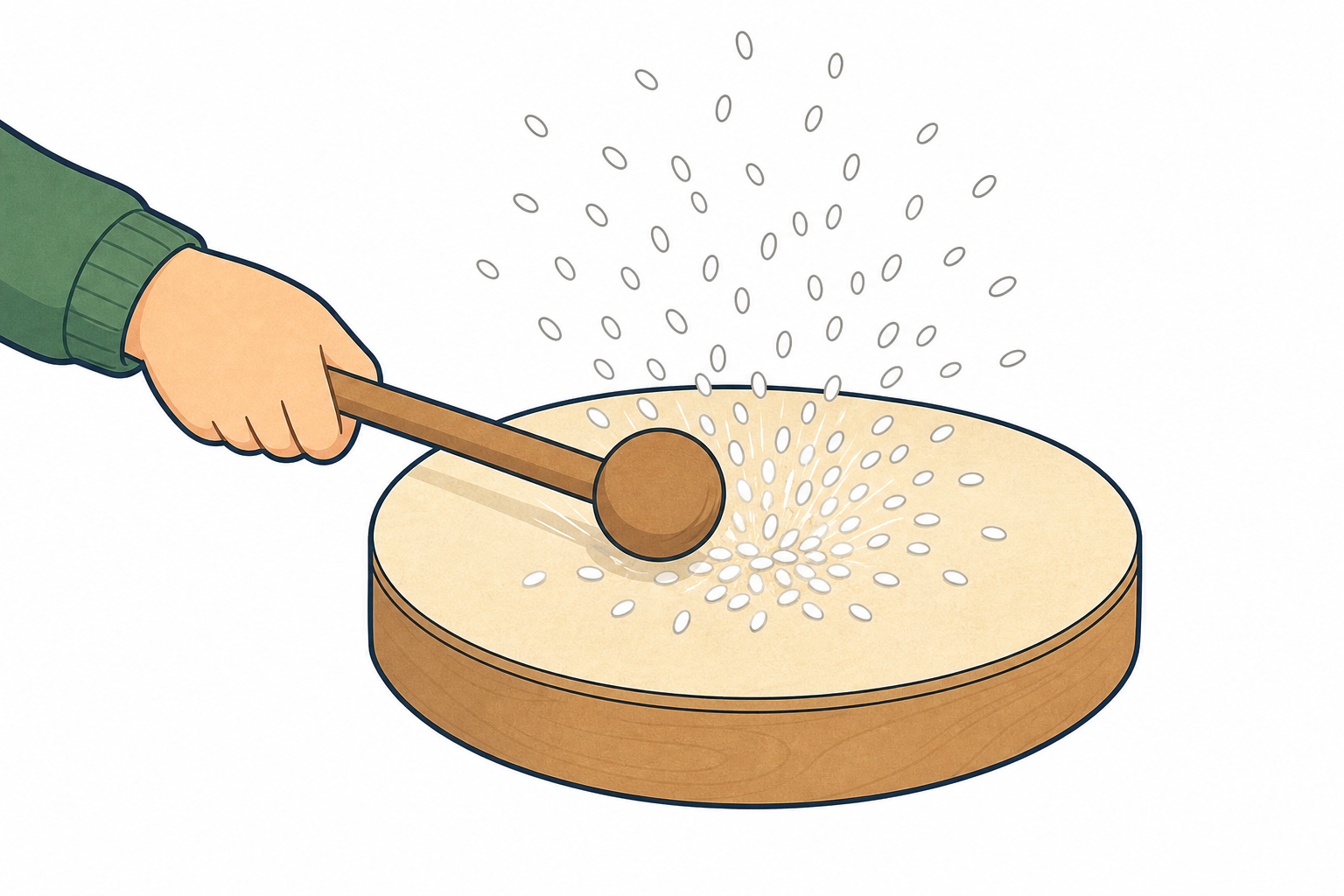
| Vibration — a quick wobble that makes a sound | If nothing wobbles, we hear no sound | Rice jumping on a drum skin shows the skin is wobbling |
| Key idea: bigger vibration → louder sound | Knowing this helps us keep sounds class-friendly and protect our ears | A strong tap makes rice jump higher and the sound louder |
On the board, only name volume lightly before the partner talk. Hold vibration until step 3, when the rice shows the wobble. The full table is your teaching support, not a board dump. The link bigger vibration → louder sound is the finding children build from evidence, not a third glossary word to memorise up front.
Misconception to head off: children often mix up loud with high. Keep the talk on how big the wobble is, not how high the pitch is. The interactive later will separate those two ideas in plain words.
Format: think-pair-share. Collect a few predictions on the board (louder / quieter / the same) without judging them. Predictions are the start of the science, never wrong. Keep prompts about the sound only; do not mention rice yet (materials are still put away).
Key questions: Will the sound get louder, quieter, or stay the same? Why do you think that?
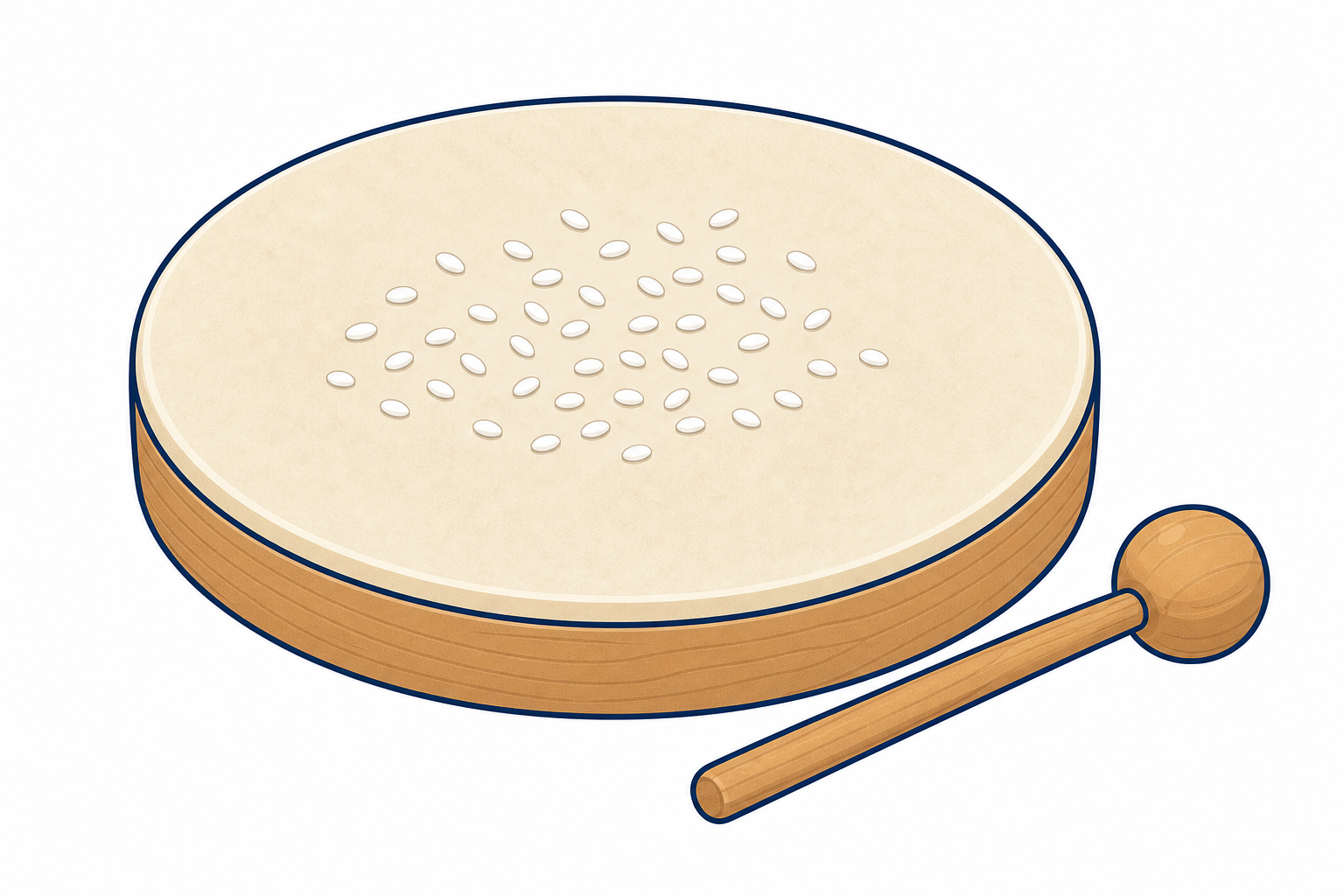
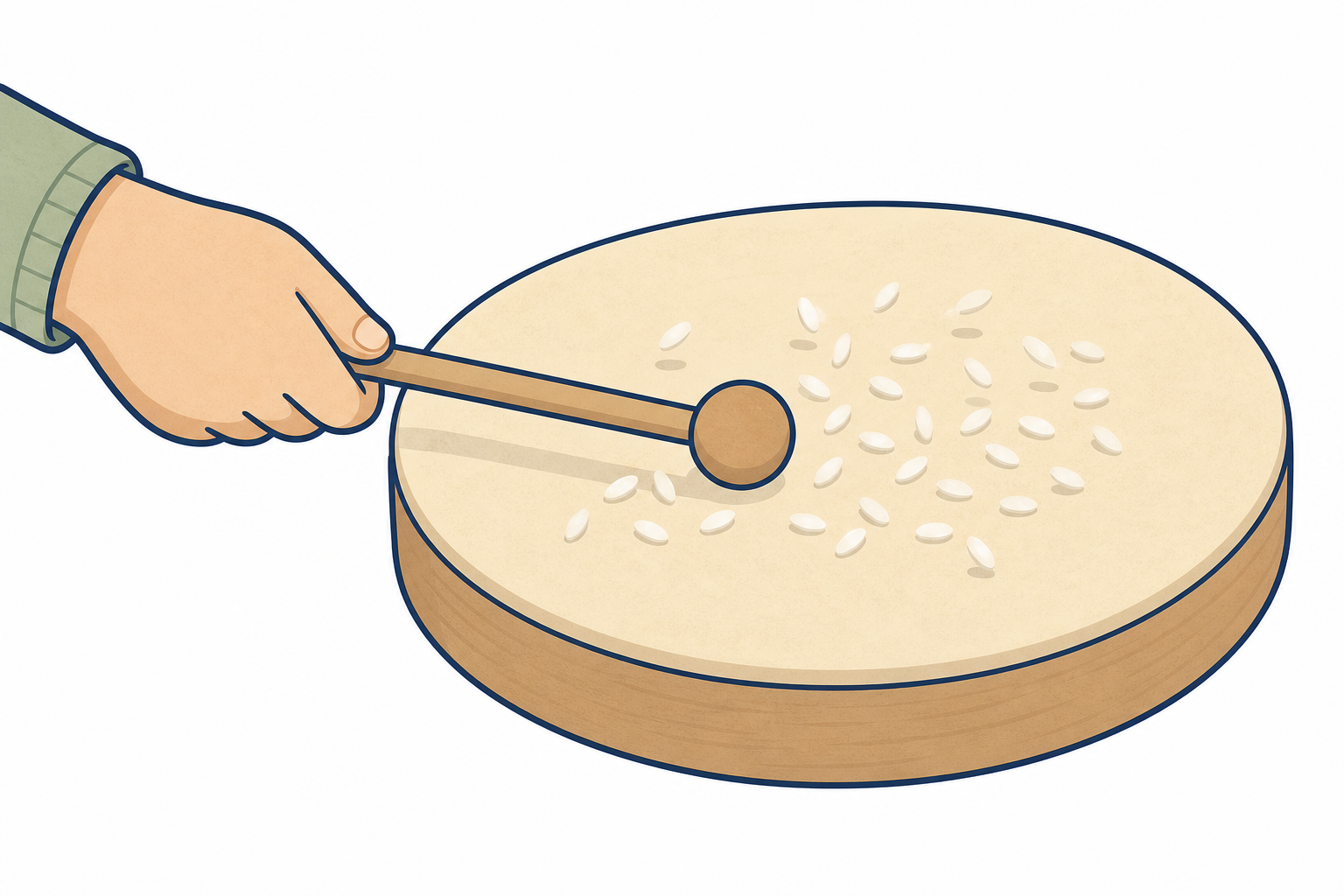
In your group, try a gentle tap, then a strong tap on the drum. Watch the rice. Listen carefully.
The rice shows a vibration: a quick wobble that makes a sound. Which tap made the rice jump higher? Which tap sounded louder?
Do one clear model aloud, then hand over to groups. Do not run a full second demo.
I wonder: does a stronger tap make a louder sound?
I predict: I think a strong tap will make the rice jump higher and the sound louder.
I test: sprinkle a little rice. Tap gently once. Pause. Tap strongly once. Same place on the skin each time.
I observed: gentle tap: rice barely moved, quiet sound. Strong tap: rice jumped higher, louder sound.
I think: a bigger vibration makes a louder sound. Name vibration here as children see the rice jump.
Groups of three to four. One child taps, one watches the rice, one listens, then swap once so more children get a turn. Main task only: drum and rice, gentle then strong. That is the load-bearing evidence for the lesson. Aim for every child to see at least one gentle and one strong trial, and for each group to complete at least one role swap.
Drop if short: a quick gentle-then-strong pluck on the elastic-band guitar, listen only, no rice. Do not start the guitar until every group has finished the drum-and-rice trial and at least one swap. If minutes are tight, skip the guitar entirely.
What to expect: strong taps send rice higher; the class should hear louder. If rice does not jump, use a thinner film or a firmer tap on the centre of the skin.
Safety: protect ears from very loud noise; no banging near faces; stop on your signal.
Fold watchers in by asking: Did the rice jump higher that time? Was it louder or quieter?
Look at the drum on the board. We will try a quiet hit, then a louder hit.
Watch the size of the wobble. Does the sound get higher like a squeak, or does it stay the same kind of sound and only get louder?
Drive the sound-explorer interactive on the IWB in explore mode on the drum scene. The class cannot change scene.
What appears on screen: a drum skin that wobbles, rings spreading toward an ear, and strength set with words quiet / medium / loud (not numbers). Optional Hear it button if the room can manage a short tone.
How to drive it:
Link back to the rice: the jumping rice was the real wobble; the board shows the same idea clearly.
If the room needs quiet, set enableTone off and teach from the picture alone.
First: on your Investigation Journal page, draw or write what you predicted. Then show the gentle tap and the strong tap: how high the rice jumped, and whether the sound was quieter or louder.
Next (must finish): put these three in order from quietest to loudest: gentle drum, strong drum, talking voice.
Pupils use the Investigation Journal page. You do not design the layout. Tell them what to record, not where boxes sit on the page.
Before pupils start writing: name the three sounds on the board so the full trio is visible: gentle drum, strong drum, talking voice. Do not leave a blank for improvising mid-task. (If talking voice is a poor fit for your room, swap in school bell once, write it on the board, and keep that fixed trio.)
Two short beats (keep light for 2nd Class):
If writing time runs short, keep rice-height drawings minimal and move the class onto the order; do the order as a quick pair sort then mark only the ranking on the page if needed.
Support writers with oral rehearsal first: I predicted… I saw the rice… I heard… Drawing the rice height is a full valid record for beat 1. Circulate and ask one child per group to read their quieter/louder finding aloud.
Differentiation: most pupils draw rice height for gentle and strong with a quiet/loud label; confident writers may add one short sentence linking bigger wobble to louder sound.
You're previewing this lesson. Get full access to this lesson and hundreds more — each one ready to teach, with interactive activities, printable resources and pupil progress tracking built in.