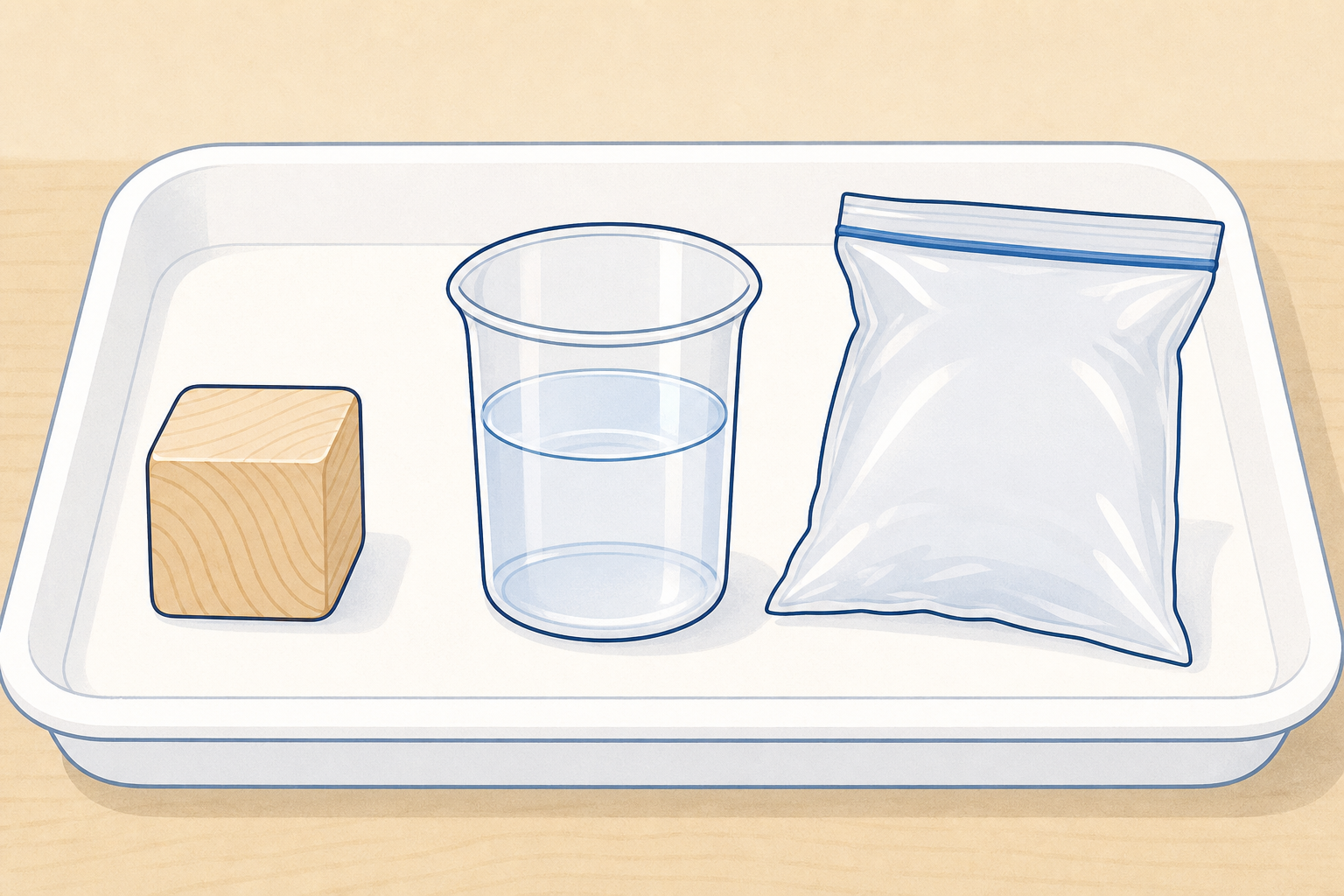
Look at these three things on the tray: a wooden block, a cup of water, and a sealed bag of air. Which one keeps its own shape? Which one pours? Which one fills its whole container?
Hands up: can the same material ever behave in more than one of these ways?
Have one wooden block, one clear cup of water and one sealed clear bag of air ready to show. Hold each up in turn and take two or three quick answers. Do not name the three states yet; let curiosity lead.
What to listen for: children often say air is "nothing" or that sand (if they have met it) is a liquid because it pours. Note those ideas without correcting them yet.
Keep this beat light. The stations come out in the next activity, not here.
The block keeps its own shape — we call that a solid. The water pours and takes the cup's shape — that is a liquid. The air fills the whole bag — that is a gas.
We will test real materials at stations. Later we will look at the tiny pieces inside materials that help explain what we see.
Project only the short board version above. Use the table below yourself when you need a fuller gloss or an example to point at. Keep the core trio to solid, liquid and gas; particle talk belongs in the interactive step later, not as a fourth equal board term here.
| Concept | Why it matters | Example |
|---|---|---|
| Solid — a material that keeps its own shape unless something forces it to change | Solids are the materials we build with and sit on because they hold a shape on their own | A wooden block still looks like a block when you leave it on the table |
| Liquid — a material that pours and takes the shape of the container it is in | Liquids let us pour drinks, wash hands and fill bottles of different shapes | Water poured from a jug into a cup fills the bottom of the cup and matches the cup's shape |
| Gas — a material that spreads out and fills the whole space of its container | Gases are all around us; the air we breathe fills every corner of the room | Air sealed in a clear bag fills the bag; gently squeeze and the bag still feels full |
Misconception to head off: sand pours, so children often call it a liquid. Each grain is a solid. Sand pours because many tiny solid grains slide over one another. Save the full correction for the sand station, but plant the seed here if someone raises it.
Worked model (say aloud before stations): "I wonder if this block will keep its shape when I leave it alone. I predict it will, because it feels firm. I put it down… I observed it still looks the same. I think that means it is a solid." Model one full cycle on the block only; children then run the same questions at every station.
Visit each station with your group. At every station ask three questions: Does it keep its own shape? Can you pour it? Does it fill the whole container?
Touch and move the materials carefully. Talk about what you notice before you move on.
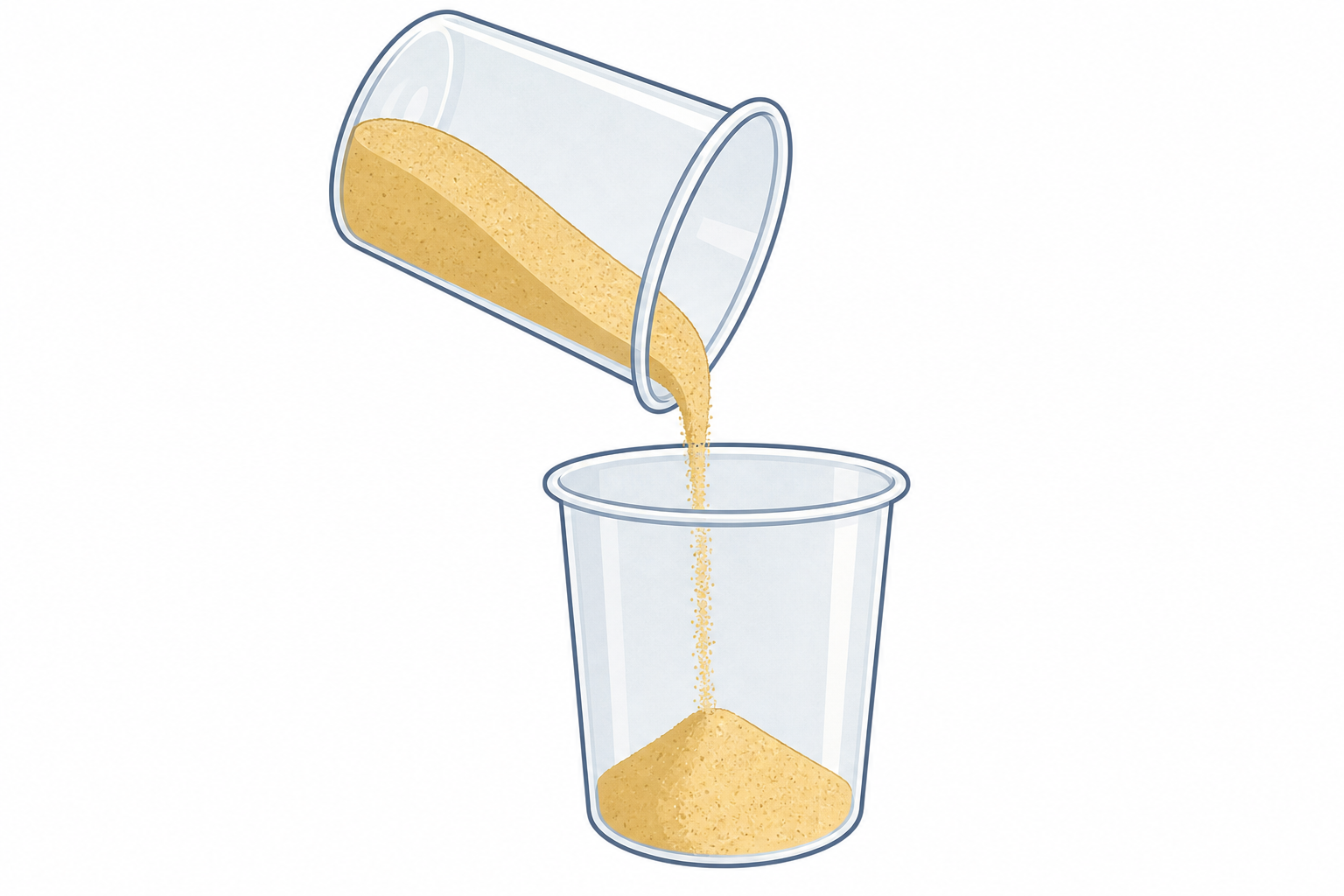
Use shared rotating stations, not a full kit on every table. Plan groups of about four to six children so each station stays calm for pouring.
How many station sets:
Label each station with a simple number card only.
If you run two sets, double those station quantities (two trays of blocks, two water set-ups, two sand trays, two air-bag stations).
Plan about three minutes of hands-on talk per station plus a short move. Stay near the water and sand stations for spill control. Groups talk only at stations; they do not write yet.
At the sand station, ask: Is every tiny grain keeping its own shape, or is the whole pile one liquid? Draw out that each grain is a solid, even though the pile pours.
At the air bag, ask children to gently squeeze (not pop) and notice the bag still feels full. Air is a real material, not "nothing".
Differentiation: less confident groups work with an adult or older peer and answer the three questions aloud only. Confident groups can try pouring water into a differently shaped container and say what stayed the same.
Back together. For the block, the water, the sand and the air bag, decide together: does it hold its shape, does it pour, and does it fill its whole container?
For sand, a short phrase is fine — you do not have to answer with only yes or no. Be ready to say one thing that surprised you.
Stand at the IWB or board and capture a quick class table with four rows (block, water, sand, air bag) and three columns (holds shape? / pours? / fills whole container?). Children call out; you tick or write short phrases.
Sand row on the board: leave space for a longer phrase, not a single tick. Write something like pile pours / each grain solid so the class can see that a longer answer is the right capture. Do not force a bare yes/no in "holds shape". The pile only loosely keeps a shape; each grain keeps its own shape. Pours yes as a pile. Does not fill a container the way a gas does. Name sand as many tiny solids that slide.
Expected pattern:
Misconception: if the class votes sand as a liquid, praise the pour observation, then hold up one grain (or pinch a few) and ask whether that single grain keeps its shape.
Fold the whole class in with cold-call questions: Do you agree with that group? What would you change?
We are about to look inside ice, liquid water and water as a gas (invisible water vapour). Particles are the tiny pieces a material is made of — far too small to see, but they explain everything we tested.
This interactive activity shows what those particles are doing. Watch carefully. What are the particles doing that makes ice keep its shape? What changes when it melts?
Open the states-of-matter interactive in guided mode on the IWB. Substance is water. Step through the guided beats below; do not let children drive the slider yet until the last prompt.
Supporting idea (particles): particles are the tiny pieces a material is made of. They are far too small to see, but the way they pack and move explains why solids, liquids and gases behave differently. Keep this as the explanation layer after children have met the three behaviours, not as a fourth equal board word from the start. The pupil board already carries the plain gloss; revoice it once if anyone looks unsure.
What appears on screen: particles of water in a container. As temperature changes, they move from a fixed wobbling pattern (solid ice) to sliding and pooling low (liquid water) to racing through the whole container (gas / water vapour). The state name and a one-line reading follow after the watching.
Guided path (match the on-screen steps):
Key teaching line: the material is still water in all three states. Heating and cooling change how the particles move, not what they are.
If the interactive is unavailable, sketch three simple boxes on the board (dots fixed / dots sliding low / dots everywhere) and narrate the same three beats.
You're previewing this lesson. Get full access to this lesson and hundreds more — each one ready to teach, with interactive activities, printable resources and pupil progress tracking built in.