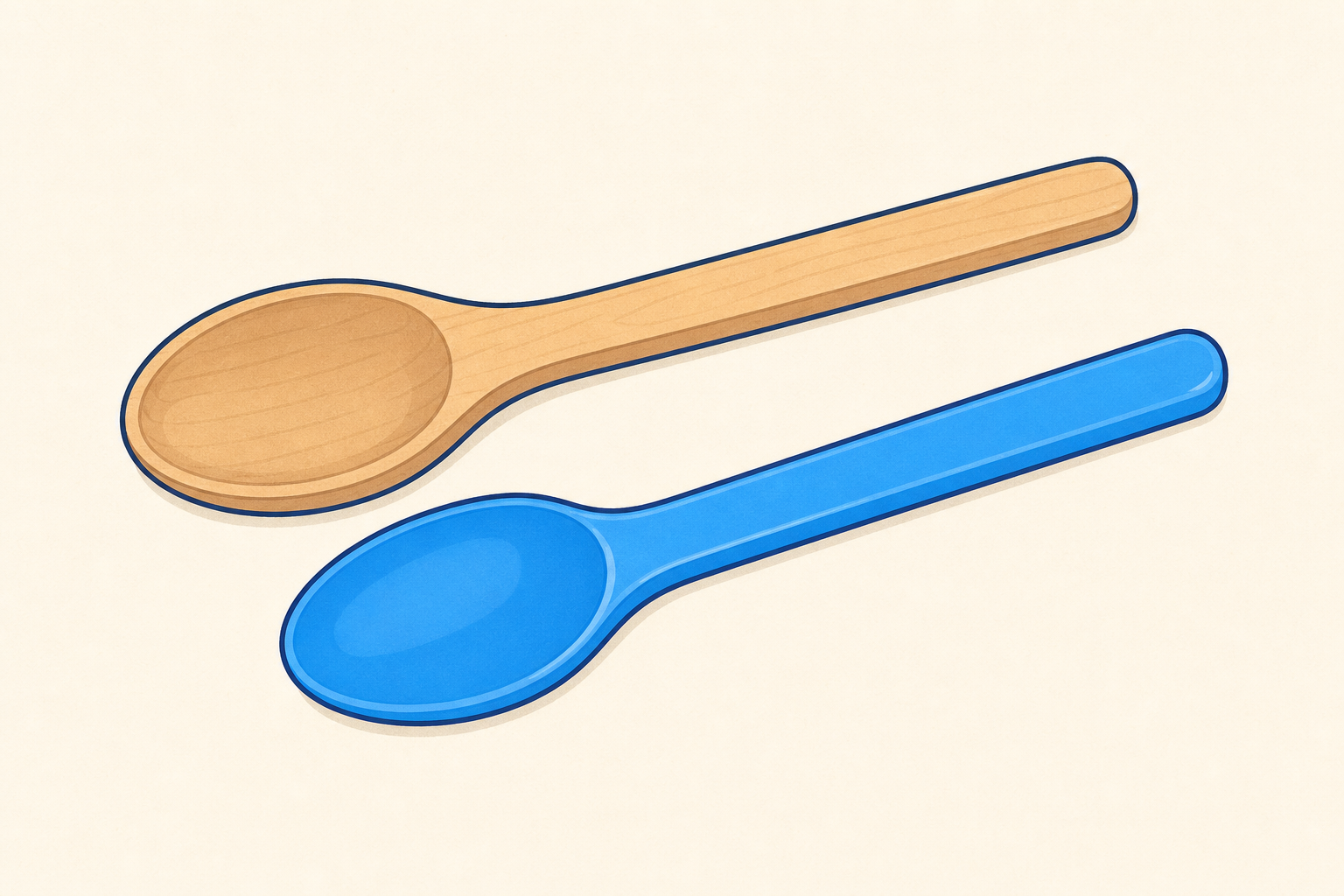
Look at these two things: a wooden spoon and a plastic spoon. Both are spoons. Both hold food. But are they made of the same kind of material?
Where do you think each one came from before it was a spoon?
Hold up a wooden spoon and a plastic spoon (or any clear natural/synthetic pair). Keep the hook light: one question and a quick show of hands. Do not introduce the full vocabulary table yet.
Key questions: Which one grew or came from nature? Which one do you think people made? What makes you say that?
Have the sorting trays ready out of sight for the next hands-on step. No full apparatus walk-through here.
Today we sort materials by where they came from.
Natural material: comes from plants, animals or the ground (even if people have shaped or cleaned it).
Synthetic material (made by people): people make it from chemicals, usually in a factory, and it does not grow ready-made in nature.
Look again at the wooden spoon and the plastic spoon. Which is natural? Which was made by people?
Teach only two ideas now: natural versus made by people. Keep the spoons in hand so pupils can point. Save mixed object until the room hunt and journal beat. Read the short board lines aloud, then use the table below as your reference. Say the hard word synthetic yourself and always pair it with made by people so pupils hear both.
| Concept | Why it matters | Example |
|---|---|---|
| Natural material — a material that comes from plants, animals or the ground, even if people have shaped or cleaned it | Helps us know where everyday things really come from, and how they link to living things and the land | Wool from a sheep, cotton from a plant, wood from a tree, stone from the ground, paper from trees, rubber from a rubber tree |
| Synthetic material — a material made by people from chemicals, usually in a factory, that does not grow or form ready-made in nature | Lots of classroom and playground objects are synthetic, so naming them helps us sort and choose materials wisely | Plastic from a bottle top, polyester fabric, foam packing |
| Mixed object — an everyday thing made of both natural and synthetic materials (introduce later in the lesson) | Most real objects are not pure one thing; noticing both parts is careful science looking | A wooden pencil with a rubber tip and metal band; a book with paper pages and a plastic cover; a wool jumper with a plastic zip |
Misconception to head off: children often say anything soft or brown is natural, and anything shiny is synthetic. Soft fleece can be synthetic; shiny silk is natural. Push them back to where it came from, not how it looks. Paper, cotton fabric and wool yarn are still natural because they came from plants or animals, even though people cleaned or shaped them. Factory finishing does not make a material synthetic.
Worked sort (model aloud before groups start): Hold up a wooden lolly stick. I wonder where this came from. I predict it is natural because it looks like wood from a tree. I look closely and feel the grain. I think it is natural wood. Now a plastic bottle lid: I predict made by people because plastic is made in a factory. I think synthetic (made by people).
Before you place each item, say where you think it came from and whether you predict it is natural or made by people.
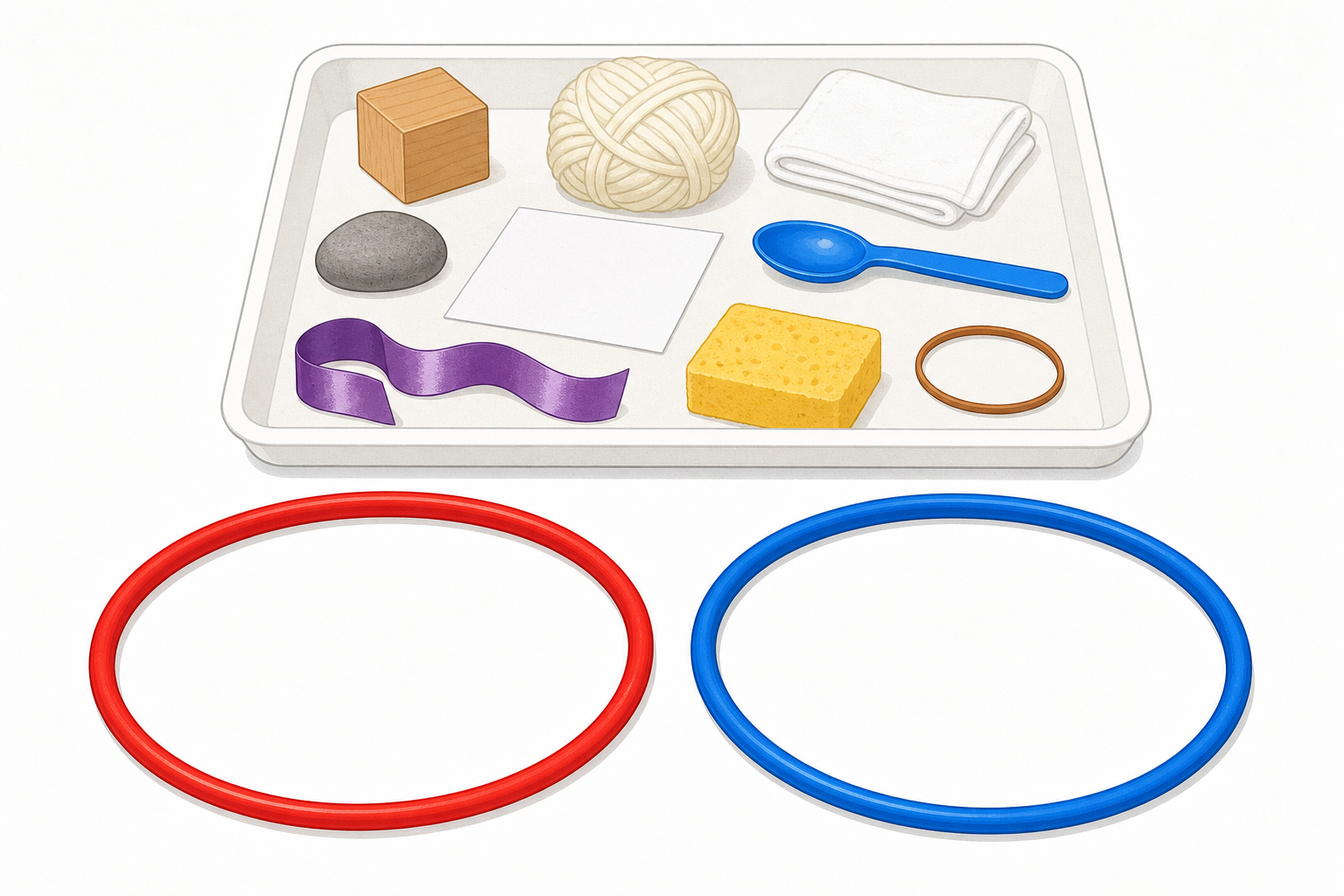
In your group, sort every item on the tray into two hoops: natural or made by people.
If you disagree, leave it on the line between the hoops. That is fine. Be ready to tell the class both reasons.
Hold up the tricky scraps and say one short origin line so sorting talk stays useful:
Keep spoken prompts on origin language: Did this come from a plant, an animal or the ground, or did people make it? Do not rush disputed items; the science talk is the point. Pupils may hear the word synthetic from you, but they can sort using made by people.
Preferred classifications: wood stick, cotton, stone, wool, paper, rubber band → natural; plastic lid, polyester, foam → synthetic. For rubber band, accept natural as the usual classroom answer; accept synthetic only if the pupil gives an origin reason about synthetic rubber made from oil.
Differentiation: less confident groups start with four clear items (wood, stone, plastic lid, polyester). Confident groups may meet a mixed object early (pencil) and name both materials, but the class term mixed object is taught next.
Choose three items from your sort. For each one, say the material, whether it is natural or made by people, and where it came from.
Now find one object in the room that joins both kinds of material. We call that a mixed object. Be ready to point to the natural part and the made-by-people part.
This is the observation beat and the first proper meeting of mixed object. Keep groups at their trays first, then a short room hunt (pencil, scissors with plastic handles, a book, a school bag, a wooden ruler with metal edge, a jumper with a plastic zip).
Prompts: What is the wooden part? What is the plastic part? Which part is natural? Which part was made by people?
What to expect: pencils and books are the easiest mixed finds. If a group claims an all-plastic object is mixed, ask them to name both materials out loud.
Safety: no putting materials in mouths; wash hands after handling tray items if any are dusty or from outdoors.
You have already sorted real materials. Now we check the ones that made us think hardest.
Look at the cards on the board: wood, wool, cotton, stone, paper, plastic, polyester, foam, rubber band.
For each one, help us answer: did it come from a plant, an animal or the ground, or was it made by people (synthetic)? Call out your reason before we place it in natural or synthetic (made by people).
If your group left this one on the line, tell us both sides. If a name feels new, look at the real scrap from the tray while we decide.
Drive the sorting-tree interactive on the IWB in challenge mode only (not explore). The on-screen items are: wood, wool, cotton, stone, paper, plastic, polyester, foam, rubber band. The two groups are natural and synthetic. Keep the only guiding question as: Did it come from a plant, animal or the ground, or was it made by people?
This is a reason-check, not a second full tray sort. Move quickly through clear cards (stone, wood, plastic, wool). Slow down for the disputed or harder ones: paper (natural, from trees even though milled), rubber band (natural rubber from trees; accept synthetic rubber only with an oil/factory origin reason), polyester and foam (synthetic; hold up the scrap).
Hold up the matching tray scrap when a harder card appears: paper scrap, polyester fabric, foam packing, rubber band. That stops pupils copying peers without a picture of the material.
Fold the whole class in: when one pupil suggests a group, ask another group Do you agree? Why?
Challenge order: stone (natural), plastic (synthetic), wool (natural), polyester (synthetic), cotton (natural), foam (synthetic), rubber band (natural), paper (natural), wood (natural).
You're previewing this lesson. Get full access to this lesson and hundreds more — each one ready to teach, with interactive activities, printable resources and pupil progress tracking built in.