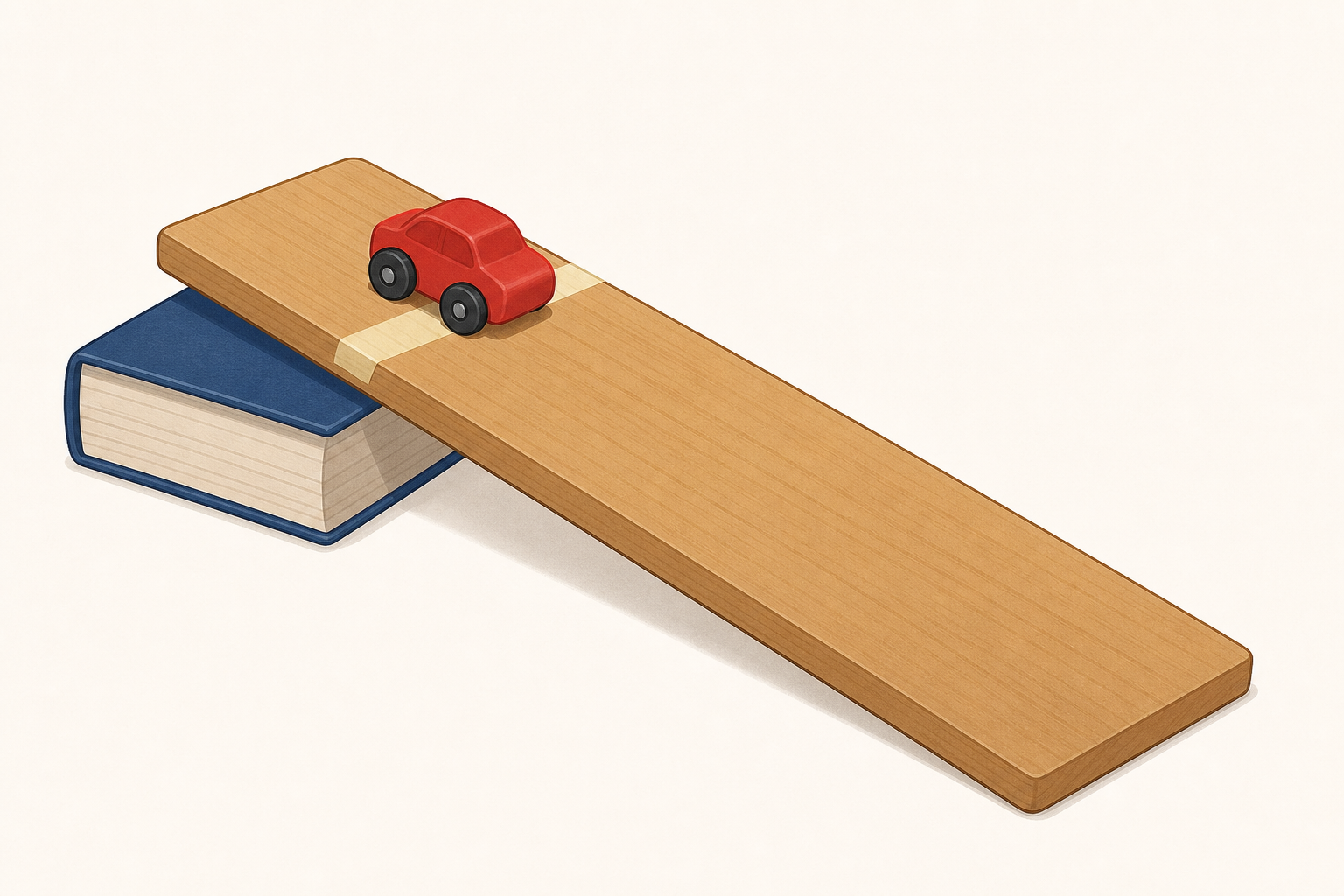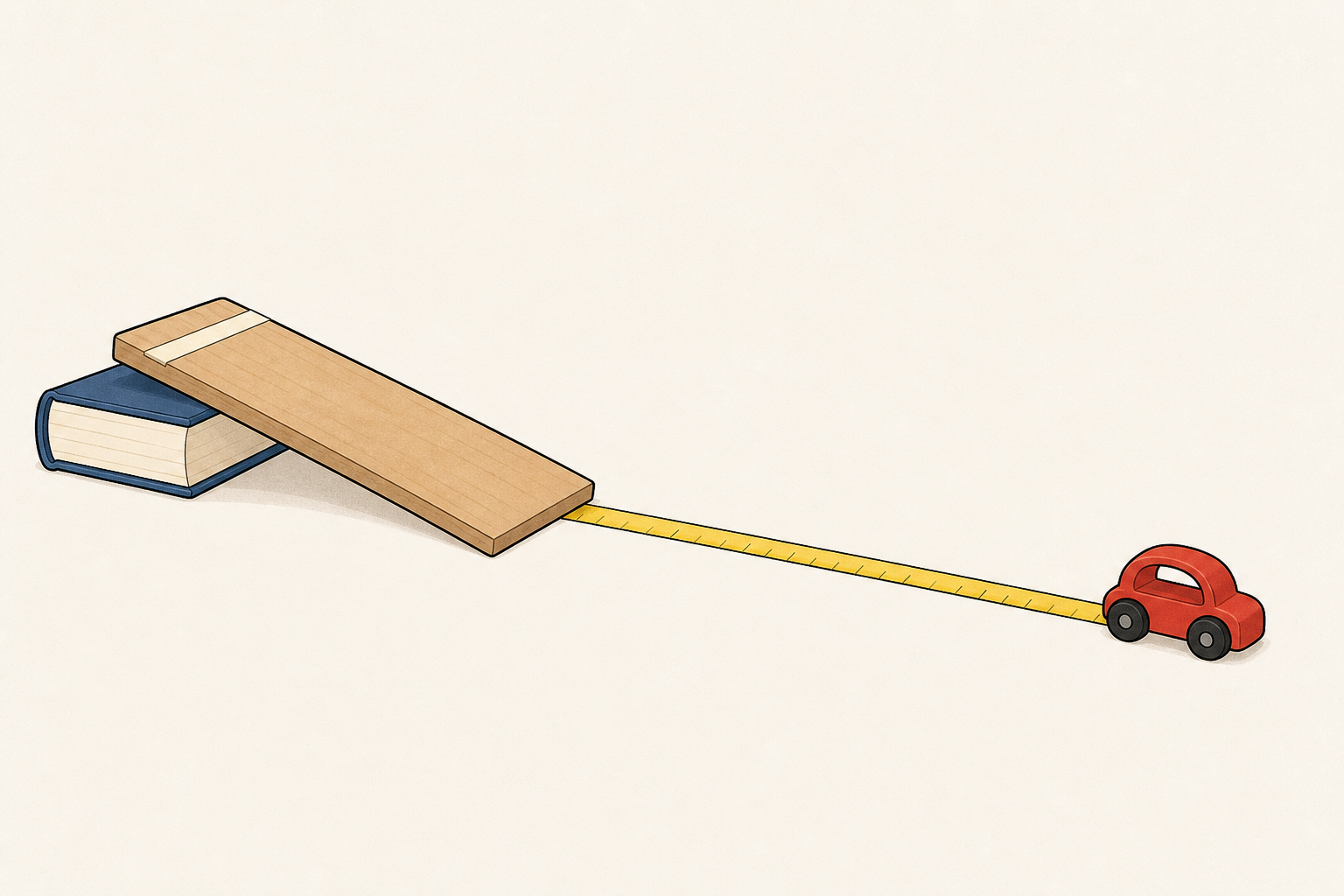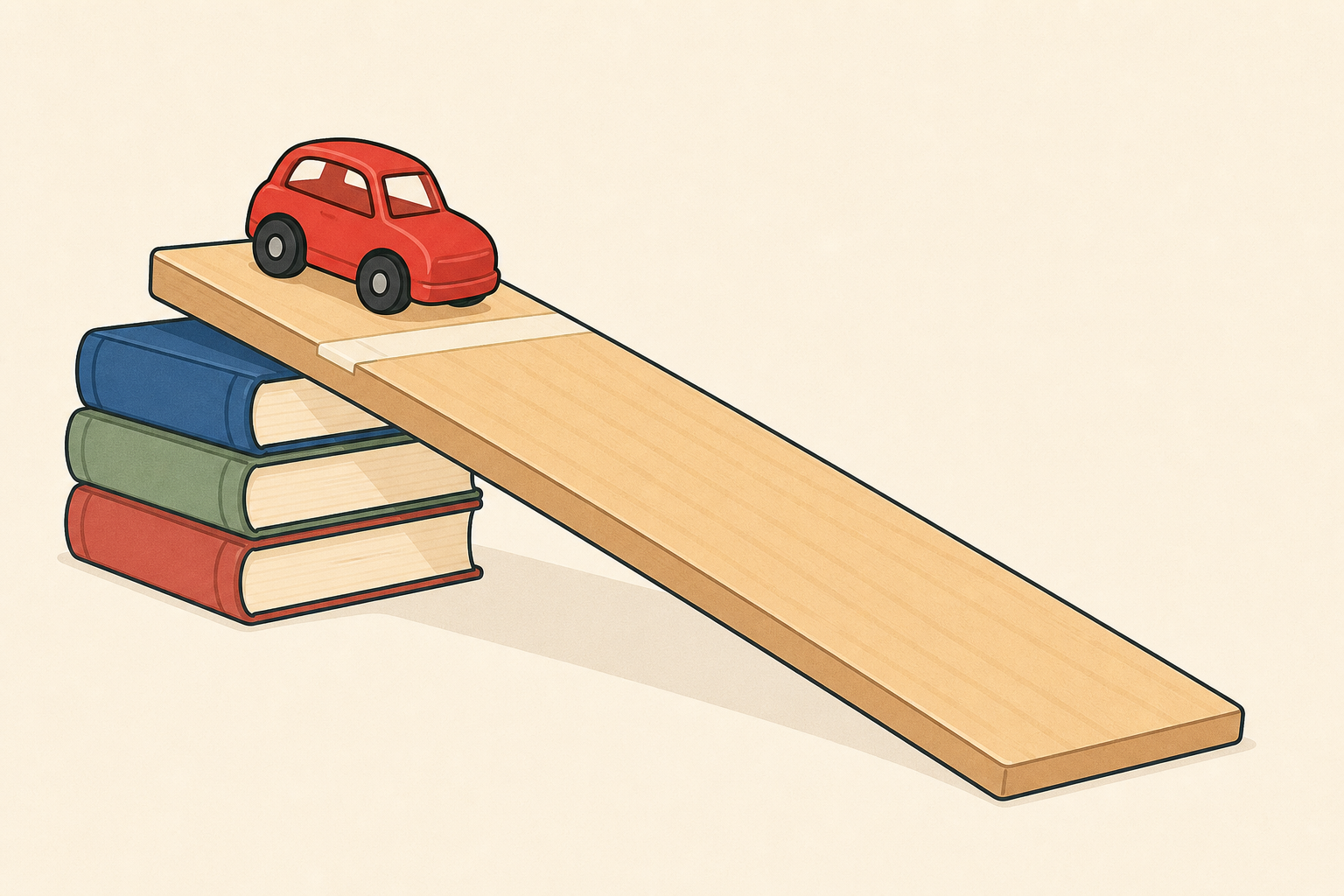
What makes a toy car roll further: a steep hill or a gentle one? Hands up for steep. Hands up for gentle. How could we find out fairly, so the answer is one we can trust?
Keep this light. Hold up one toy car only if you want a prop; do not lay out ramps or books yet. Take a quick show of hands and one or two reasons, then move on. Do not name variables or front-load the method here.
Link to prior skill: pupils already know how to plan a fair test from earlier materials work. Frame it as a skill they have, not as a dated lesson: You already know how to keep a test fair. Today we use that skill with forces and movement.
Today's words: force is a push or pull that can start, stop or change how something moves. A fair test means we change one thing, measure one thing, and keep the rest the same.
Our question: Does the height of the ramp change how far a toy car rolls?
Whisper to your partner: which ramp will send the car furthest, low, medium or high, and why? Be ready to share.
| Concept | Why it matters | Example |
|---|---|---|
| Force — a push or a pull that can make something start, stop, speed up, slow down or change direction | Forces are what get the car moving down the ramp and what slow it on the floor | Gravity pulls the car down the slope. On a steeper ramp (more books), that pull acts more strongly along the board, so the car usually leaves faster and rolls further |
| Fair test — change only one thing, measure one thing, and keep everything else the same | If two things change at once, we cannot tell which one made the difference | We change only ramp height; same car, same start line, same floor |
| Middle value — when three readings are ordered from smallest to largest, the one in the middle | One lucky or messy roll can mislead us; three tries and the middle value is more trustworthy | Introduce with live numbers in step 4 (e.g. 95 cm, 102 cm, 98 cm → middle value 98 cm) |
Board focus: only force and fair test on the IWB here. Leave middle value for the first modelled trio of distances so pupils meet the term with three real readings and an ordered example.
Prediction talk: predictions are never wrong. Collect two or three reasons aloud. Typical pupil ideas: higher is faster so it goes further; lower is safer so it goes further; they will all go the same. Leave the answer open.
Misconception to head off: some children think a bigger push is the only way to make something go further. Today the force change comes from the ramp height (how steeply gravity pulls the car), not from an extra hand-push at the start.
Nature of STEM: briefly note that engineers use fair tests like this when they compare ramps, slopes and road surfaces so designs are based on evidence, not guesses.
We will plan our fair test together on the board. Five cards appear: ramp height, how far the car rolls, the car, starting point, and the floor.
Call out where each card belongs: Change, Measure, or Keep the same. Then write the plan on your Investigation Journal page.
Drive the fair-test-planner interactive on the IWB in explore mode. The five cards on screen are exactly: ramp height, how far the car rolls, the car, starting point, the floor.
Narrate each keep-the-same aloud: If we swapped cars halfway, we would not know whether height or the car made the difference. Agree as a class that nobody gives the car an extra push; it rolls from rest at the top tape mark.
Pupils complete the fair-test plan on their Investigation Journal page while you lock the plan on the board. Bounded choice only: the class uses ramp height as the one change today so results can be pooled. Fast finishers sketch a second prediction (what if we changed the floor next time?) rather than starting early on devices.
Before the lesson: print the Investigation Journal pages. Gather one ramp set per group. Mark a clear start line with masking tape on each board. Space plan: decide before Monday how groups will get a clear floor run (hall, corridor, playground strip, or staggered waves in the classroom). Simultaneous whole-class runs need several long clear lanes; if the room is too full, run half the groups while the others watch and question, then swap.
Watch the first modelled run. Then work in your group:
Keep the same car, start line and floor every time.
Use one ramp at the front. Model one height only (1 book) with a full quick cycle. Protect about 20–22 minutes of group hands-on time for nine rolls, three middle-value finds and two height changes:
Do not model all three heights live; groups need that time. Before groups start, name roles and have books counted beside each ramp so height changes take seconds, not minutes. Measure in whole centimetres only.
Group work (about 4–6 pupils per set of kit): one releases, one spots the stop point, one measures, one records. Rotate roles. If a roll hits a chair leg or a foot, discard that try and roll again. After each height, order the three numbers and circle the middle value before changing the books. Every group must finish all three heights with three trials and a middle value at each; circulate to keep releases identical and measuring brisk.
Space and staggered waves: use the lanes you planned (hall, corridor, playground strip, or staggered waves). Keep each run clear. If you must run waves, fold the watching half into the investigation with live teacher questions while the active groups roll: Will this release stay fair? Where do you predict it will stop? Are they measuring from the same end of the car each time? What would make this trial unfair? Then swap so every group completes the full three-height set. Watching is participation; do not invent a separate desk task for the waiting half.
What to expect: higher ramps usually send the car further on a smooth floor. If all three heights look the same, the run is too short or the floor is very grippy — clear a longer path. If the car veers, check the board is not twisted and the start tape is square.
Teaching tips: keep the release identical: car nose on the tape, no shove. If a group is slow after height 1, co-measure one trial and restate the role rotation so they still reach 3 books.
Differentiation: support groups by co-measuring the first trial; stretch groups by asking what one extra book might do and whether they would still trust a single roll.
Safety: roll cars away from feet and faces. Keep the floor run clear. Mind fingers under the raised board edge when changing book height.
We will put results on the board together. One group will share their three middle values for 1 book, 2 books and 3 books. Watch as we type them into the table and show the chart.
On your Investigation Journal page, write your three middle values in the results table first. Only after we look at the chart, add one sentence about what the numbers show.
Open the data-recorder interactive in explore mode on the IWB. Columns are Ramp height and Distance (cm). Set three rows (1 book, 2 books, 3 books) and three trials so Try 1, Try 2, Try 3 and the middle value sit on each row.
Board routine (default on the pupil slide): one group shares their three middle values live; type those into the table and show the chart. Alternate if needed (teacher only): if that group's data is incomplete, quickly pool a class middle value for each height from two or three groups and enter those three numbers instead. Do not try to type every group's full table; other groups complete their own journal while watching the shared chart.
When the chart appears, ask: Which bar is tallest? What does that tell us about ramp height and distance? The chart uses the last numeric column, so middle values should read as rising bars if the higher ramps went further.
Pupils finish their Investigation Journal page with their own three trials and middle values first, then one sentence of meaning after the chart talk. Keep measured numbers separate from that sentence.
If a group has messy data: help them order the three numbers and pick the middle one; do not average unless a confident group already knows averages and you want a quick aside — the lesson standard is the middle value.
You're previewing this lesson. Get full access to this lesson and hundreds more — each one ready to teach, with interactive activities, printable resources and pupil progress tracking built in.