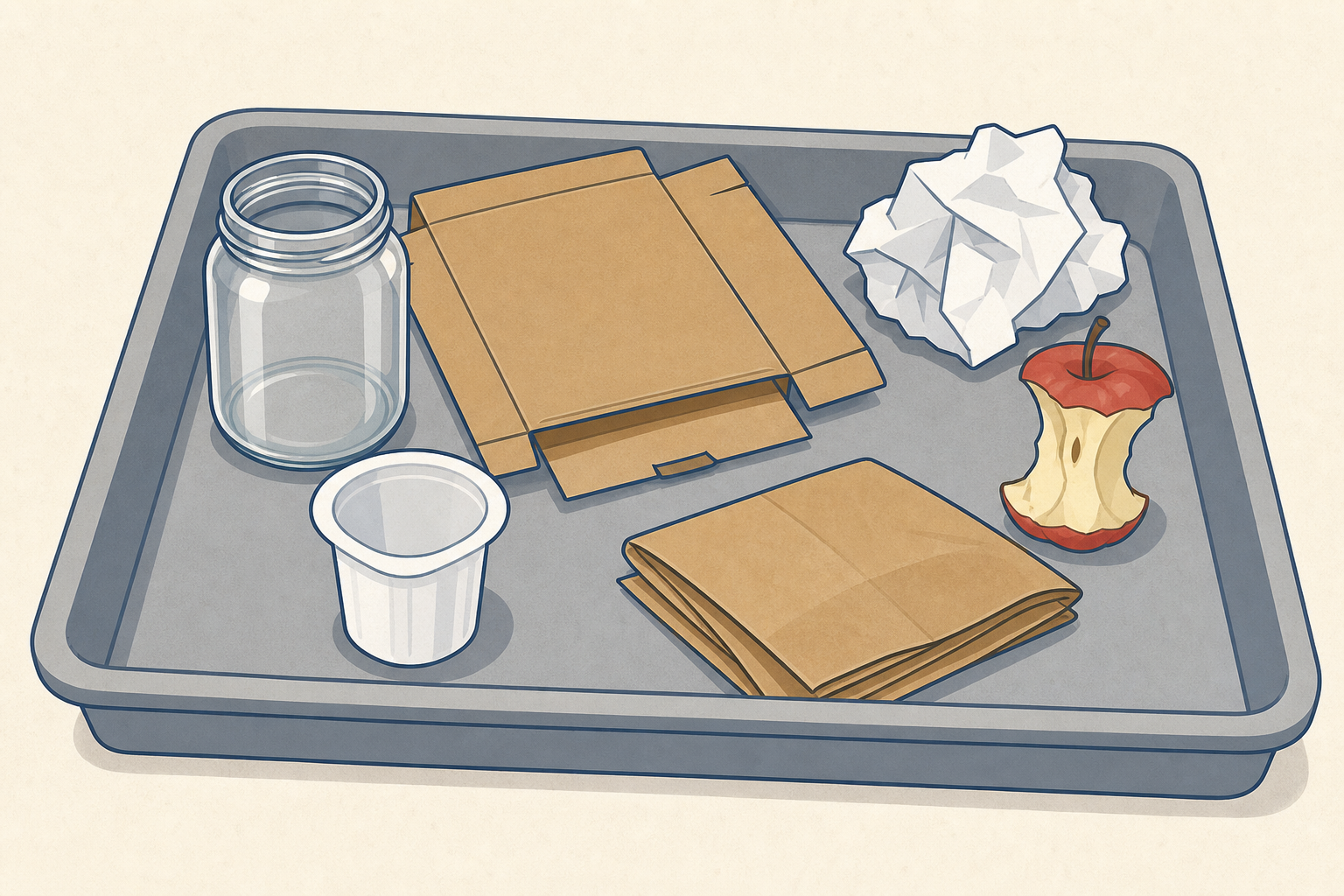
Look at this clean scrap from our classroom. Where should it go when we are finished with it: the recycling bin, the compost, or could we use it again?
Today we will look carefully at clean scraps from our classroom, sort them, and agree one action that helps our school and our planet.
Hold up one clean, everyday scrap (for example a clean paper offcut or an empty yoghurt pot). Keep the hook light: one object and one question. Do not empty bins yet or set out the full sort.
Key questions: Where do you think this should go? Why? Have you noticed recycling or compost bins at home or in school?
STEM eyes: link briefly to noticing waste and reuse at home and in our school, without a long lecture.
We have three helpful paths for clean waste. Remember them as short labels:
Reuse: use it again first (a jam jar for pencils).
Recycle: send clean material away to be made into something new.
Compost: food and garden scraps that can become soil for plants.
Try this order: can we reuse it, recycle it, or compost it? Rubbish is the last choice.
Project only the short board labels and one tiny example each. Do not read three long definitions aloud. The hands-on tray sort is the main teacher of the three paths. Use the table below for your own reference while you teach.
| Concept | Why it matters | Example |
|---|---|---|
| Reuse — use something again for the same job or a new job | Reusing means we need fewer new things and make less waste in the first place | A clean jam jar becomes a pencil pot; the blank side of paper is used for a draft |
| Recycle — send a clean material away so it can be made into something new | Recycling keeps useful materials in use and means less new material has to be made | Clean paper, card and many plastic bottles go in the school recycling bin (check what your school bin accepts) |
| Compost — put food and garden scraps where they break down into soil that helps plants | Compost turns scraps into something useful for growing, instead of filling a rubbish bag | An apple core, banana peel or fallen leaf can go in a compost caddy or school compost |
Worked example (model aloud before the sort; this is the load-bearing rule for the whole lesson): I wonder where this clean cardboard tube should go. First I ask: is it food or garden scrap? No. Next: could we still use it in class? Yes, we could keep crayons in it, so I choose reuse. Reuse comes before recycle. Only if we had no class use for it would clean cardboard go to recycle (if our school recycling takes it). Rubbish is last.
Decision order to teach end-to-end (tray, board and journal):
Misconception to head off: dirty food packaging does not go straight into recycling. Only clean items belong in today's audit trays. Real sticky peels stay off the trays; use picture cards or dry leaves for compost practice. Rubbish is the last choice when reuse, recycle and compost do not fit.
Ask: which choice usually helps most: use less and reuse, then recycle or compost, then rubbish?
In groups, look carefully at the clean classroom waste on your tray. Sort each item into recycle, compost or reuse. Talk about why each item goes where it does. If you are not sure, put it in the "not sure" pile and we will decide together.
Collect a day's worth of clean classroom waste only (paper offcuts, clean packaging, clean pots or bottles, fabric scraps, dry leaves if available). No sticky food, no sharp tins, no bathroom waste. For compost practice, use a dry leaf and/or picture cards of an apple core or banana peel, not real sticky peels. Set out three labelled hoops or trays per group: Recycle, Compost, Reuse, plus a small Not sure pile or fourth zone. Optional: place the provided category picture cue cards on the hoops for groups who need support. Print the Investigation Journal page.
Gloves on. Groups handle items gently and keep them on the tray. Circulate and press the same decision order you modelled: Is it food or garden scrap? Could we use it again in class? Could it go in our school recycling bin? Celebrate reuse-first thinking before recycle.
Look-fors:
Differentiation: use the category picture cue cards on the hoops for groups who need support. Challenge groups to name one item they could reuse in a new way.
Safety: clean items only; gloves; wipe spills; wash hands at the end. Sticky food samples stay off trays.
On your Investigation Journal page, record three items from your group's tray sort while your decisions are still fresh. For each one, write or draw whether it goes to recycle, compost or reuse, and give a short why.
Pupils record on the paper Investigation Journal page only, straight after the tray sort and before the board check. Do not invent extra columns or a second homemade sheet. Support writers with the three words on the board: recycle, compost, reuse. Three item-plus-reason rows is enough for 2nd Class stamina. Fast finishers add one extra clean item from the classroom that was not on the tray and say where it would go.
Check a few pages while circulating: reasons should match the taught order (for example compost because it is food scrap; reuse because we can still use it in class; recycle only when it is clean, accepted at school, and not needed for reuse).
Now we will check a few clean-waste cards together on the board. Call out recycle, compost or reuse, and say why. The screen will show one card and a yes or no question at a time to help us decide.
Drive the interactive on the IWB as a quick whole-class check, not a second full sort. Pupils do not need devices. Read each card name aloud and take class votes before dragging. Fold the whole class in: "Do you agree with that group? What would you say?"
On-screen path (must match the tray rule): three branching questions in this order: (1) "Is it food or garden scrap?" → compost; (2) "Could we still use this in class?" → reuse; (3) "Can it go in our school recycling bin?" → recycle. Reuse is asked before recycle so the board reinforces, rather than overwrites, the tray sort.
Answer guide (reuse-before-recycle):
If the class argues that clean paper or cardboard could also be reused first, celebrate that thinking: reuse before recycle is the strong STEM habit. Before the lesson, check what your school recycling actually accepts (pots vs bottles can differ by local contract). Prefer bottles, paper and card as unambiguous recycle exemplars when you talk about the bin.
You're previewing this lesson. Get full access to this lesson and hundreds more — each one ready to teach, with interactive activities, printable resources and pupil progress tracking built in.