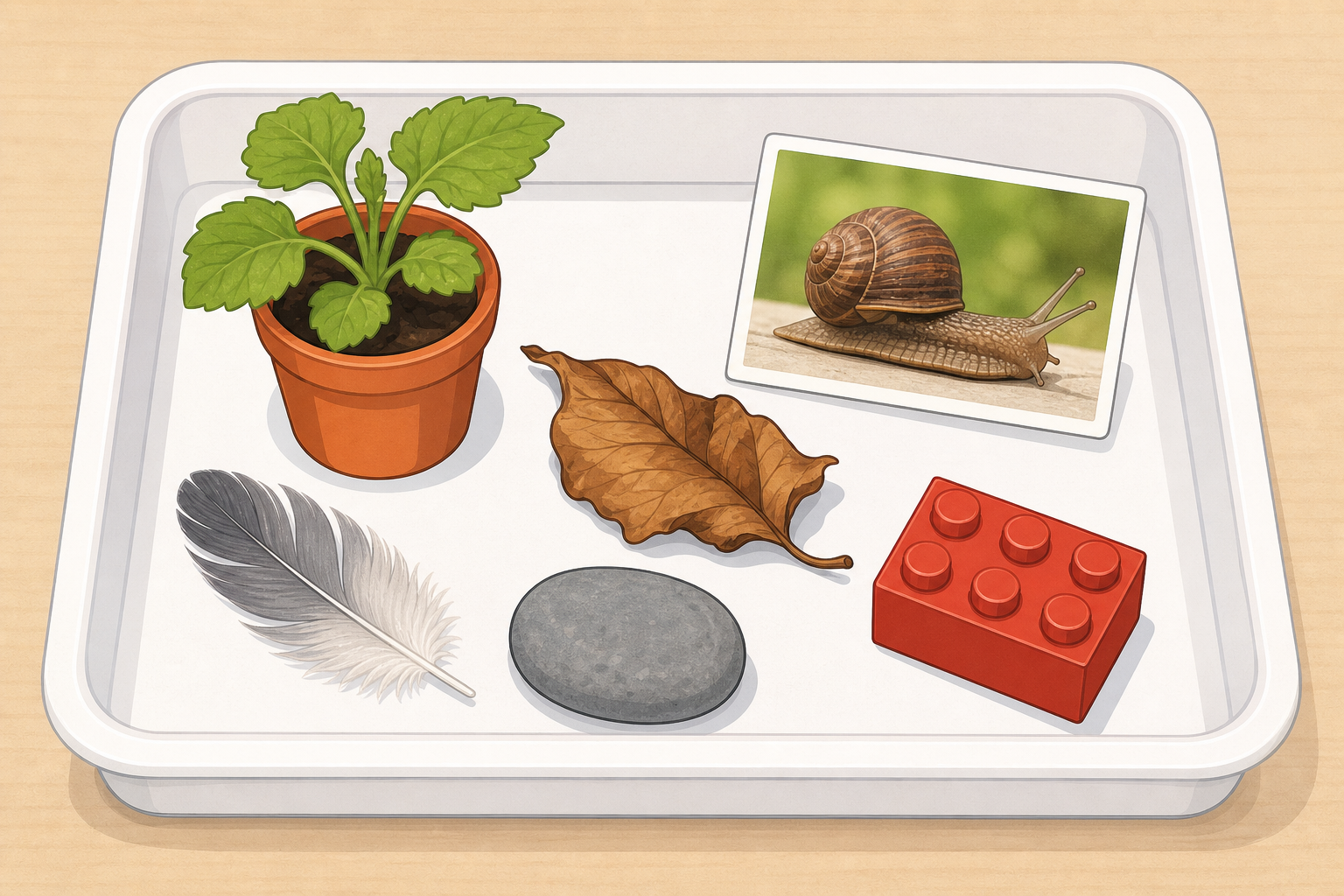
Your teacher is holding up a sorting tray. On it there is a plant, a snail photo card, a leaf, a feather, a stone and a plastic toy.
Which ones are alive right now? Which ones used to be alive? Which ones were never alive?
Turn to the person beside you and whisper your guess. We will sort them with careful noticing.
Have the sorting tray covered or just out of reach so curiosity builds. Hold the real tray up for the class (this step does not rely on a screen image). Hold up one surprising pair (for example the leaf and the plastic toy) and ask: Are these the same kind of thing?
Before the whisper, point or name talk partners so every child knows who to turn to: Turn to the person beside you.
What to listen for: children often say anything that moves is living, and anything still is not. Do not correct yet; let the sort do the teaching.
Have three floor hoops or large paper circles ready per group, with the group names written on paper or card: Living, Once-living and Never-living.
We will sort into three groups. Meet them one at a time as your teacher holds each object.
Living: alive right now, like our plant.
Once-living: used to be part of something alive, like a dry fallen leaf.
Never-living: was never alive and never came from a living thing, like a stone.
What can we notice to help us decide? Call out one idea to the class.
Land the three groups one concrete example at a time before the tray sort. Hold or point to each anchor object as you name its group. Keep the board short; use the table below for your own reference.
| Concept | Why it matters | Example |
|---|---|---|
| Living — something that is alive right now: it grows, needs things like food, water and air, and can respond to the world around it | We look after living things carefully and return creatures to where we found them | A snail moving slowly on a leaf, or a plant in a pot on the windowsill |
| Once-living — something that was alive before, or used to be part of a living thing, but is not alive now | Many everyday materials (wood, wool, paper, feathers) came from living things | A dry fallen oak leaf, a robin's feather, a wooden ruler |
| Never-living — something that was never alive and never came from a living thing | Stones, plastic and metal are not living and never were — they are different from once-living materials | A smooth stone from the yard, a plastic toy, a metal paperclip |
Misconception to head off: children often say a fallen leaf is still living because it is from a plant, or that a stone is once-living because it is natural. Living means alive now. Once-living means it was alive before or came from something that was alive. Never-living was never part of a living thing.
Plastic aside (if it comes up): At this stage we class plastic as never-living (it was made from materials that were not parts of plants or animals we can point to). If a child raises oil or fossils, park it as a great question for later rather than reopening the sort.
Model one sort aloud (worked noticing cycle): Hold the fallen leaf. I wonder which group this goes in. I predict once-living, because it came from a tree but it is dry and not growing. I look carefully: no green, no soft stem, it snaps. I think it is once-living — it used to be part of a living plant. Then invite the class to use the same noticing talk for the next item.
Take two or three quick call-outs on what we can notice, then move straight to the tray sort.
At your table group, sort every item into one of the three hoops: living, once-living or never-living.
For each item, say what you notice that makes you sure. If you disagree, look again together before you place it.
Before this sort begins, put children into table groups of about 3–4 (use existing table groups if that is already how the class sits). Give each group one tray and three labelled hoops or paper circles. Check every child knows which group they are in and where their tray is before you say go.
Photo cards stand for the living thing: Say clearly before sorting starts: We are sorting the animal in the picture, not the card itself. If needed, ask: Is the snail alive, or only the picture? so the plant and snail both land in living for the right reason.
Circulate and ask: What did you notice that made you put it there? Push for evidence (moves, grows, came from a plant or animal, never was alive) rather than guesses.
Likely placements: plant and snail → living; leaf and feather → once-living; stone and plastic toy → never-living. If a group puts the leaf in living, ask them to check whether it is growing or changing now.
If using a live snail: one child holds the pot still; no poking; return the snail outside after the lesson; wash hands.
Differentiation: less confident groups start with the plant and the stone (clear contrast). Confident groups can add one extra classroom object they choose and justify its group.
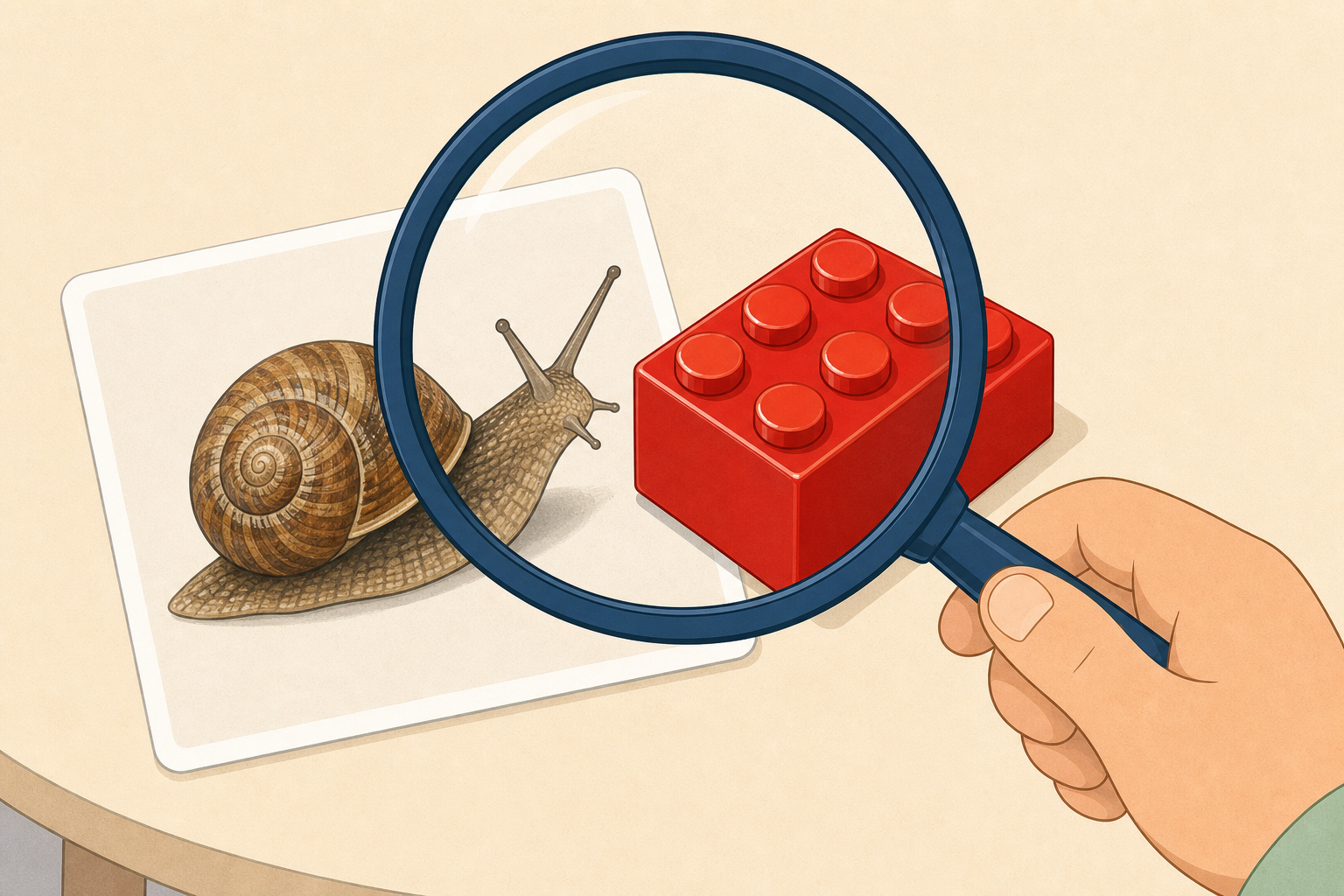
We will look carefully with a magnifier at the front of the class.
Watch the snail photo card and the plastic toy side by side. What new clue can you spot about surface, colour or shape?
Call out what you notice. We will draw and write on the journal page later.
Primary path (use this by default): run one shared magnifier look at the front. Hold the snail photo (or live pot if you have one) beside the plastic toy. Take two or three spoken clues from the class. This keeps the beat inside five minutes with shared kit.
Only if time and kit clearly allow: give pairs of groups two magnifiers and let them choose one item from each hoop for a quick look, still oral only.
Keep this beat oral: children notice and talk; they do not make a separate written record here. Any sketch belongs on the Investigation Journal page in the next recording step.
Prompt science words: smooth, rough, dry, soft, shiny, moving slowly, green, cracked.
Look-fors: children notice the snail's shell and slow movement (or shell shape on the photo); veins on the leaf; plastic that feels the same all over with no plant or animal pattern; stone with no fibres or grain like wood.
Safety: wash hands after handling a live snail pot and natural items.
Now we check our thinking on the board. Cards show the same kinds of things: plant, snail, fallen leaf, feather, stone and plastic toy.
Two questions help us decide: Is it alive right now? and Did it come from a plant or animal?
We will focus on any cards that felt tricky or where groups disagreed. Call out which group each one belongs in and the clue that makes you sure.
Lead this as a whole-class interactive activity on the IWB only — no pupil devices and no independent turns. Open the sorting-tree interactive in explore mode. The three groups on screen are living, once-living and never-living. The guiding questions on screen are: Is it alive right now? and Did it come from a plant or animal?
Do not re-place every easy item. Start with any disagreement from the tray sort, then use the your-turn prompts (feather, stone vs leaf, snail). Drag a card only after the class agrees and can give a reason aloud. No scores.
If the interactive is unavailable: stick six name cards under the three hoop labels on the board and run the same check-and-reason talk.
You're previewing this lesson. Get full access to this lesson and hundreds more — each one ready to teach, with interactive activities, printable resources and pupil progress tracking built in.