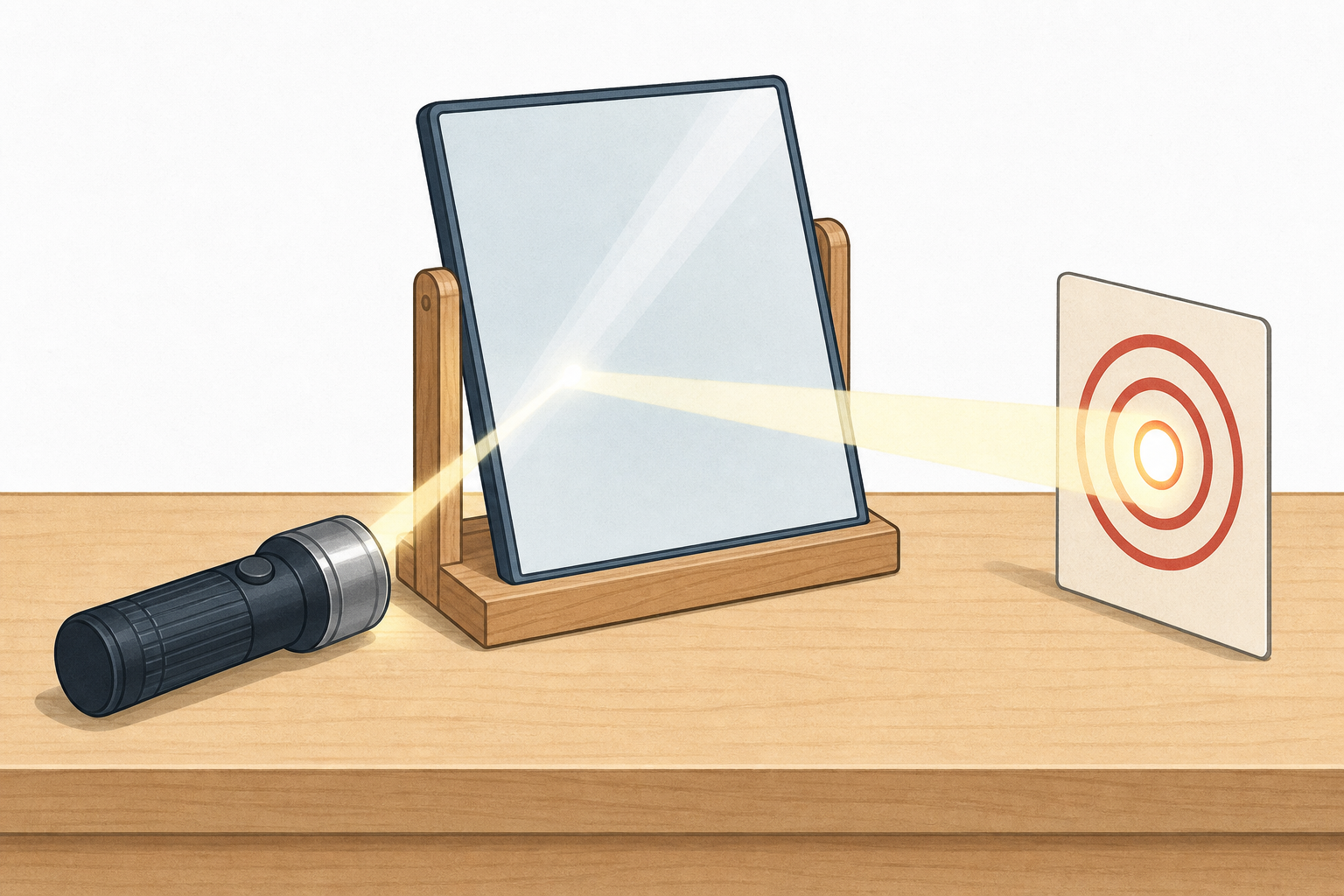
Look at this. A bright spot of light is sitting on the wall, but the torch is pointing somewhere else. How did the light get there?
Today we will find out three things light can do: bounce, split into colours, and help us see tiny things more clearly.
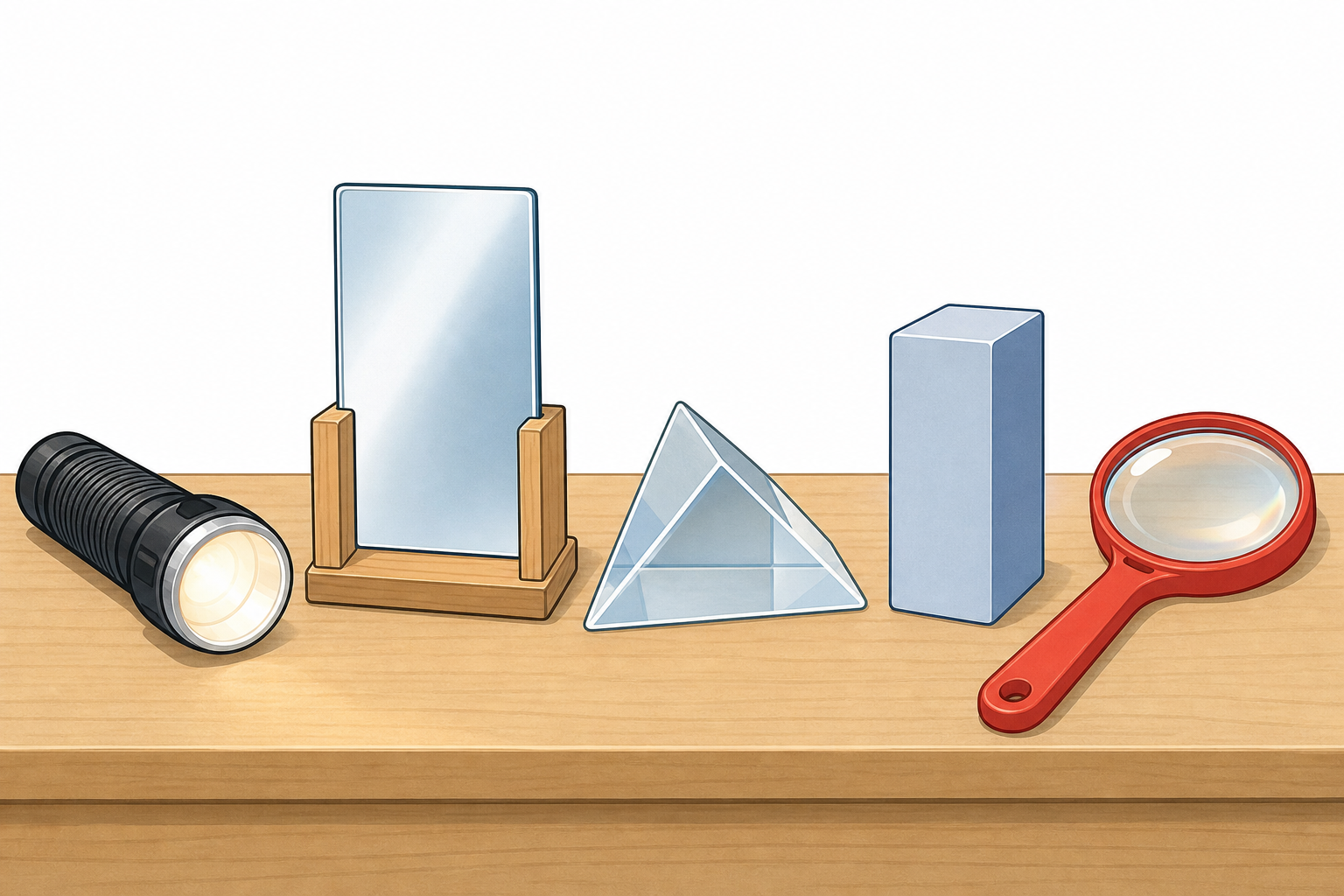
Before the class arrives, set station trays to one side (do not hand them out yet). Have one mirror and one torch ready in your hand for the hook only. Pre-stage spare Bounce kits (torch, mirror, target card) on the two Bounce tables so the later investigation reset is mostly seating, not kit hunting.
Dim the room a little if you can (blinds half closed is enough). Shine the torch at a hand mirror so a bright spot lands on the wall or board. Do not explain yet. Ask: How did the light get from the torch to the wall? Take two or three ideas. Keep it playful; wrong ideas are useful starting points.
Nature of STEM cue (one line only if it fits): people have watched rainbows for thousands of years, but it took careful testing with glass and water to work out that white light holds the colours inside it.
Which are you most curious about right now: bouncing light, or light that splits into colours? Tell your partner why.
Two quick pictures for today:
A torch beam can hit a shiny mirror and the bright spot can land somewhere new.
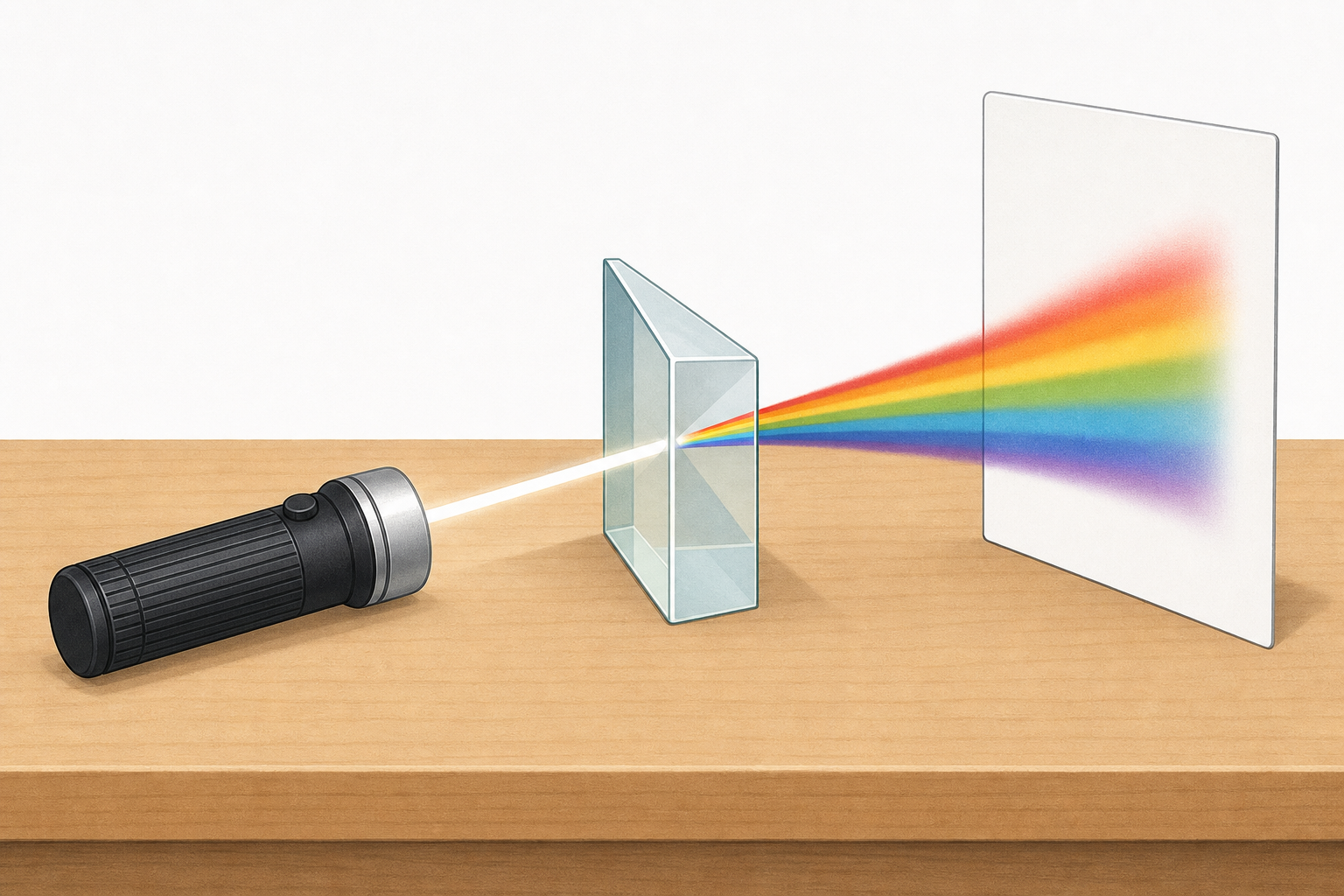
Ordinary white light can open out into rainbow colours when something spreads it.
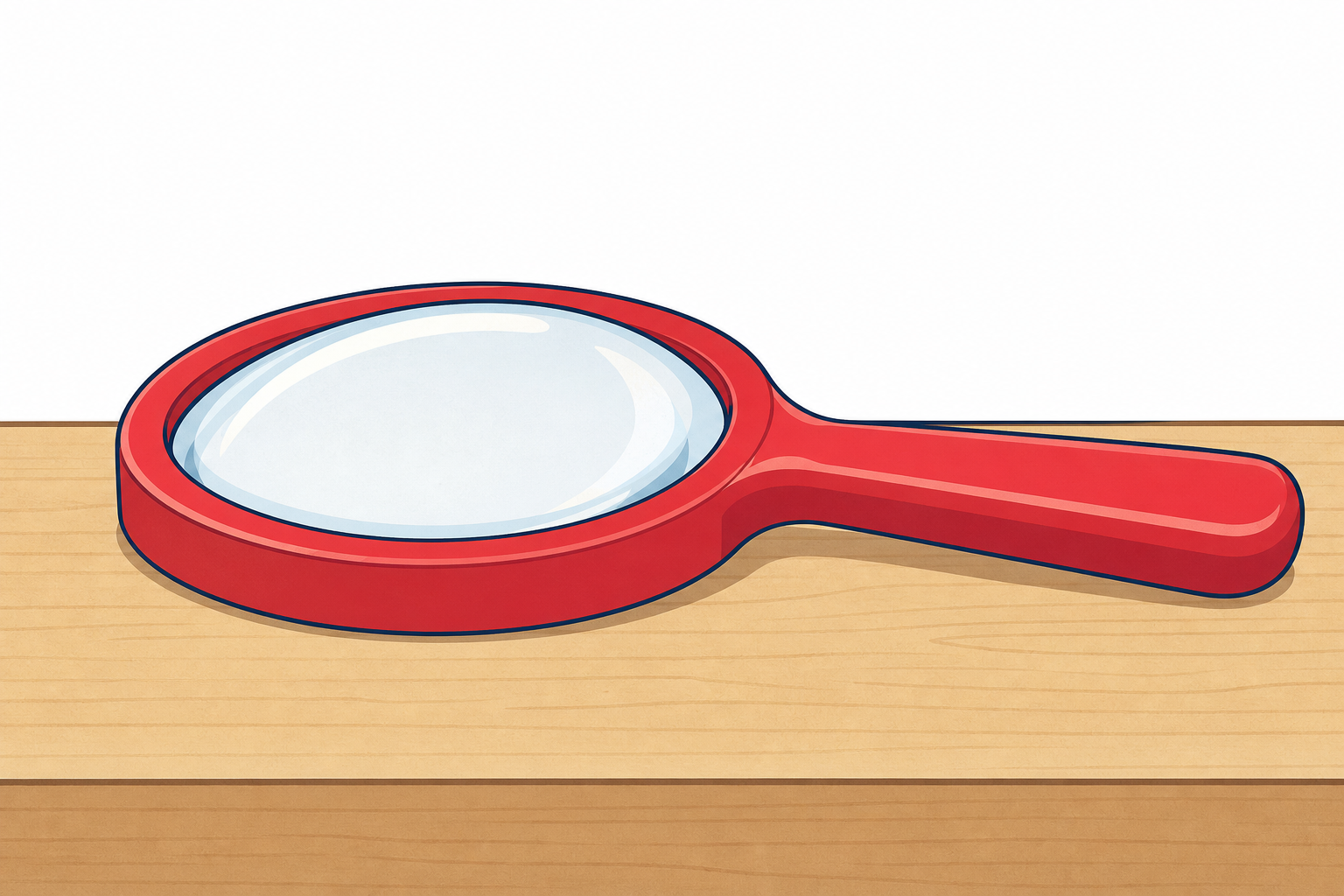
Later we will also look at tiny print through a curved glass and notice what changes.
Project only the short board text. Curiosity question first; keep naming light. Do not put the whole table on the IWB. Bounce is the deep investigation later; spectrum and magnifier are shorter notice-and-name stops for now. Save fuller magnifier talk for Station C after they have compared bare eyes and the lens.
| Concept | Why it matters | Example |
|---|---|---|
| Reflection — light hits a smooth shiny surface and bounces off in a new direction | Mirrors, shiny spoons and still water all bounce light, which is how we see ourselves and how a torch beam can be steered | A torch beam hits a hand mirror and the bright spot jumps to a target card on the far side of the table |
| Spectrum — white light can split into a band of rainbow colours | The colours of a rainbow are already inside ordinary white light; something has to split them so we can see them | Torchlight through a prism, or light aimed at a small mirror angled in a shallow water tray so a spectrum lands on white card, shows red through to violet |
| Magnifier (lens) — a curved clear piece of glass or plastic that bends light so small things look larger | Glasses, cameras and microscopes all use the same idea so people can see more detail | Tiny print on a card is hard to read with bare eyes, then clear through a hand magnifier |
Misconception to head off: children often say the eye “sends out” light to see, or that a mirror “makes” light. Light comes from a source, bounces or bends, and then arrives at the eye. Nothing leaves the eye.
Worked model (say aloud before stations, one full cycle on the mirror only):
Then send groups to the stations. Curiosity choice is enough as a send-off.
Three stations are ready. Try the challenge at each one and notice what the light does.
Station A — Bounce: shine the torch at the mirror. Can you land the bright spot on the target card?
Station B — Split: send light through the clear triangle block (the prism). What colours appear on the white card?
Station C — Closer look: read the tiny-print card with bare eyes, then through the magnifier. What changes?
Before you leave each station, sketch or jot one thing the light did on your Investigation Journal page.
Stay at each station until I call the rotate. Keep torches away from eyes and faces.
Plan for about six groups of three or four. Preferred layout so every group gets hands-on at every station: six tables in parallel — two Bounce (Station A: mirror, torch, target card each), two Split (Station B), two Closer-look (Station C: hand magnifier + tiny-print card each).
Station B throughput (choose what you can resource):
Card C — Tiny print (Station C): print in the smallest readable font you can: Robins hop on the school grass when the morning is quiet and bright. Underneath in normal teacher size (not for pupils to need): pupils first try bare eyes, then the magnifier. After they read it with the magnifier, ask aloud: The print looks bigger. What do you think the curved glass did to the light? Steer them to “it bends the light,” from talk about what they saw, not from any claim printed on the card.
Card A — Target (Station A): a simple bold circle or star. Print one set labelled Blue target and one set labelled Red target (colour name only; no other text). One target card per Bounce table is enough for explore; keep spare targets for the later bounce investigation.
Preferred: triangular prism (the clear triangle block of glass or plastic) and torch onto white card or a pale wall.
Water backup / second setup: shallow clear tray of water with a small mirror propped at an angle under the surface. Aim the torch at the submerged mirror so a spectrum lands on white card or the wall. Bare water with no angled mirror rarely shows a clear spectrum; do not run that weaker setup as the main demo.
Never shine torches in eyes. Never look at the sun or at the sun through a lens or magnifier. Never use a magnifier to focus sunlight onto skin or paper. Handle mirrors and glass with two hands; wipe water spills at once.
Differentiation: less confident pairs work Station A first (clearest success). Confident pairs at A can try a second bounce path with a spare small mirror if you have one. Spectrum and magnifier stay shorter notice-and-name stops; bounce carries the deeper investigation next.
Stations are finished. This bounce round is a real investigation, not free explore.
In threes at a Bounce table: one holds the torch still, one tilts the mirror, one is the spotter. I will place your target.
Before you move anything: predict where the bright spot will go if you tilt the top of the mirror toward you.
Then test: shine only at the mirror, keep the torch still, and tilt until the spot lands on the target. When you hit it, move the target once and bounce again. Be ready to say what you changed.
Reset bridge (aim under 2 minutes — kits already staged): call stop on stations. Park prism and water tray on a safe side table. Send every trio straight to a Bounce table where torch, hand mirror and target card are already waiting (pre-staged before the lesson; spare Station A kits cover extra trios). Name roles as they sit, e.g. nearest the window holds the torch, middle tilts the mirror, third is spotter. If short of kits, two trios share and swap after one successful hit. Do not rebuild groups from scratch in the middle of the room.
This beat is the deep investigation: same physics as Station A, but with a clear success check (hit the target), a spoken prediction first, torch kept still, and one deliberate retarget. Make that difference obvious on the board and in your send-off words. The 10 minutes is for predict–hit–retarget, not regrouping.
Model once at the front only if needed: torch fixed on a book, mirror in hand, target on the board. Narrate: I change only the tilt of the mirror. I keep the torch still. I measure success by whether the spot lands on the target.
Swap roles once if time allows.
If the room is too bright: cup a hand as a hood around the torch, or work in the shadiest corner. The light-rays step later still consolidates the bounce idea if the beam is hard to see.
Key question while you circulate: Did the light travel in a straight line to the mirror, then change direction?
Open your Investigation Journal page. Tidy the quick notes you started at the stations and add the bounce investigation.
Check you have something for each part:
Write or draw what you saw.
Pupils record on the paper Investigation Journal page only. No typing. Station jots should already be started; this step is for tidying, filling gaps, and adding the bounce success check so spectrum and magnifier are not invented from memory alone.
Keep the board checklist short. Coach observation versus idea in your talk only (do not put that abstract line on the board): I saw a band of colours on the card is an observation; so white light holds the colours inside is the idea they will meet more firmly in the next step.
Circulate and push for at least one note or drawing per station plus the bounce hit. Fast finishers add a simple arrow sketch of the bounce path on spare paper.
Do not invent extra columns or name layout boxes on the journal page. Say only what to record; the page layout is generated separately.
You're previewing this lesson. Get full access to this lesson and hundreds more — each one ready to teach, with interactive activities, printable resources and pupil progress tracking built in.