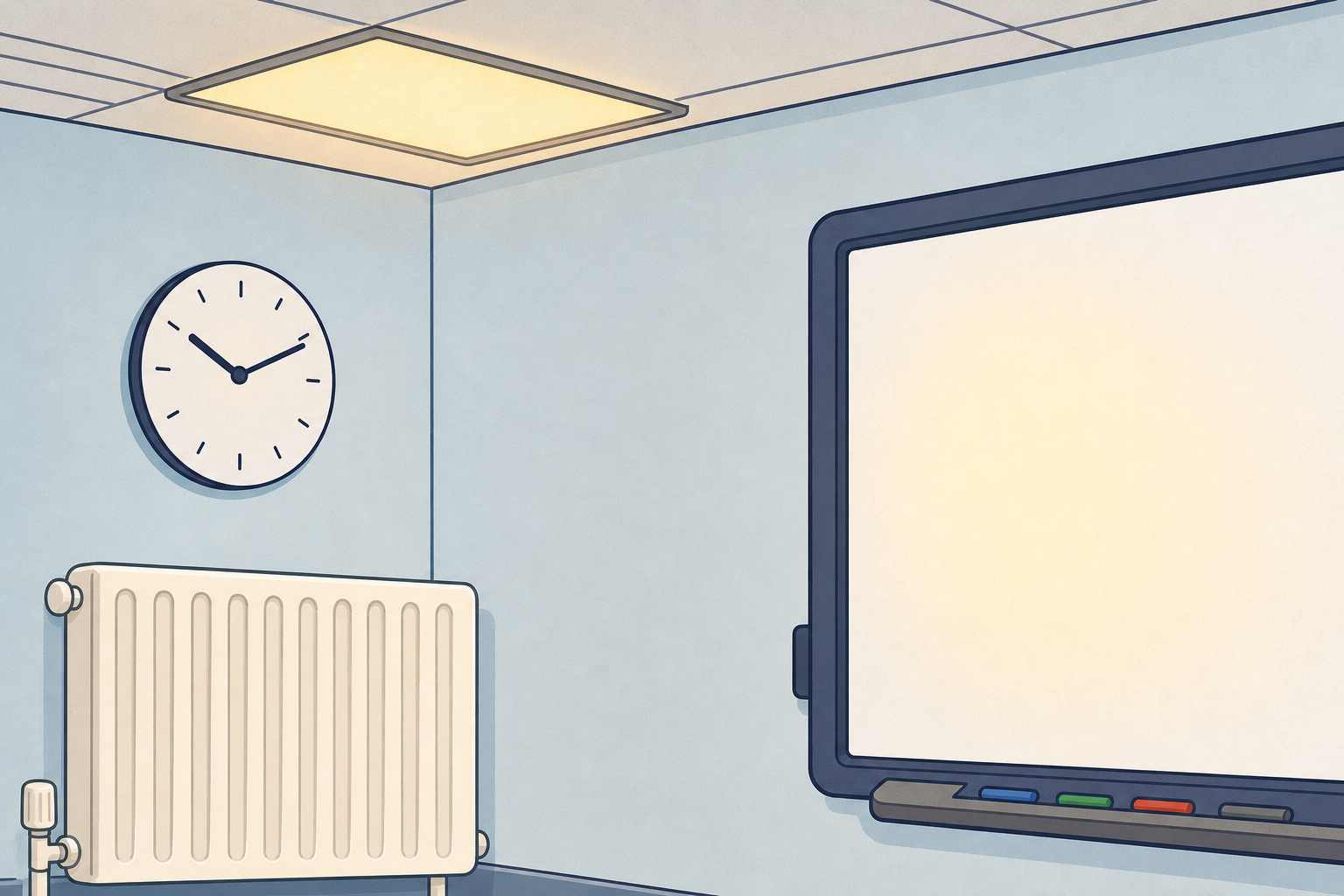
Look around this room for a moment. What is working right now without anyone pushing it by hand?
The lights, the interactive whiteboard, maybe a heater or a clock: something is making each of those do its job. What do you think that something is called?
Keep this light. Do not hand out cards or name the four energy jobs yet. Let pupils call out things they notice (lights, board, heater, clock, their own bodies after PE).
Key question: What is making these things work? Accept everyday answers (electricity, batteries, food) and hold the word energy for the next step.
Have the picture cards ready face-down for later, but do not show them here.
Look at the classroom lights. Something is making them work. That something is called energy.
Energy makes things do a useful job. The jobs we will hunt for today are lighting, heating, moving, and making sound.
What energy job is the classroom light doing right now?
Before cards go out: after naming energy and the four jobs, speak the wall-clock noticing cycle aloud (full worked example below). Do not move to the hunt until the class has heard one complete model.
Teach on the board in short spoken lines only: name energy, then the four jobs. Do not put a full glossary of three terms on the IWB. Hold our own energy until the end of the card hunt in the next step.
Use the table below as your reference (not for the board).
| Concept | Why it matters | Example |
|---|---|---|
| Energy — what makes things do a useful job (lighting, heating, moving, or making sound) | Once we can spot energy at work, we start to notice how much of school and home depends on it | The interactive whiteboard needs energy so we can see the lesson pictures; a radiator’s job is heating; a school bus’s job is moving people; a fire drill bell’s job is making sound |
| Our own energy — the energy our bodies use to run, think, play and grow, which comes from food | We are part of the energy story too, not only machines and gadgets | Lunch gives you energy for the yard and for thinking in the afternoon |
Misconception to head off: children may say energy is only electricity. Energy also comes from food for our bodies, and from fuels that heat homes. Keep the focus on the job being done, not on naming every fuel.
Worked example (model the noticing cycle aloud before the hunt):
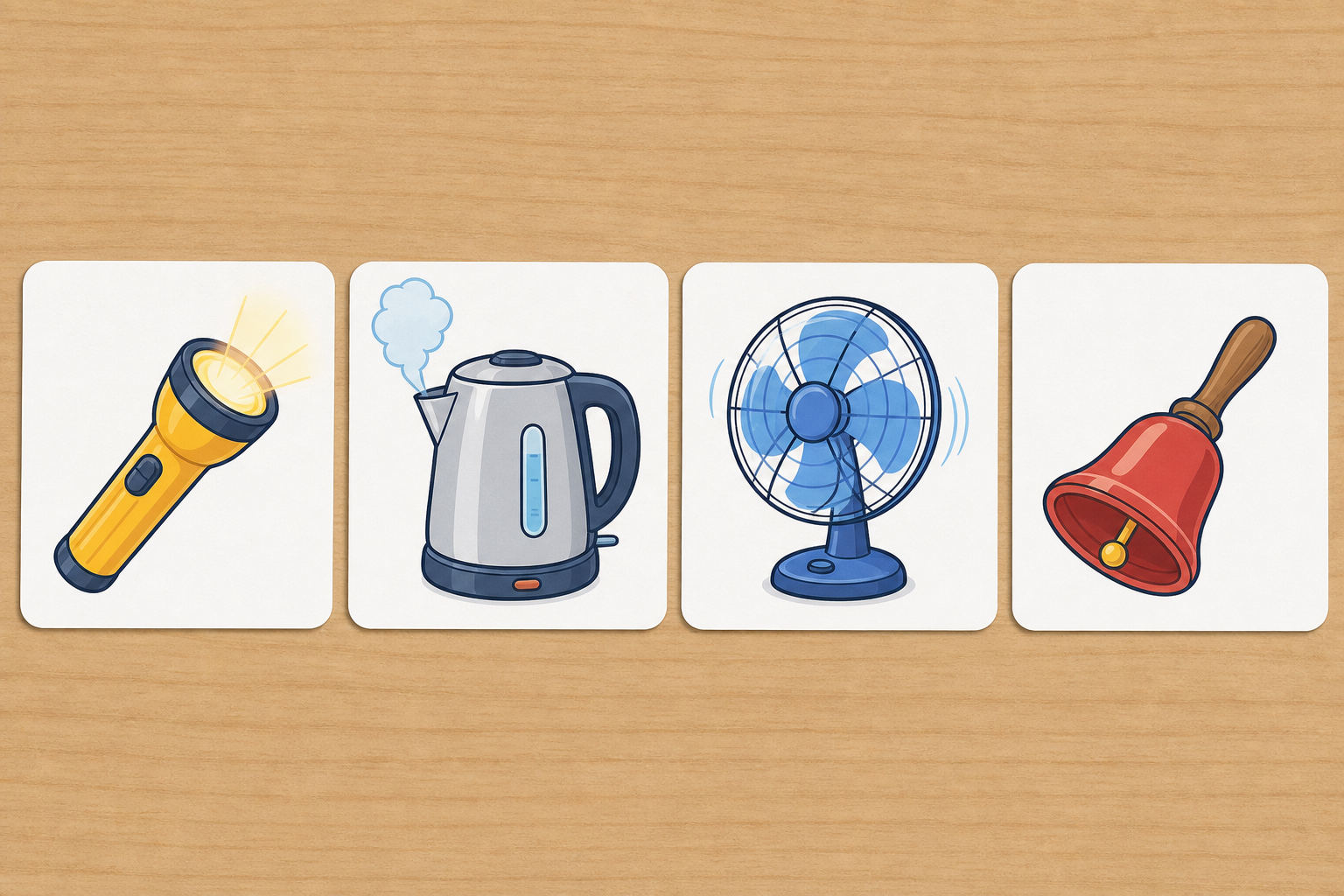
We are going on an energy-job hunt with picture cards. For each card, name the thing and say which job its energy is doing: lighting, heating, moving, or making sound.
Work in small groups with the four cards you are given. Talk first, then agree one main job for each card.
Print the provided energy-job picture cards (one full set per group). Each card is an image with a short caption naming the everyday thing only — do not print the energy job on the pupil side. Cut the cards apart. Put four job labels ready for the next step: Lighting, Heating, Moving, Making sound.
Keep the remaining eight cards face-down for optional extension during the sort step.
Give each group the four default cards only. Circulate and ask: What is it? What job is the energy doing? If a group argues, praise the talk and settle on the main job.
Our own energy beat (protect about 2 minutes near the end of this step): hold up no card — point to the class. You ran, talked and thought today. Where did your energy come from? Food. Link breakfast or lunch to play and learning. This is the first time you name our own energy in full for the class.
Differentiation: every group starts on the same four clear cards. Confident groups who finish early may peek at one extension card and name its job, ready for the sort.
Sort your cards into four groups on the table: lighting, heating, moving, and making sound.
When your group agrees, be ready to hold up one card and tell the class why it belongs in that group.
Place four large job labels (or four corners of the desk) for each group: Lighting, Heating, Moving, Making sound. Groups physically sort the four cards they already used.
Optional extension: hand out some or all of the remaining eight cards so confident groups can sort a fuller set. Early finishers sort first, then add extension cards one at a time.
Expected sorts (full set):
Invite three or four groups to share one card each. Revoice: So the energy is doing a lighting job / a heating job…
For the interactive whiteboard, if pupils say “showing pictures”, accept that talk and revoice: we can see the pictures because the screen lights up, so we sort it under lighting.
For the washing machine, if pupils raise hot water, accept that talk and settle on moving as the main job (the drum turning is what we see).
STEM eyes: ask quickly, Which of these energy jobs can you spot in this classroom right now? Lights, board, maybe heater, voices and chairs moving.
Misconception: if pupils put the bicycle only under “people power”, accept that people supply the energy, but the job is still moving.
On your Investigation Journal page, do three rows.
For each row, write or draw a thing that uses energy and the job it does.
Now add one more row about your body: write yourself (or “my body”) and a job you do with energy from food, such as running or thinking.
Pupils record on the paper Investigation Journal page. They do not type into the platform. Read the board lines aloud in two beats: first the three thing/job rows, then the body-and-food row.
Clear minimum checklist: three thing/job rows, then one body-and-food row (four rows total).
Sentence starters if needed: The ___ uses energy for ___. / My body gets energy from food so I can ___.
Look for at least one lighting, one heating or moving, one sound where possible, and the food-to-body row. Circulate and prompt: Is that lighting or moving?
Protect the full eight minutes so developing writers can finish the four-row minimum before the share.
Fast finishers add one more thing from home (fridge, lamp, toaster) without needing a new card set.
You're previewing this lesson. Get full access to this lesson and hundreds more — each one ready to teach, with interactive activities, printable resources and pupil progress tracking built in.