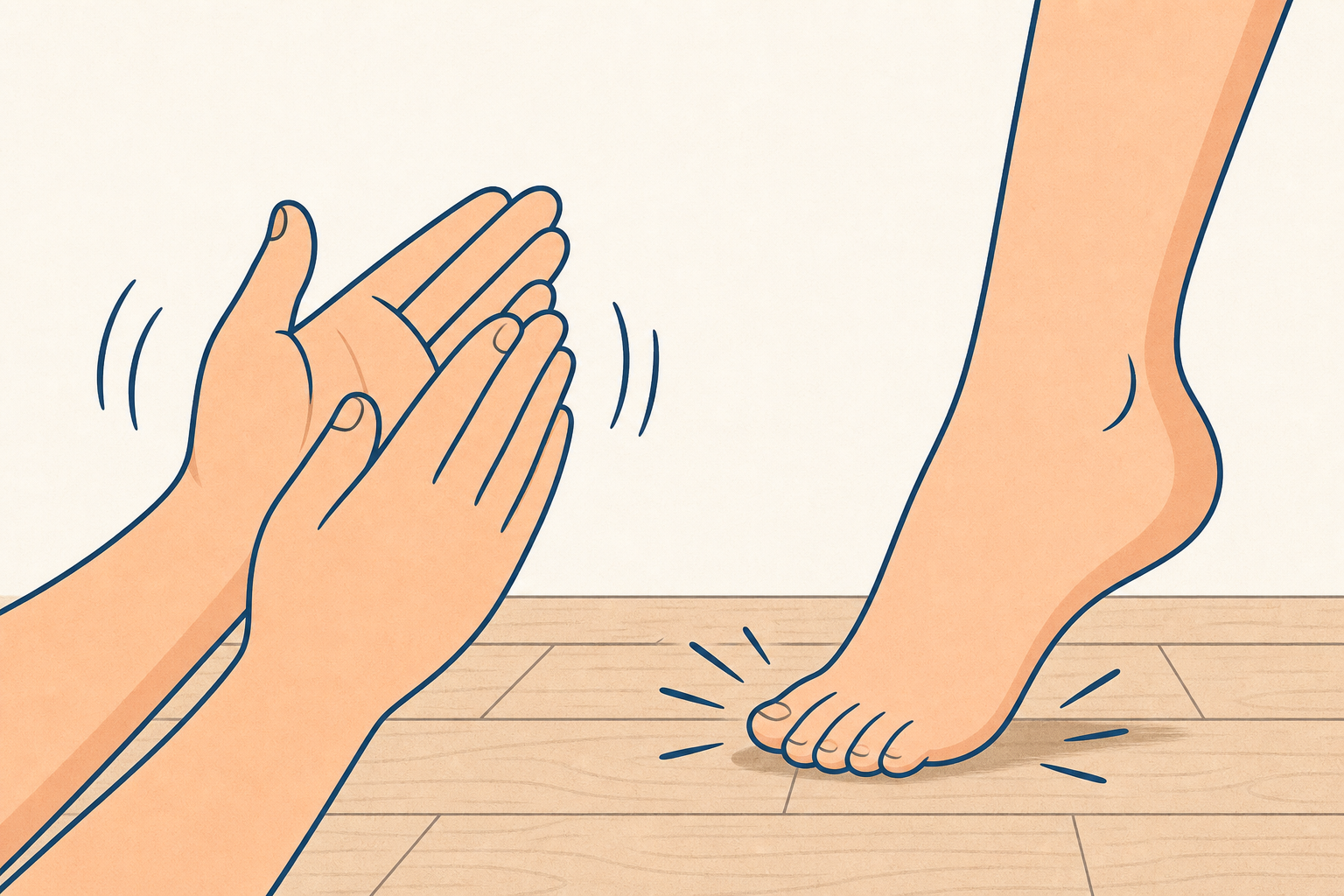
Watch this short class dance: clap, clap, stamp, clap, clap, stamp, clap, clap, stamp.
Hands up: which bit did we do more than once? It felt long when we said every clap. Maybe there is a clever shorter way to write it.
Do the dance yourself three times in a clear rhythm. Do not name the words decompose or loop yet. Let pupils notice the repeat first.
Key question: Which bit came back again and again?
If answers stay vague, perform it once more and freeze after each clap-clap-stamp block so the chunk is obvious.
Have floor space clear enough for a short standing dance later. No apparatus set-up in this beat.
That chunk that kept coming back (clap, clap, stamp) is a pattern.
A short way to say "do that chunk again" is a loop: repeat clap, clap, stamp three times.
Watch as we break the dance into small steps on paper strips. That breaking-down is what we will do next.
Project only the short board text above. Meet one idea at a time against the dance the class just did. Keep decompose as teacher talk with the live strip model rather than a third definition on the board.
| Concept | Why it matters | Example |
|---|---|---|
| Pattern — a chunk of steps that happens more than once in the same order | Spotting the chunk saves time and helps us notice when something goes wrong | In clap, clap, stamp, clap, clap, stamp, the pattern is clap, clap, stamp |
| Loop — a short instruction that means do this pattern again | Loops stop us writing the same steps over and over; computers and people both use them | Repeat clap, clap, stamp three times is shorter than writing nine separate actions |
| Decompose — break a bigger job into smaller steps in a clear order | Big jobs feel messy until we split them; smaller steps are easier to follow, teach or fix | The morning line-up becomes: stand up, push chair in, walk to the door, wait quietly |
Worked model (do this live before groups start):
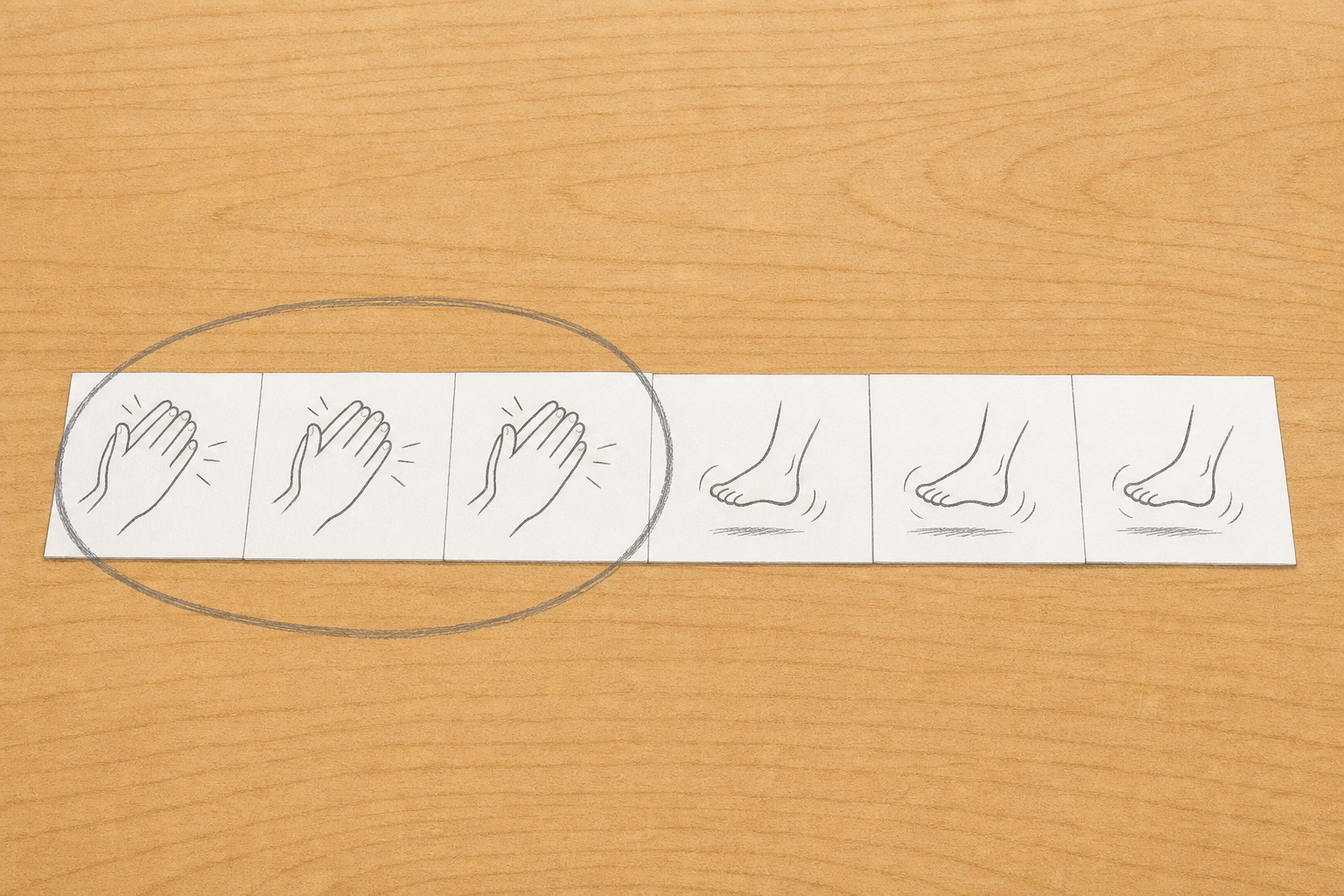
Lay blank paper strips on the desk as you talk. Say each action out loud and write one strip per action:
clap · clap · stamp · clap · clap · stamp · clap · clap · stamp
I wonder how to write our dance so someone else could do it without watching me.
I predict the repeating chunk is clap, clap, stamp.
I test by reading every strip in order.
I observed the same three steps came back three times. Circle that chunk on the strips so the class can see it.
I think we can write a loop: repeat clap, clap, stamp three times. As you say the word loop, point to the circled chunk and hold up three fingers for the count so the label sticks to something visible. (As you finish, use the word decompose once in speech: "We decomposed the long dance into small ordered steps.")
Misconception to head off: pupils may call any long list a loop. A loop needs a chunk that truly repeats.
Link gently to what they can already do: they already know instructions must be precise and in order. Today we make long instructions shorter by finding the repeat.
In your group, choose one task: a short class dance, a repeating border on squared paper, or a PE warm-up set.
Keep desk groups seated for strip writing and border colouring. Only movement groups (dance or PE warm-up) use the cleared front strip, and only when they are ready to practise or show. One group practises at a time; the others stay at desks until called. That way floor practice and desk work share the room without collisions.
Target pattern to circle: step side, clap, step side, clap, turn. Loop count: 2.
Keep the choice bounded: each group picks one of the three tasks only. Every option must end with ordered steps and a named loop (chunk + how many times). Stay guided: if a group writes giant vague steps such as do the dance, send them back to split it.
Task A — class dance: invent 6–10 body actions with one clear looped chunk. Strong example pattern: step side, clap, step side, clap, turn (repeat twice).
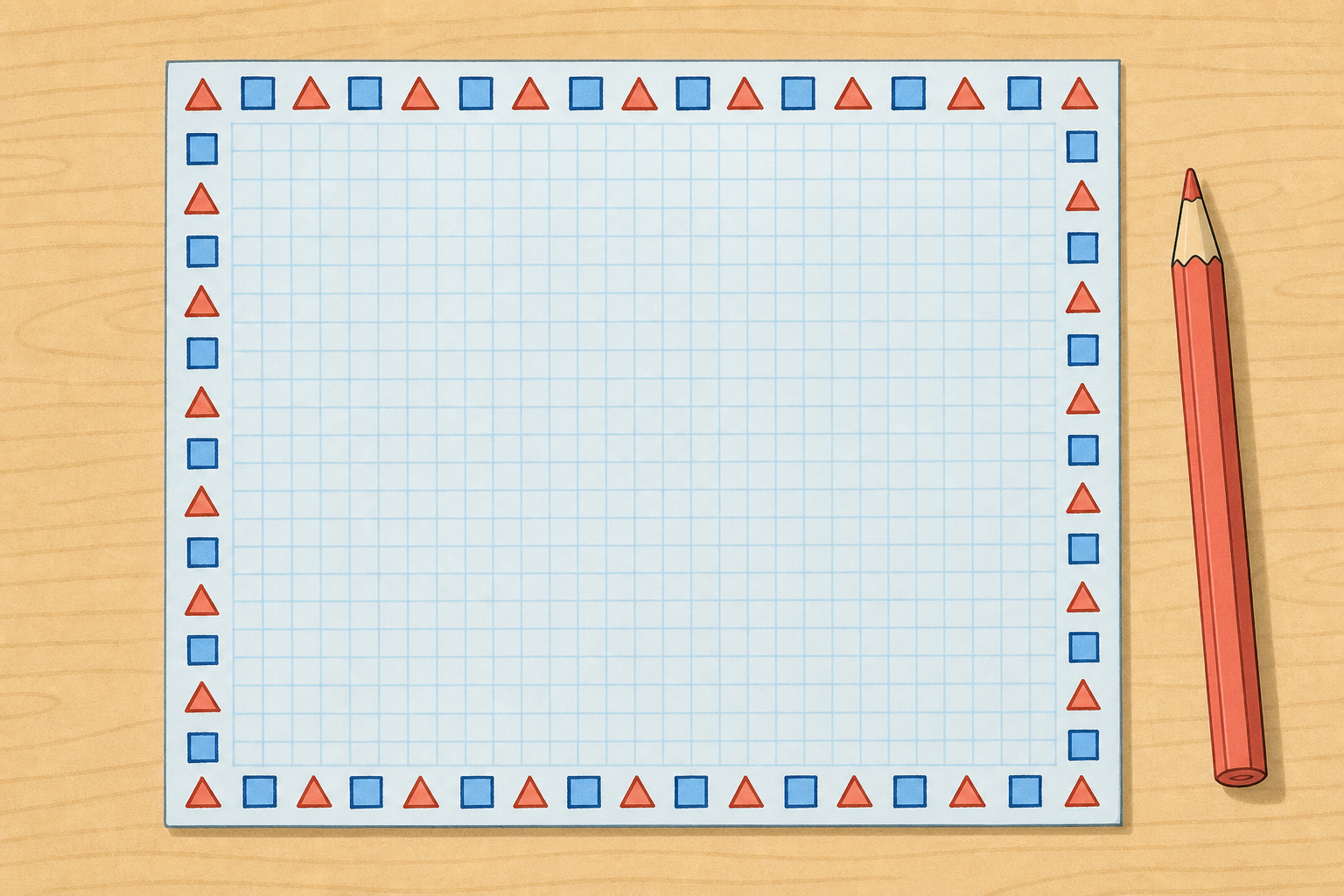
Task B — repeating border: on squared paper, colour a short unit (for example red, blue, green) and repeat it along a line. The coloured unit is the pattern; the number of repeats is the loop. Showing work means holding up the border and pointing to the unit.
Task C — PE warm-up set: build a short warm-up that uses a clear loop, for example star jump, touch toes, jog on the spot, repeated three times, or a lining-up chant the class already knows. Do not choose a long list with no repeat; the loop is required.
While groups work, ask: What is step one? What must come next? Which strip would you circle? How many times does that chunk happen?
Fold watchers in when one group shows early: Did their steps stay in order? Where is the loop? What would break if step two vanished?
What good looks like: steps are small enough to follow one at a time; order is fixed; the loop names the exact chunk and how many times.
Recording path: this step is strips (and border drawing) only. Journal write-up comes in the next step. Do not fill the Investigation Journal page here.
Quick capture so we keep the short version: on your Investigation Journal page, write the ordered steps, mark the repeating chunk, and note how many times it loops.
This is the single formal recording beat. Groups already built the sequence on strips; now transfer the essentials only. Keep it brisk (about 6 minutes). Do not invent extra columns or a special page layout. Ask only for: the steps in order, the repeating chunk, and how many times it loops.
Circulate and check that loops name a real repeated chunk, not the whole job.
If time is tight, one shared group record is enough, with each pupil still noting the loop sentence in their own journal.
Two or three groups show their sequence. The rest of us watch for the ordered steps and the loop.
Start with something we already know: our PE warm-up set, or a familiar assembly chorus. Where is the loop hiding?
Then we widen the talk: where else do people use repeating patterns to make work shorter or machines run smoothly?
Invite two or three contrasting groups if you can: one dance, one border, one warm-up. Keep each share under a minute. Showing work fits every task: act the dance, hold up the border and point to the unit, or lead the warm-up loop.
After each share ask the watchers: What was step one? Where did the loop start? What would go wrong if the order changed?
Draw out the Nature of STEM idea without a lecture: spotting patterns helped people invent shortcuts and machines. Lead with a concrete school example on the board first (PE warm-up or assembly chorus), then widen:
Misconception: pattern does not mean decoration only. Here pattern means a repeated chunk of actions or instructions.
Keep the discussion display-only. No typed answers.
You're previewing this lesson. Get full access to this lesson and hundreds more — each one ready to teach, with interactive activities, printable resources and pupil progress tracking built in.