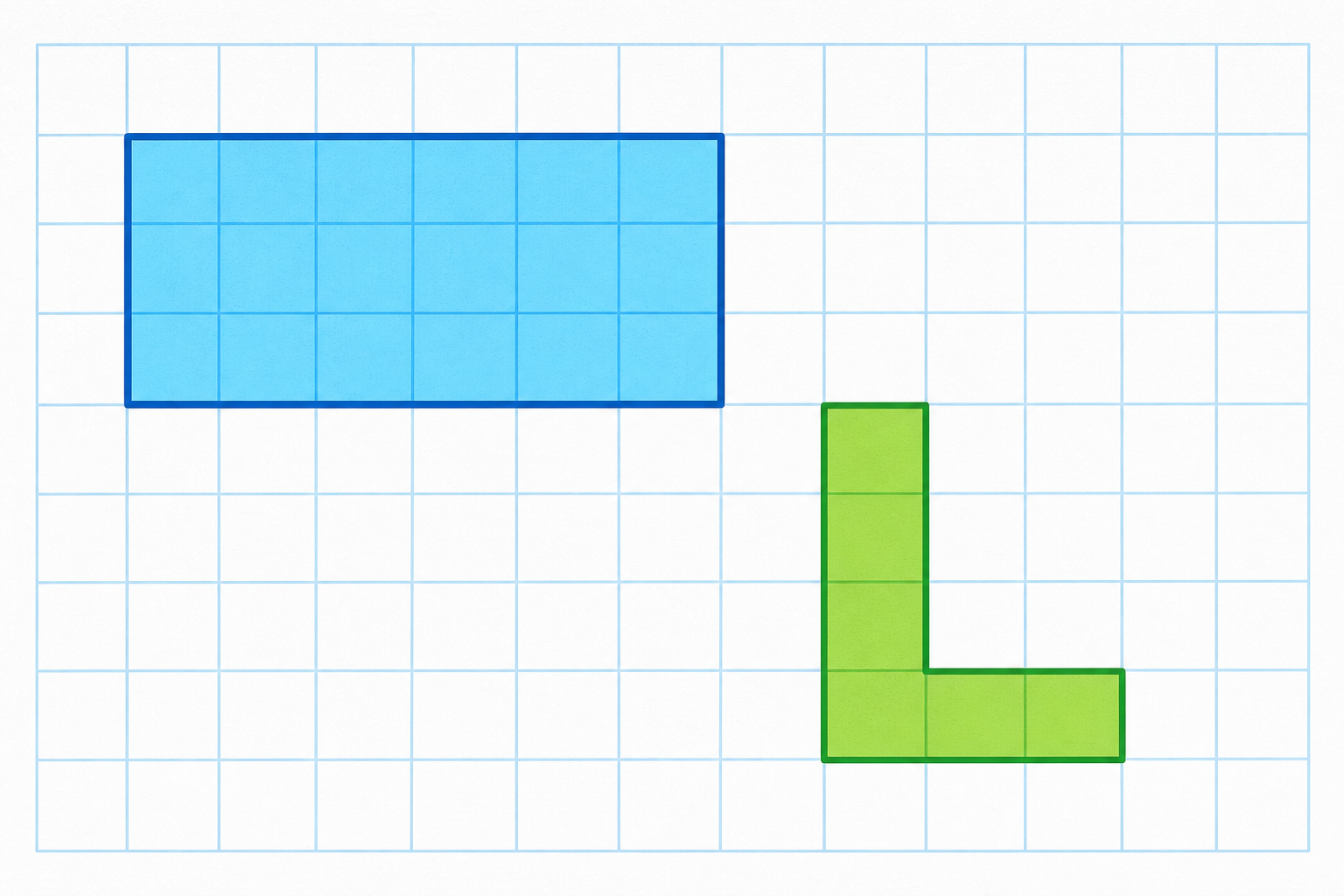
Here are two shapes on the yard drawn on the same square grid. One clearly covers more of the grid than the other. Which shape do you think covers more space on the page? How could we be really sure, without just guessing?
Take three hands-up answers, not open call-outs. Hold out for a pupil who says count the squares rather than it just looks bigger — that is the idea the lesson builds on.
Watch two shapes get covered with square tiles on the grid, one tile in every cell (each little square of the grid). As each shape fills, count the tiles with me. One square tile is one square unit, and the number of tiles is the area, in square units. The one rule that matters: every tile is the same size, and we count each whole tile once.
Now a trickier one. This shape bends, so it is easy to skip a cell or count a corner twice. Watch how we work along it row by row so none is missed.
Point at each tile in the rectangle and count aloud with the class: one, two, three… six square units. On the L-shape, run your finger along one row at a time — this is where pupils double-count the bend, so slow down there.
Hold the class on the same-size rule: ask what would go wrong if two of the tiles were bigger than the rest.
Now we cover shapes together on the grid and count the tiles to find the area. Tap a square tile into every cell inside the shape. Keep a running count as the tiles go in. When every cell is covered, say the area out loud in square units.
Talk this one through together — pupils take turns at the board and the class agrees or corrects out loud.
Run three shapes in order, one at a time on the grid: first a shape that takes 4 tiles, then one that takes 8, then an L-shape where you count carefully. Reset between each so pupils only hold one shape in mind. Outline a region, then a pupil taps a square tile into each cell inside the outline while the class keeps a running count.
Pacing lever for the rows not at the board: revoice the running count aloud, and turn-and-name a pupil to say the next number as each tile lands. On the L-shape, ask the class to predict the area before the last tile lands. Watch for the double-count on the bend — that is the one to catch on the spot.
In your squared copy, draw any shape at all that covers exactly 7 squares. Then shade each square and count them to prove your shape covers 7 — no more, no less.
Walk the room glancing for shapes that follow the grid lines and squares shaded whole, not part-shaded — this is whole-class copybook practice, not marking. If a pupil's shape does not land on 7, ask them to recount rather than telling them the number.
Now you try it at your desks with real tiles on printed outlines. Cover the 4-tile shape first. Then cover the 8-tile shape. Then cover the L-shape, counting along one row at a time. If you finish those, hunt for two differently-shaped outlines that take the very same number of tiles. Say each area aloud when the outline is full.
This is the practice round — real square tiles cover printed outlines at pupils' desks, and the class confirms each area aloud at the end. Keep the pass-on rhythm brisk rather than over-explaining.
Circulate as pupils tile: catch any gaps left inside the outline and any tiles overhanging the edge. The same-count hunt (two different shapes, same tile count) is the extension for finishers — it is genuinely the hard part, so slower tilers should bank the three core shapes first. Strong finishers can find a third matching outline.
Why must all the squares we count be exactly the same size? What would go wrong if we counted a few big tiles in with the small ones?
Listen for a pupil naming that bigger tiles cover more space, so the count would no longer be a fair measure. Revoice a strong answer: so a square unit has to be one fixed size, or the number stops meaning anything. Head off the idea that area is about how long the shape is — steer back to space covered.
Next we find the area of rectangles a faster way — by counting the squares in one row and then the number of rows. That is our first link from area to multiplication.
Keep this brisk. The rows-and-columns idea in the next lesson grows straight out of today's careful counting, so leave the class confident that counting works before shortcuts arrive.
You're previewing this lesson. Get full access to this lesson and hundreds more — each one ready to teach, with interactive activities, printable resources and pupil progress tracking built in.