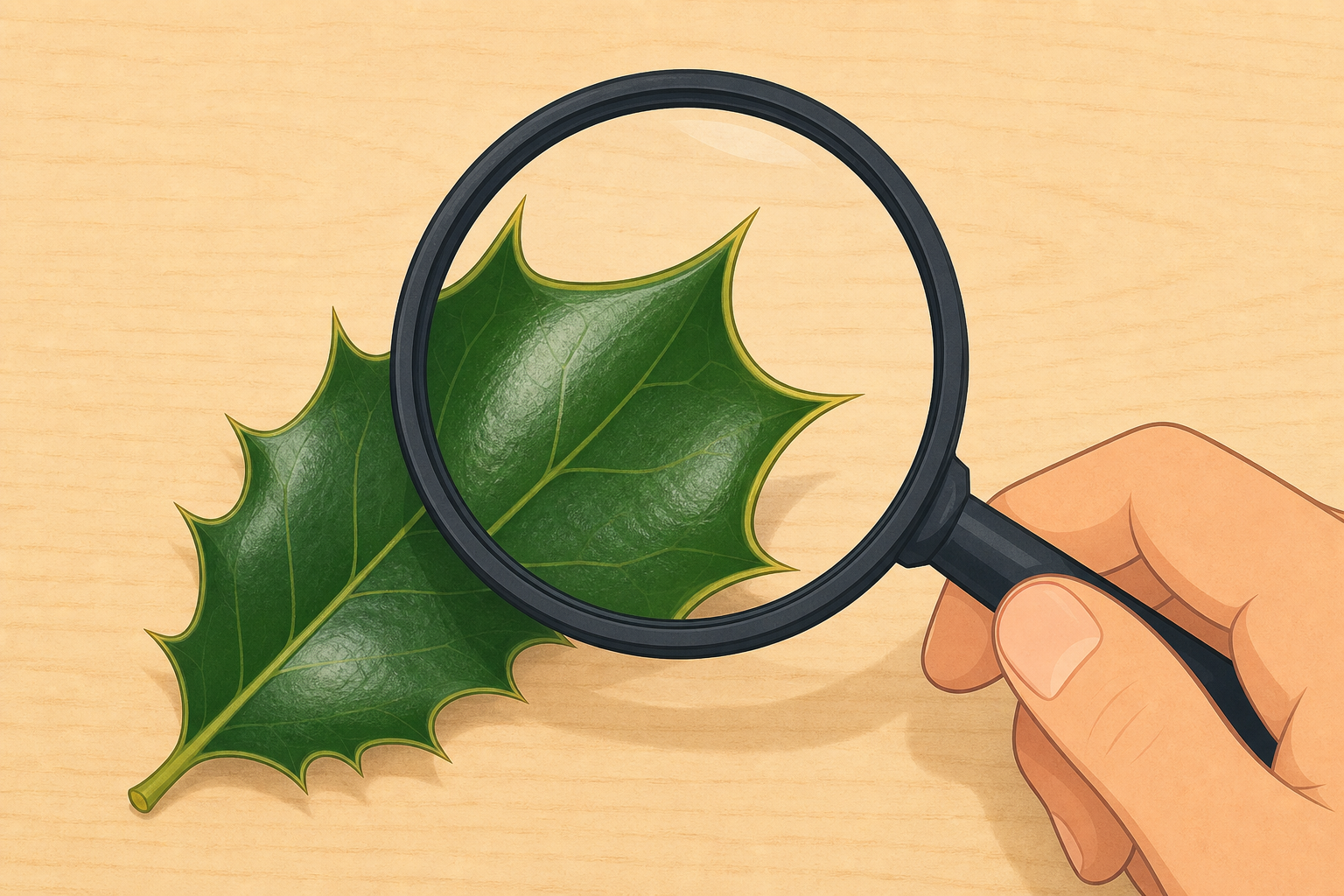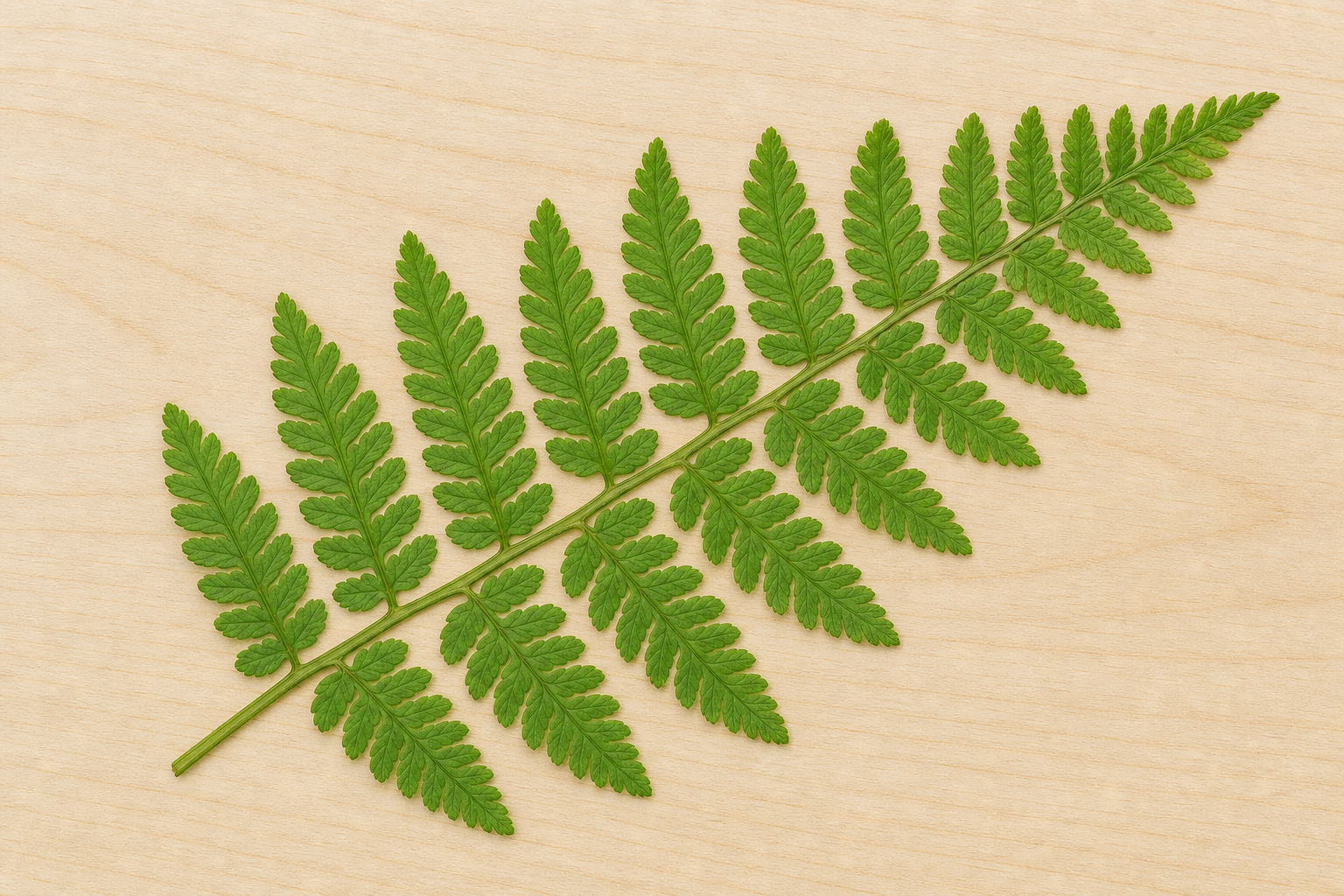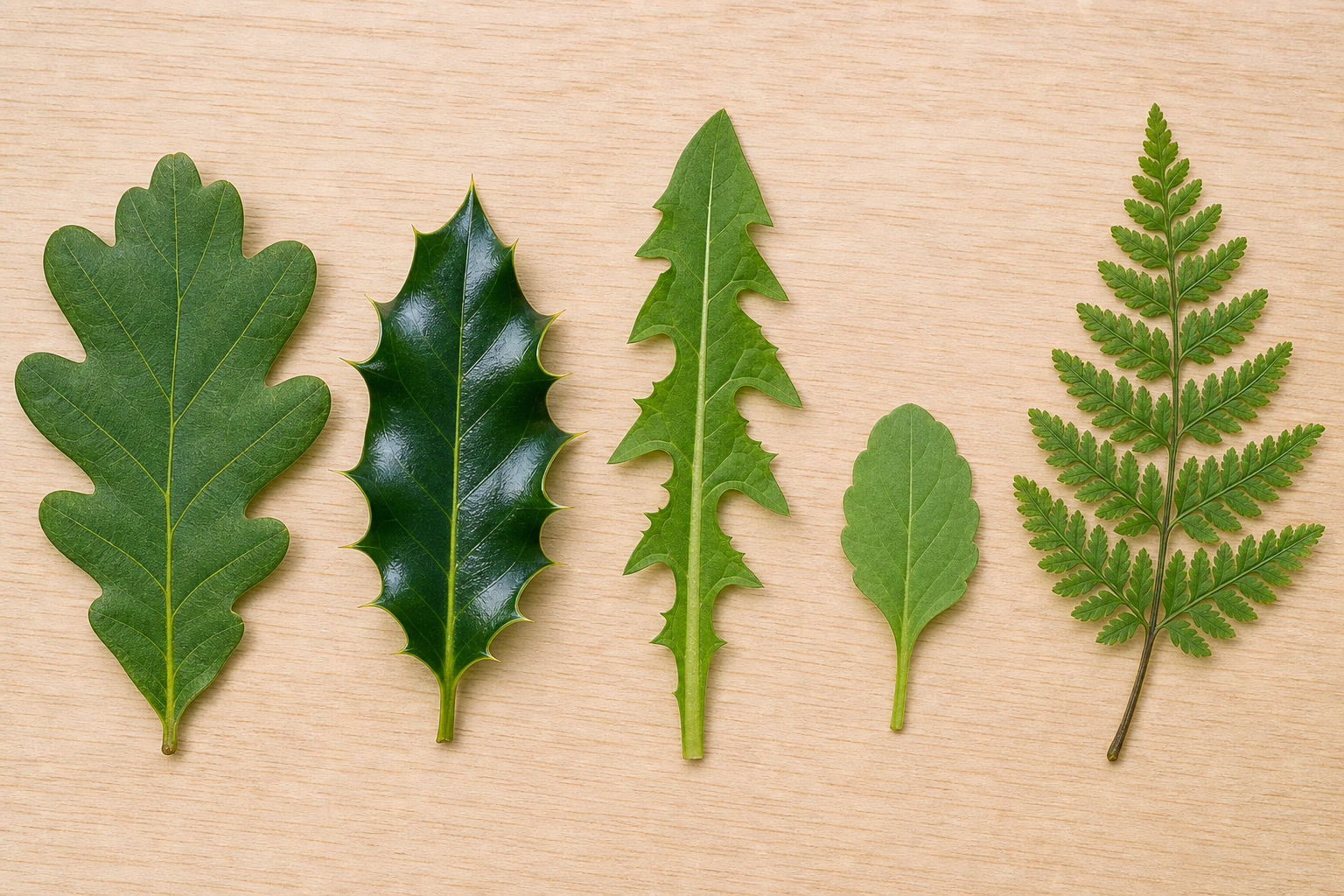
Look at these five leaves from Irish hedges, lawns and school gardens. How would you tell a friend which one is which — without pointing?
Scientists use a special tool called a branching key. Today we will complete one as a class and use it to name a mystery leaf.
Hold up five real leaves or laminated leaf cards (oak, holly, dandelion, daisy, fern) so the class can see them. Do not name them yet. Ask: What is different about these leaves? Accept quick observations — shape, edges, size — then move on. Keep the hook light: no key structure yet. One line of Irish context is enough: these are plants children may pass at break or see in hedges and lawns.
Before the lesson: print the provided leaf cards if you cannot collect real leaves; check the school garden for safe collecting spots; have hand magnifiers ready.
A branching key is a path of yes-or-no questions that leads to a name.
A feature is something you can see on a leaf that helps tell it apart, like a prickly edge or a wavy shape.
Identify means work out the name by following the clues carefully.
We will look closely at real leaves next, then use clear features to finish our class key.
Teach the three words briefly before sorting. Project only the short board text; keep the full table for yourself. Do not run a long colour-versus-edge debate yet — children have not observed the leaves together. After Step 3, when edges and shapes are fresh, you can say: colour can change in autumn or after a dry week, but shape and edge stay steadier, so they make fairer yes/no questions.
| Concept | Why it matters | Example |
|---|---|---|
| Branching key — a step-by-step set of yes-or-no questions that sorts living things until each one is named | It lets anyone identify a plant without already knowing its name — walkers, gardeners and scientists all use keys | Does the leaf have prickles? Yes → holly. No → ask the next question |
| Feature — something you can see or feel on a leaf that helps tell it apart from others | Good features split the pile cleanly; weak ones (like colour in autumn) leave you stuck | Oak has deep wavy lobes; fern is divided into many small leaflets |
| Identify — work out the name of something by following the clues carefully | Identification is how we keep records of Irish wildlife and protect habitats | Using our finished key to name a mystery leaf from the yard |
Nature of STEM: A branching key (sometimes called a dichotomous key) was invented so people could name living things the same way every time. Naturalists in Ireland, including Robert Lloyd Praeger, used careful grouping and keys when they recorded Irish plants and animals. The idea is still used today in field guides and apps.
Misconception to head off: children may think any difference will do. Steer them toward features that are clear and stable — shape and edge, not colour or size alone. Hold that point until after the leaf look in Step 3 so they can point at real edges.
In groups, look closely at five leaves: oak, holly, dandelion, daisy and fern. Use a hand magnifier. What features can you see?
On your Investigation Journal page, note one clear feature for each leaf — edge, shape, or how it is divided.
Gather real leaves from the school grounds if you can, or print the provided laminated leaf cards (oak, holly, dandelion, daisy, fern) — one set per group. Check for allergies and do not pick anything spiky or unknown beyond the known holly sample already provided.
Take the class outdoors briefly if weather allows, or work at tables with collected or laminated leaves. Each group handles the five leaves and talks about features. Circulate and prompt: Is the edge smooth or jagged? Is the leaf one piece or many small parts? Does it feel prickly?
Expected features to draw out:
Strong vs weak features (after they have looked): colour can change in autumn or after a dry week. Shape and edge stay clearer, so they make fairer questions for a key. We will use those kinds of features on the board next.
Safety: do not pick unknown plants; wash hands after handling; mind holly prickles.
Differentiation: less confident groups get sentence starters on the board (The edge is… The shape is…). Confident groups can suggest a second feature for each leaf.
We will complete a yes-or-no branching key for our five leaves. Look at the interactive activity on the board.
The questions are:
Help decide where each leaf goes until every leaf has its own name: holly, fern, oak, dandelion or daisy.
Drive the sorting-tree interactive on the IWB in explore mode. Five item cards appear: oak, holly, dandelion, daisy, fern. Four yes/no questions guide the sort so each leaf reaches its own end point. Terminal groups on screen are the five leaf names: holly, fern, oak, dandelion, daisy.
Full path (model this aloud):
Worked model (say this aloud before pupils copy the idea into their journal):
Invite pupils to call out yes or no for each leaf. Fold the watching class in: Do you agree? Which question would you ask next? Briefly revoice why we used edge and shape, not colour alone.
After the class tree is built, pupils record the same key on their Investigation Journal page: the four questions in order and which leaf sits at each end point. Say only what to record (questions and final leaf names), not box titles on the page.
Then do two or three quick oral checks on the finished tree (e.g. Where does holly go? Where does fern go? Where does daisy go?) so the class checks every leaf has one clear end. Stay in explore mode; do not rely on an on-screen challenge bank for this step.
Your group gets a mystery leaf. Do not look at the name. Follow your branching key step by step — yes or no at each question — and decide which leaf it is.
Write your answer and one reason on your Investigation Journal page. Be ready to explain your path to the class.
Give each group one mystery leaf (real or a card) from the same set of five, face-down or in an envelope so the name is hidden. Use a different leaf for different groups if you can so answers vary. The class key from Step 4 now ends on a single name for every leaf, so any of the five is a fair mystery.
Prompt groups to:
What to expect: most groups will identify correctly if they stick to the key. If two groups disagree, walk both paths on the board and find where a feature was misread (common slip: calling dandelion's jagged edge prickly, or missing oak's deep wavy lobes).
Key questions: Which question did you answer first? What would happen if we started with a weak question like colour?
Differentiation: support groups by sitting with them for the first yes/no. Stretch: ask a group to invent one extra yes/no question that would still separate oak from dandelion.
You're previewing this lesson. Get full access to this lesson and hundreds more — each one ready to teach, with interactive activities, printable resources and pupil progress tracking built in.