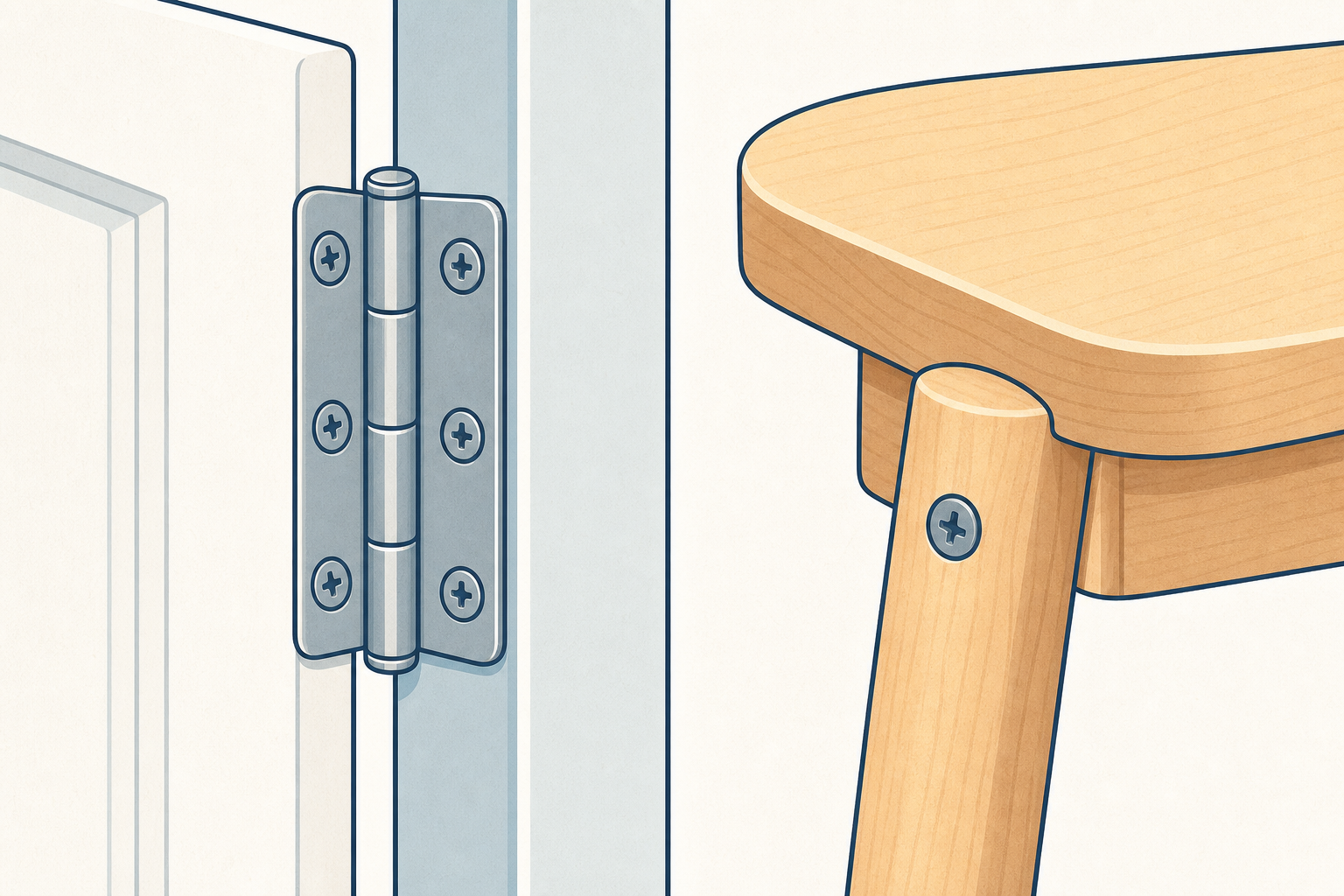
Look at our classroom door and at a chair leg. One needs to swing open. One must never move. How do the joins do such different jobs?
Point to the real classroom door (or its hinge) and to a fixed chair leg or a taped poster edge. Keep the hook light: one question only. Do not hand out materials yet.
Key question: What job does each join need to do?
Have the join materials ready out of sight for the next step. Hold up a split pin briefly when you name the materials later so children recognise it. Have the pre-set glue joins ready on the group trays (made earlier so they are already firm).
A join is where two pieces meet. A firm join locks still, like a chair leg. A swinging join holds on but can move, like a door.
Some joins hold only loosely and may slide or come apart. That is different from a swinging join like a door.
Which kind of join would you want on a classroom door? Which on a chair leg?
Project only the short board text. Keep the full table for yourself. Do not run the full join worked example here; model one firm and one swinging join at the start of the make step.
| Concept | Why it matters | Example |
|---|---|---|
| Join — the place where two pieces are stuck or fixed together | Every build needs a join; the join decides whether the build stays still or can move | Two card strips held end to end with sticky tape |
| Firm join — a join that locks the pieces so they do not swing or pull apart easily | Chairs, shelves and book stands need firm joins so they stay safe and still | Glue holding two card strips stiff when you pull gently (once it has had time to set) |
| Swinging join — a join that holds the pieces together but still lets them turn or move | Doors, lids and ring-binders need joins that move on purpose | A split pin linking two strips so they swing like a little gate |
Misconception to head off: children may say a swinging join is "broken". Name it as useful: a door needs to swing. Keep "swinging join" talk for joins that stay linked and move (the split pin). A paperclip that slides or comes apart is a loose join that holds loosely / slides, not the door-hinge kind of swinging join. Say the plain phrase once: holds loosely / slides.
In your group of three or four, make three joins. Use the same size card strips each time.
Your tray also has a ready glue join the teacher made earlier. That one is already firm. Make each join carefully so you can test it next.
Before you pull, whisper your guess: which join will stay firm?
Hold up a little metal fastener (split pin) beside a paperclip so everyone sees they are different. Then model aloud with two pairs only: I wonder which join will hold firm. Show the ready glue join and pull gently: it stays stiff. Split-pin two strips: I predict these will stay linked but swing. They swing but stay linked. I think the ready glue is firm, and the split pin is a swinging join. Do not demo all joins here; groups will make the rest.
Groups of 3–4. Simple share-out so each pupil join is made once: Child A does tape; Child B does the paperclip; Child C (or A with help) does the split pin. Child D minds the ready glue join on the tray. Teacher helps only if a pin still needs opening. Three pupil-made joins plus the ready glue join keeps the step inside 10 minutes.
Look-fors: every group has four joins ready to test (three they made, one ready glue); strips are the same size so the later pull is a fair comparison of the join, not the card.
Safety: split pins can be fiddly even when pre-opened; help younger fingers. No running with pins.
Optional slow-set noticing: if you want children to see wet glue, dab a spare pair and set it aside. Do not use it as the firm result in this lesson; point back to the ready glue join for the firm contrast.
Hold each join and pull gently. Does it stay stiff and locked, slide or come apart, or swing while still linked? Talk about what you notice.
Demonstrate a gentle pull so strips do not fly. Same pull each time. Ask aloud: Does it stay stiff, slide, or swing?
What to expect: the ready glue join should hold firm; tape may hold then peel; paperclip often slides or comes apart; split pin usually swings but stays linked.
If anyone tests a still-wet spare glue pair: say, It needs more drying time — firm joins often need time to set. Point them back to the ready glue join as the firm example. Do not let the class conclude that "glue is not firm".
Treating joins that come apart: if a join peels or slides fully apart (often the paperclip, sometimes tape), name it as holds loosely / slides, not as a true swinging join. Reserve "swinging join" language for the split pin, which stays linked and turns like a little hinge. That keeps the door-hinge idea clear and stops the misconception that a moving join is simply broken.
STEM eyes: Where in our classroom do we already see firm joins and swinging joins? Point at your own hall door or a lunchbox lid if one is nearby.
Sort your four joins into three groups:
Then name one classroom job for a firm join and one for a swinging join. Start with the ones we know: firm like a chair leg; swinging like a door.
Use three hoop labels or three table zones: holds firm, swings (stays linked), and holds loosely / slides. Groups place each join in a zone. Expect ready glue under firm; split pin under swings; paperclip (and sometimes tape) under holds loosely / slides.
Only match jobs to the two target kinds: firm and swinging. Do not invent a classroom job that needs a loose slide. Firm jobs: chair leg, shelf, book stand, coat-hook rail. Swinging jobs: door, lid, ring-binder, lunchbox lid. Point at your own hall door or a lunchbox lid if you have one so the match feels local.
Reserve swinging-join talk for the split pin when matching to doors or lids, so children do not match a sliding paperclip to a door hinge.
Differentiation: less confident groups match jobs from the named examples you say aloud (door, chair, shelf, lid, book stand, hall door, lunchbox lid) — no extra picture cards needed. Confident groups invent a third classroom job for one join type.
You're previewing this lesson. Get full access to this lesson and hundreds more — each one ready to teach, with interactive activities, printable resources and pupil progress tracking built in.