
Look at this spoon. People made it. What helpful thing does it do for us — eating, scooping or stirring?
Today we will find out that lots of everyday things are technology, because people made them to help with a job.
Hold up one ordinary spoon. Keep the hook light: one object and one question. Do not name the full tray yet.
Accept any sensible answers such as eating, stirring or scooping. Then say: People made this spoon to help with a job. That is what technology means. Here, job means the helpful thing it does — not a grown-up's work.
Before the lesson: gather the tray of safe everyday technologies and print the Investigation Journal page (one per pupil).
Today's words: technology means anything people make to help do a job. Job means the helpful thing it does for people.
Is a spoon technology? What job does it help with?
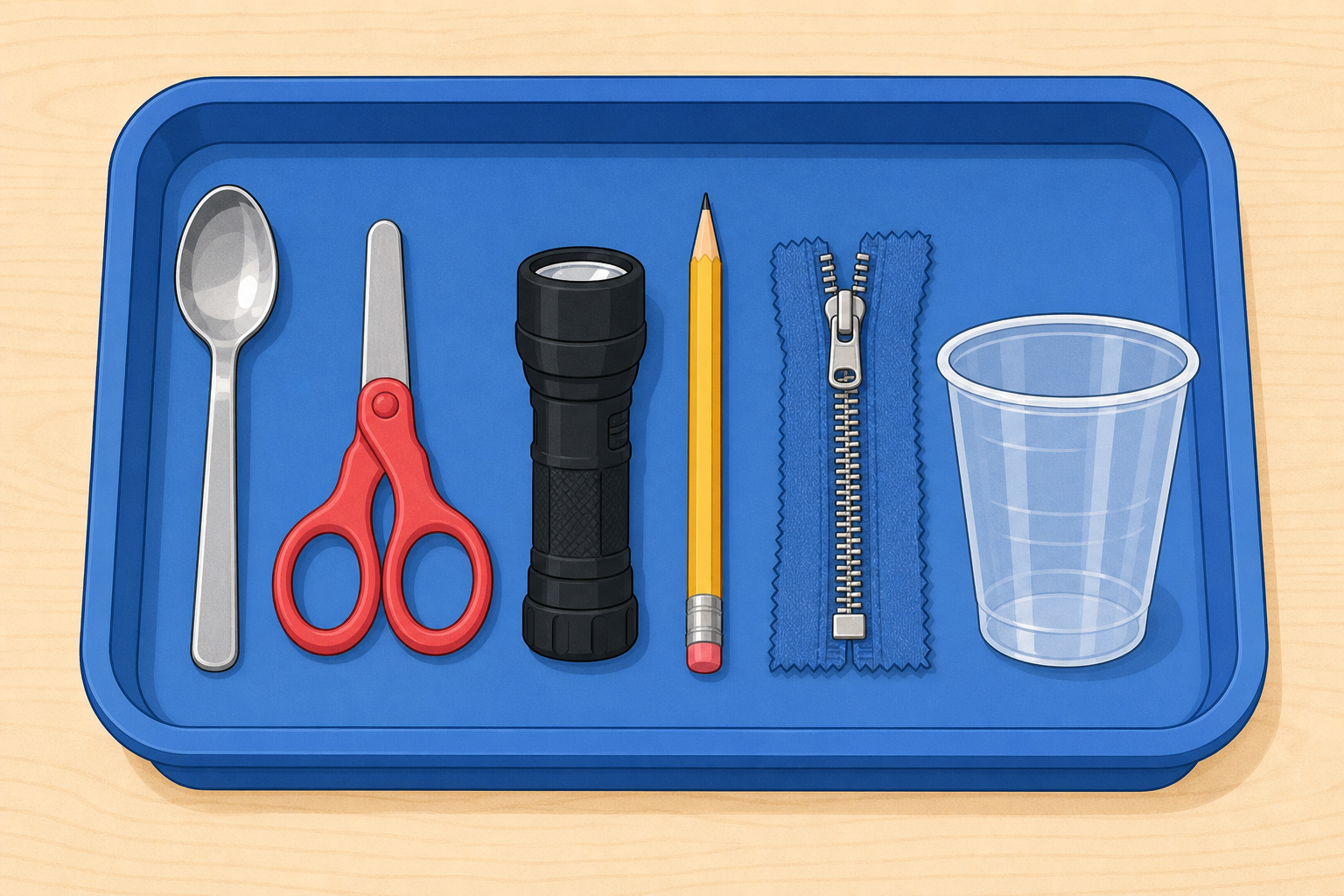
Project only the short board version above. Use the table below yourself while you teach.
| Concept | Why it matters | Example |
|---|---|---|
| Technology — anything people make to help do a job | When we notice the job something does, we start to see technology all around school and home, not only on screens | A zip helps close a coat; a torch helps us see in the dark; a tablet helps us look things up or play a learning game |
| Job — the helpful thing a piece of technology does for people | Naming the job helps us sort and talk about tools clearly | The job of scissors is to cut; the job of a clock is to tell the time |
Say aloud: Here job does not mean a grown-up's work. It means the helpful thing this tool does for us.
Misconception to head off: many children think technology only means tablets, phones or computers. Use the spoon again and say clearly that technology can be simple and have no screen.
Short live model (keep this tight): Hold the spoon: People made this to help us eat. That helpful job is why the spoon is technology. Then hold one natural object (stone or leaf): Did people make this to help with a job? Guide the class to see that not everything is technology.
Save extra examples (torch, zip, clock) for questioning while groups explore the tray. Do not run a full second worked model in this board beat.
Your group has a tray of safe everyday things. Take turns to hold one thing carefully.
For each one, ask: What is it? What job does it help people do? Did people make it?
Set out one tray per group with a mix of safe everyday technologies. A good set is: spoon, zip on a fabric scrap or old coat piece, small torch, child scissors (blunt tip), simple clock or kitchen timer, and a tablet or phone that is switched off (or a picture card of a tablet if devices are not available). Add one or two extras if you have them, such as a pencil sharpener or a stapler with the teacher holding it.
Circulate and prompt: What job does that help with? Keep language concrete. If a group only says "it's a tablet", push for the job: learning, looking things up, talking to family.
If useful, model one quick torch think-aloud at a table: I think this helps people see when it is dark, show the switch or beam briefly, then: So the torch is technology because people made it to help with seeing in the dark.
Differentiation: less confident pupils can point and say one word for the job (cut, light, eat). Confident groups can find two jobs for one object.
Safety: blunt-tip scissors only; torch beams away from eyes; no climbing on chairs to reach wall clocks — use a table clock or picture instead.
Now sort the things on your tray by the job they help with.
Watch the board. Your teacher will show one pile name at a time. Put each thing with its job. If the job is different, put it in other job and be ready to say what that job is.
Keep the tray sort brisk. Write one pile name at a time on the board so the brief stays short. Use these single-job piles:
Celebrate the other-job pile: it is good thinking, not a wrong answer. After a quick sort, take a short whole-class talk on one or two other-job items: What job does it really help with? Accept answers such as tell the time or look things up.
Groups may still disagree (a zip might be called clothes rather than close). Ask: What job is it really helping with? and revoice into one clear job.
If a group finishes early while others sort, challenge them to name one more classroom object for a pile without leaving their table (pencil, glue stick, ruler).
Do not use the words fair test. This is a simple sort and talk about jobs.
On your Investigation Journal page, choose technologies from the tray.
Start with two. For each one, write or draw what it is and the job it helps with. If you have time, add a third.
This is the paper recording beat. Aim for every pupil to finish at least two entries securely with the stem and board names; use any spare minutes for a third or a classroom example. The lesson goal is still three named jobs, but do not treat three unaided written entries as the only success in this slot.
Sentence stems to say aloud: This is a ___. It helps people ___.
Check that each pupil names a real job, not only the object's name. A strong response might be: spoon — helps us eat; torch — helps us see in the dark; scissors — helps us cut paper.
Support writers with the object names on the board. Fast finishers who already have three add a fourth technology they can see in the classroom.
You're previewing this lesson. Get full access to this lesson and hundreds more — each one ready to teach, with interactive activities, printable resources and pupil progress tracking built in.